
For most wounds, start with the clinician already treating you, usually primary care, and for a foot wound in someone with diabetes a podiatrist is often the right first specialist. Nearly 15% of Medicare beneficiaries, about 8.2 million people, had at least one wound or wound-related infection in 2014, and spreading redness, fever, black tissue, or exposed bone means urgent care the same day.
You're looking at a bandage that hasn't changed the picture. The sore on a heel, shin, or surgical line looked small last week. It isn't smaller now, and you don't know whether the next call is your regular doctor, a foot specialist, or the emergency department.
A later five-year analysis found the number of Medicare beneficiaries with wounds rose to 10.5 million, with recorded prevalence moving from 14.5% to 16.4%. The same work estimated wound-related Medicare spending from $29.7 billion to $102.6 billion in 2014 and from $22.5 billion to $67.1 billion in 2019, depending on how costs were attributed, as reported in published Medicare wound analyses. That scale is why a single dressing change is often not the whole plan.
What doctor to see for wound care is a routing decision. Match the wound to a first clinician, use a time checkpoint, and add a specialist without dropping the doctors who already know your health.
## Table of Contents - Which Clinician Starts Wound Care for Your Situation - What Each Specialist Adds to a Wound Workup - One problem leads, the others follow - Red Flags That Call for Same-Day Care - When surgery can't wait for a clinic slot - How Long a Wound Can Wait Before Referral - How to read the checkpoints - Signs a Wound Needs a Surgeon - What happens after the decision - Referral Steps and Preparation Checklist - Before you call - What to ask your current doctor to write - Request speed when the checkpoint has passed - How we handle the handoff - Check the destination before you book
Which Clinician Starts Wound Care for Your Situation
The first call is the clinician already treating you, usually primary care. If the wound is on the foot of someone with diabetes, a podiatrist is often the right first specialist. The match depends on cause, location, severity, and whether the wound is responding, not on how alarming it looks in a photo.
Primary-care clinicians commonly identify a wound and start treatment. Podiatrists carry diabetic foot wounds. Vascular specialists take circulation-related ulcers. Infectious-disease clinicians step in for complicated infection. Plastic or general surgeons judge tissue coverage and operative problems. A wound-care team then coordinates debridement, dressings, pressure relief, and follow-up, as outlined in CDC guidance on diabetes and podiatry.
| Wound situation | First clinician to see | Escalate to if it stalls |
|---|---|---|
| Diabetic foot ulcer, no infection | Podiatrist or primary care | Wound-care specialist if not improving within 4 weeks |
| Pressure injury on heel or sacrum | Primary care or wound-care nurse | Wound-care specialist if it stalls or deepens |
| Cold, pale, or painful leg or foot ulcer with weak pulses | Vascular surgeon, urgent | Wound team once blood flow is assessed |
| Wound with spreading infection, pus, or fever | Emergency or urgent care now | Infectious-disease clinician and surgeon as needed |
| Leg ulcer with swelling or varicose veins | Primary care, then vascular specialist | Wound-care specialist if it does not heal |
| Wound exposing bone, tendon, or dead tissue | Wound-care surgeon or surgical specialist | Surgical debridement or tissue coverage |
| Unusual, painful, or non-healing skin lesion | Dermatologist | Biopsy-based evaluation, then wound team |
| Surgical or traumatic wound on face or hand | Plastic or reconstructive surgeon | Wound team for complex healing |
The first column is where care starts. The last column is where it goes if the wound stops shrinking. Don't shop the whole list. Pick the row that matches what you can see and feel.
Approximately 12% of people with diabetes develop a foot ulcer during their lifetime. In 2016 the United States recorded 4.9 lower-extremity amputations per 1,000 adults diagnosed with diabetes, about 130,000 hospital discharges. The CDC also reports that 19% to 53% of patients with diabetes who have a lower-extremity amputation have the opposite limb amputated within 5 years. A diabetic foot wound that is deep, infected, recurrent, or not improving should not wait for the next routine visit.
Note the location, and note whether the wound is smaller than last week. Then use the matching row.
What Each Specialist Adds to a Wound Workup
A wound team works like a repair shop. The mechanic who hears the knock isn't always the one who rebuilds the transmission. Each clinician owns one part of why the wound is open.

Primary care triages, orders labs, adjusts medicines, and keeps blood sugar and blood pressure in range. Healing fails when those basics drift, even if the dressing is correct.
Podiatry takes pressure off a diabetic foot ulcer, removes unhealthy tissue from the foot, and fits shoes or off-loading devices so the same spot isn't struck with every step.
Vascular medicine or vascular surgery measures blood flow and reopens arteries when poor circulation is the block. A cold, pale, painful foot or a nonhealing ulcer with weak pulses needs that assessment urgently, not after another month of dressings.
Infectious-disease clinicians manage infection that has spread or keeps returning. Dermatology evaluates unusual skin that may need a biopsy before anyone treats it as an ordinary ulcer. Plastic, general, or orthopedic surgeons judge coverage when bone, tendon, joint, or a large tissue defect is involved.
Wound-care nurses measure, dress, and track the wound between physician visits. That record is what later clinicians use to decide whether care is working.
One problem leads, the others follow
Complex wounds rarely belong to one specialty. The 2024 AHA/ACC peripheral artery disease guidance calls for primary care, podiatry, wound care, rehabilitation, and vascular specialists together, with prompt referral for ulcers, infection, deformity, neuropathy, or suspected limb-threatening ischemia. A wound-care specialist adds that targeted input. The specialist doesn't replace the doctors who manage your diabetes, heart disease, or daily medicines.
Access is uneven. A 2025 survey of 56 specialist centers in 20 countries, presented through the European Scleroderma Trials and Research Group, found that 91.1% had wound-care services but only 9.8% had specialist wound-care services, according to the international digital-ulcer survey. You may need to ask for the referral rather than wait for it to appear.
Ask this before you book: Which problem is dominant for this wound, pressure, blood flow, infection, unusual skin, or tissue that needs surgery?
Red Flags That Call for Same-Day Care
Some signs mean the emergency department or urgent care today. A routine appointment is the wrong next step.
Go the same day for any of these:
- Spreading redness: Color moves past the wound edge or up the limb.
- Fever or feeling very unwell: Chills, confusion, or a sudden drop in how you feel.
- Severe pain: Pain that is new, sharp, or much worse than yesterday.
- Black or dark tissue: Dead skin or a patch that has turned hard and dark.
- Exposed tendon or bone: You can see structures that should stay covered.
- Rapidly worsening drainage or pus: Fluid increases, smells stronger, or turns thick.
Add circulation warning signs. A foot that is cold, pale, or painful at rest, with weak or absent pulses, needs urgent vascular assessment. Infection or poor blood flow can threaten a limb within days. In diabetes, nerve damage can hide pain, so a quiet wound can still be dangerous.
When surgery can't wait for a clinic slot
International diabetic foot guidance is direct. Arterial ulcers need prompt vascular-surgery evaluation because inadequate perfusion blocks healing and may require revascularization. In diabetic patients with peripheral artery disease plus ulceration or gangrene, the recommended team includes a surgeon, a vascular specialist, a diabetes clinician, podiatry, and infection expertise.
If infection is severe, or moderate but paired with extensive gangrene, a suspected deep abscess, necrotizing infection, compartment syndrome, or severe ischemia, urgent surgical consultation decides on drainage, debridement, hospitalization, or revascularization.
Three actions, in order:
- Go now. Use the emergency department or urgent care. Don't wait overnight to see if it settles.
- State the history. Tell staff how long the wound has been open, and say if you have diabetes.
- Bring the facts. Carry your medication list and any dated wound photos.
A specialist referral can follow once the immediate threat is handled. It doesn't come first.
How Long a Wound Can Wait Before Referral
Four weeks is a checkpoint, not a safe waiting period. Pages that say "see someone if it isn't healing" leave you without a number, and a fixed wait is unsafe when circulation or infection is involved.
Two thresholds set the pace when basic care is already in place. A wound with less than a 20–30% reduction in size after about four weeks should be referred. Failure to reach about 40% area reduction within 4–6 weeks means the diagnosis, blood flow, infection status, pressure plan, or need for debridement should be reassessed, a performance threshold described in American Family Physician guidance on chronic wounds.
| Checkpoint | Expected progress | Action |
|---|---|---|
| Week 4 of appropriate treatment | Less than 20–30% smaller | Refer to a wound-care specialist |
| Weeks 4–6 | Less than about 40% area reduction | Reassess diagnosis, blood flow, infection, and off-loading |
How to read the checkpoints
Measure length times width in centimeters at each visit. Photograph under the same light. Note depth, drainage, and tissue color. Compare week 4 with day 0, not with your memory of last month.
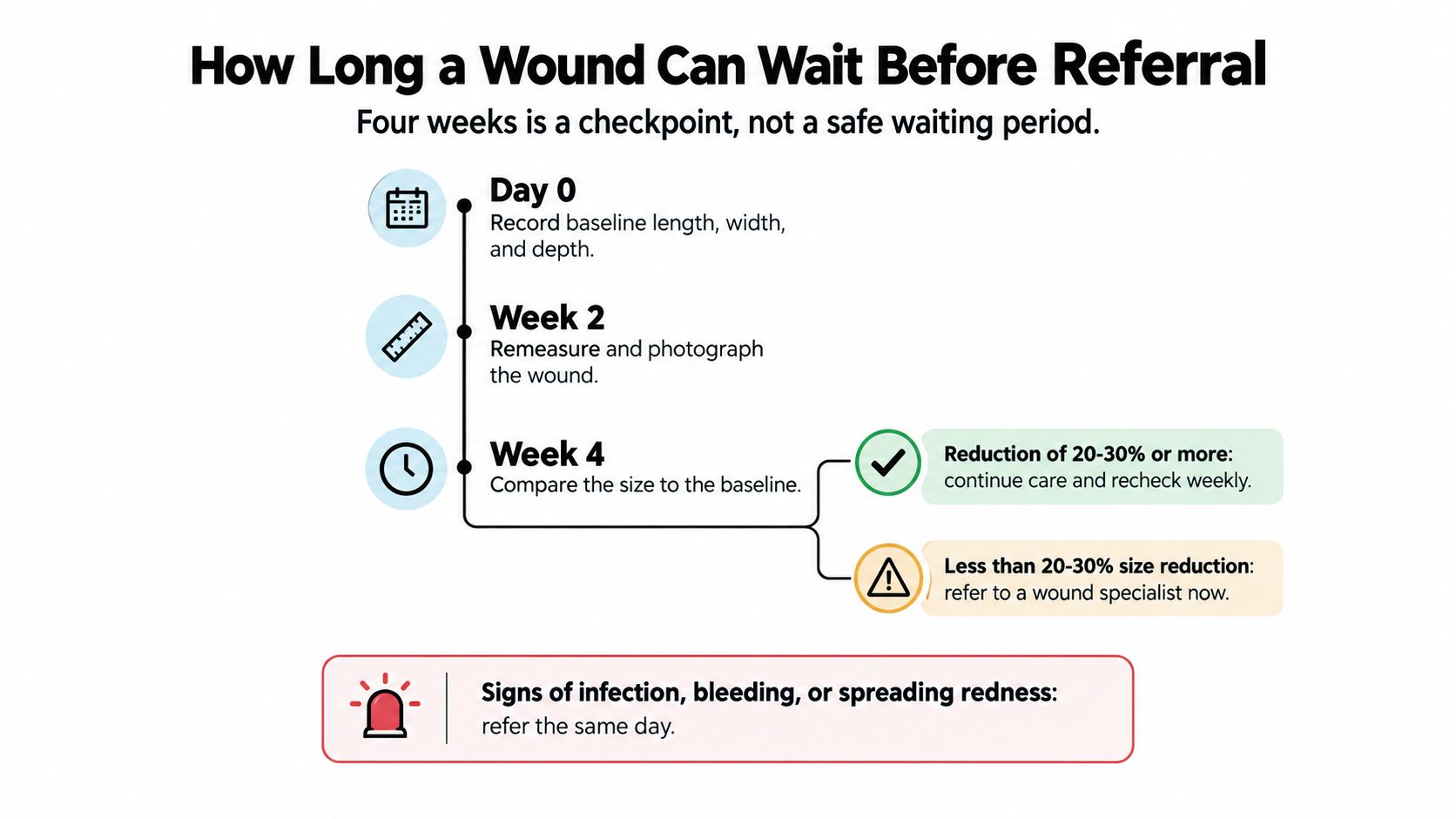
A 2025 consensus study found more than 90% expert agreement that referral is indicated for peripheral vascular disease, a need for multidisciplinary management, advanced therapies, and complex findings such as exposed fascia or surgical material, as reported in that referral-indicator consensus. Suspected ischemia, recurrent infection, exposed tendon or bone, non-viable tissue, surgical material, rapidly worsening pain, or whole-body symptoms cancel the four-week wait.
The measurement sets the normal pace. The red flags remove the wait. Send the referral to wound care, podiatry, vascular services, or surgery based on the dominant problem, and ask whether records and images can be reviewed before you travel. Our escalation pathway is built for that handoff when a wound has stalled or looks surgical.
Four weeks of no progress is a reason to refer. It is not permission to ignore a cold foot or a fever until the calendar says so.
Signs a Wound Needs a Surgeon
Surgical evaluation depends on findings, not on how many weeks the wound has been open. A shallow scrape can wait. A wound that hides dead tissue or deep structures should not.
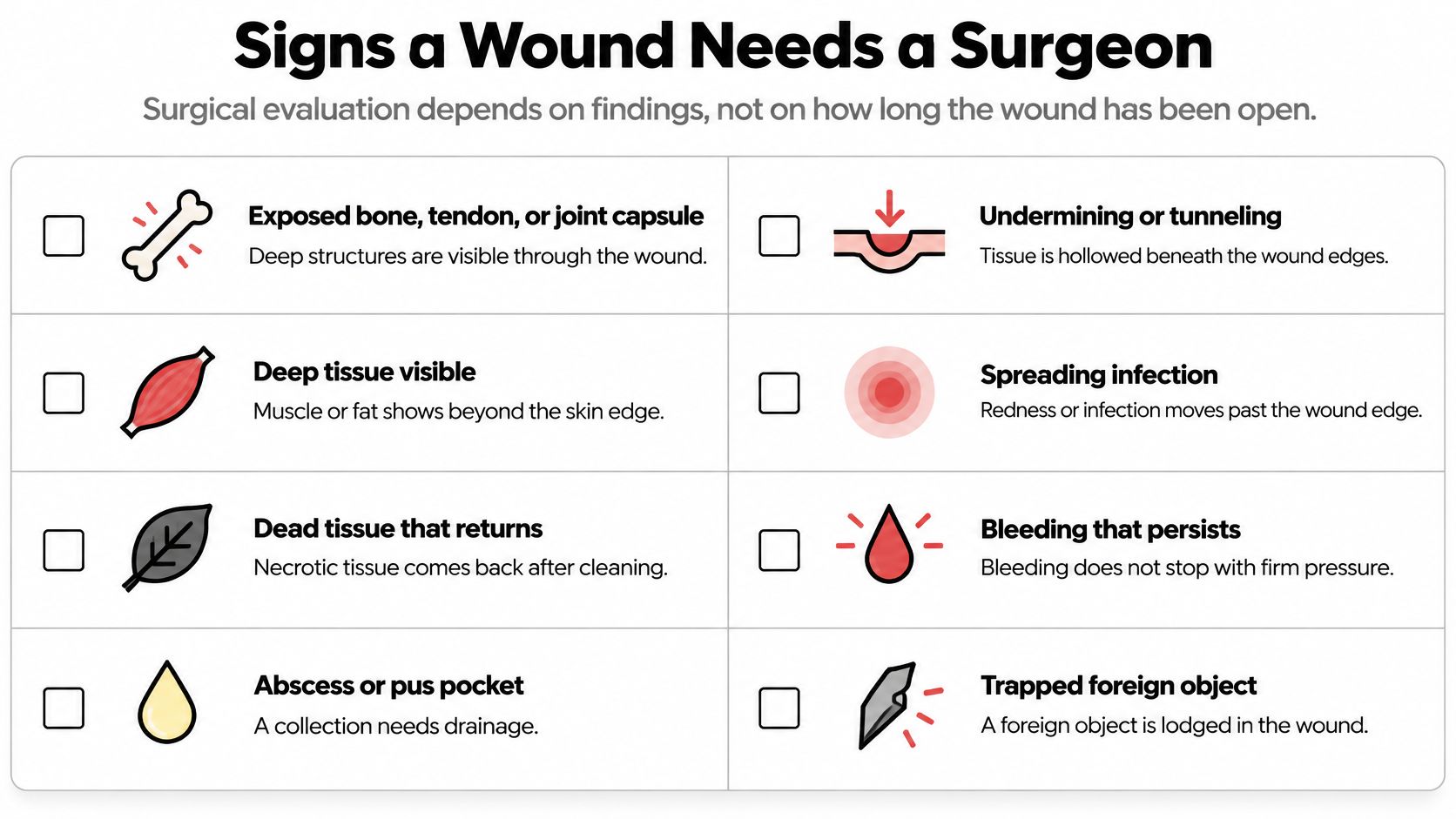
We use eight indicators that a wound may deserve surgical evaluation:
- No measurable size reduction: The numbers from visit to visit are flat.
- Necrotic or dead tissue: Dark or leathery tissue remains after cleaning.
- Persistent undermining: A pocket or tunnel runs under the skin edge.
- Infected tissue or recurrent cellulitis: Redness and infection keep returning.
- Exposed tendon or bone: Deep structures are visible.
- Persistent slough: Yellow or stringy tissue will not clear.
- Recurrent wound breakdown: The wound closes, then opens again.
- Minimal improvement despite appropriate evidence-based care: The plan was right, and the wound still stalled.
An evaluation asks whether debridement, reconstruction, or tissue coverage is needed. Some of that work happens in a sterile operating room with anesthesia support and imaging. An evaluation doesn't automatically mean an operation. Conservative care stays the foundation, and there is no required waiting period before a specialist looks.
What happens after the decision
When surgery is appropriate, a nurse confirms the wound in person, transportation can be arranged, and the patient moves to an ambulatory surgical center. Some patients recover at home the same day when that is clinically suitable. The surgeon who evaluates is the surgeon who operates, and who follows healing afterward.
That video walks through how a surgical look differs from another round of dressings. If several indicators on the list are already present, use our surgical wound evaluation rather than repeating the same dressing plan.
An evaluation is a decision, not a commitment to the operating room.
Referral Steps and Preparation Checklist
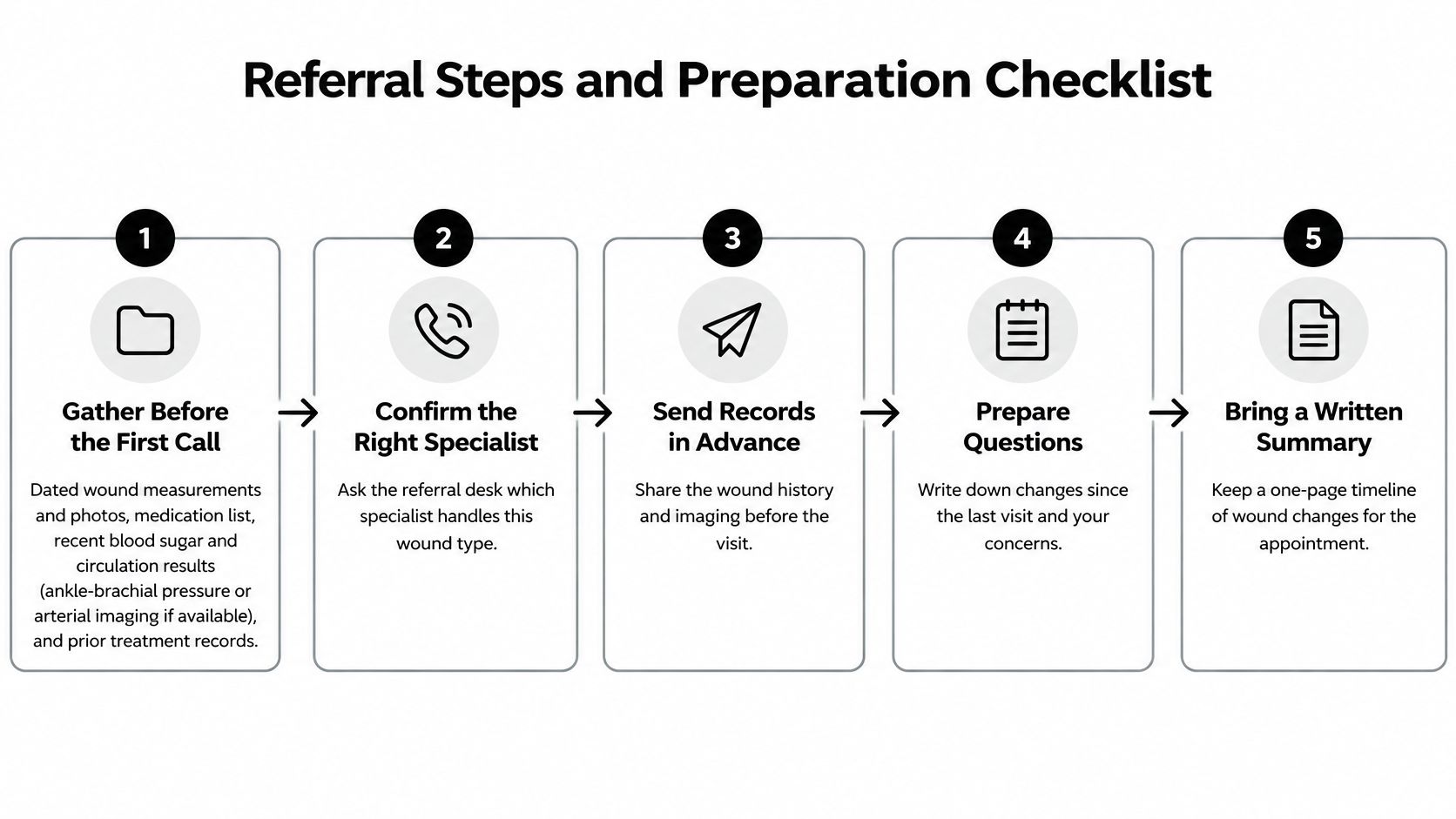
A referral fails when the next clinician gets a name and no facts. In a 2025 European Wound Management Association survey, conducted in 2024–2025, 88% of wound-care professionals reported suboptimal diagnostic and referral procedures in primary care, and 82% reported insufficient coordination between wound-care centers or units, as published in the EWMA state-of-affairs report. Ask for the handoff. Don't assume it happens.
Before you call
Gather dated measurements and photos, your medication list, recent blood sugar results, and circulation results such as ankle-brachial pressure or arterial imaging if you have them. List each prior treatment and how long it lasted. Add any imaging. A one-page timeline beats a stack of unlabeled pictures.
What to ask your current doctor to write
The referral should state wound size, depth, infection status, circulation findings, and the specialty requested. "Nonhealing wound" is not enough for the receiving clinician to prepare.
Request speed when the checkpoint has passed
If a red flag applies, or the wound missed the week-4 or week-4-to-6 checkpoint, ask for an expedited referral. Ask that records and images travel with it. A virtual review can sort urgency before you make the trip.
How we handle the handoff
We review the history, the wound, imaging, and treatment response virtually, usually within days, including by video. A surgical wound-care nurse then validates the wound in person so the photos match what is really there. If intervention is appropriate, the evaluating surgeon is the surgeon who operates and who follows healing after. Transportation can be arranged when a procedure is needed. After surgery, follow-up and recommendations return to your existing care team, and virtual follow-up tracks the wound to closure. You can start that process through our referral page.
Check the destination before you book
Confirm whether your insurance requires a referral, because that decides who must send it. Confirm the clinic that will see you.
Practical rule: If the packet doesn't include size, photos, infection status, and circulation, the first specialist visit is often spent rebuilding information you already had.
For readers in the Washington, DC area, Comprehensive Wound Services is at 2112 F Street, NW, Suite 804, Washington, DC 20037, and by phone at 202-861-2971. We offer virtual consultations, tele-wound consultations for referring partners, and in-person validation, and we work alongside the clinicians you already have.
---
This wound service evaluates complex, stalled, and possibly surgical wounds virtually or in person, then coordinates advanced care with the doctors already treating you. If your wound has stopped shrinking, keeps reopening, or shows bone, tendon, or dead tissue, a specialty look can tell you whether surgery belongs in the plan. Visit Comprehensive Wound Services to request a consultation or send a referral.