A toe that's cold, numb, blackening, or developing spreading redness, swelling, drainage, or fever needs emergency or same-day medical evaluation, not a wait for it to darken further or separate. A measured toe pressure below 30 mmHg is a warning of severe loss of blood supply, but you shouldn't wait for testing before seeking help.
The familiar advice to watch for a black toe misses an important opportunity. Threatened tissue can look purple or red, feel unusually cool, or lose sensation before obvious black tissue appears. And a painless toe isn't necessarily a safe toe, especially when diabetes has damaged the nerves.
Gangrene means tissue death. Appearance alone can't tell a family member whether tissue has died, whether infection is underneath it, or whether enough blood reaches the foot to support healing.
## Table of Contents - Which Toe Symptoms Are Emergencies and Which Need Same-Day Care - How to choose the right level of care - Early Signs Easy to Miss Before a Toe Turns Black - Why a painless toe still needs attention - How to Tell Dry Gangrene From Wet Gangrene - Why the surface can mislead you - Why a Gangrenous Toe Carries Limb-Level Risk - Why the whole foot needs assessment - Tests That Confirm Poor Blood Flow in a Toe - What the measurements mean - How Treatment Changes With the Cause - When vascular and surgical care overlap - What to Gather and Do Before the Appointment - What the clinician needs to establish - What to do today
Which Toe Symptoms Are Emergencies and Which Need Same-Day Care
| Tier | Signs to look for | What to do |
|---|---|---|
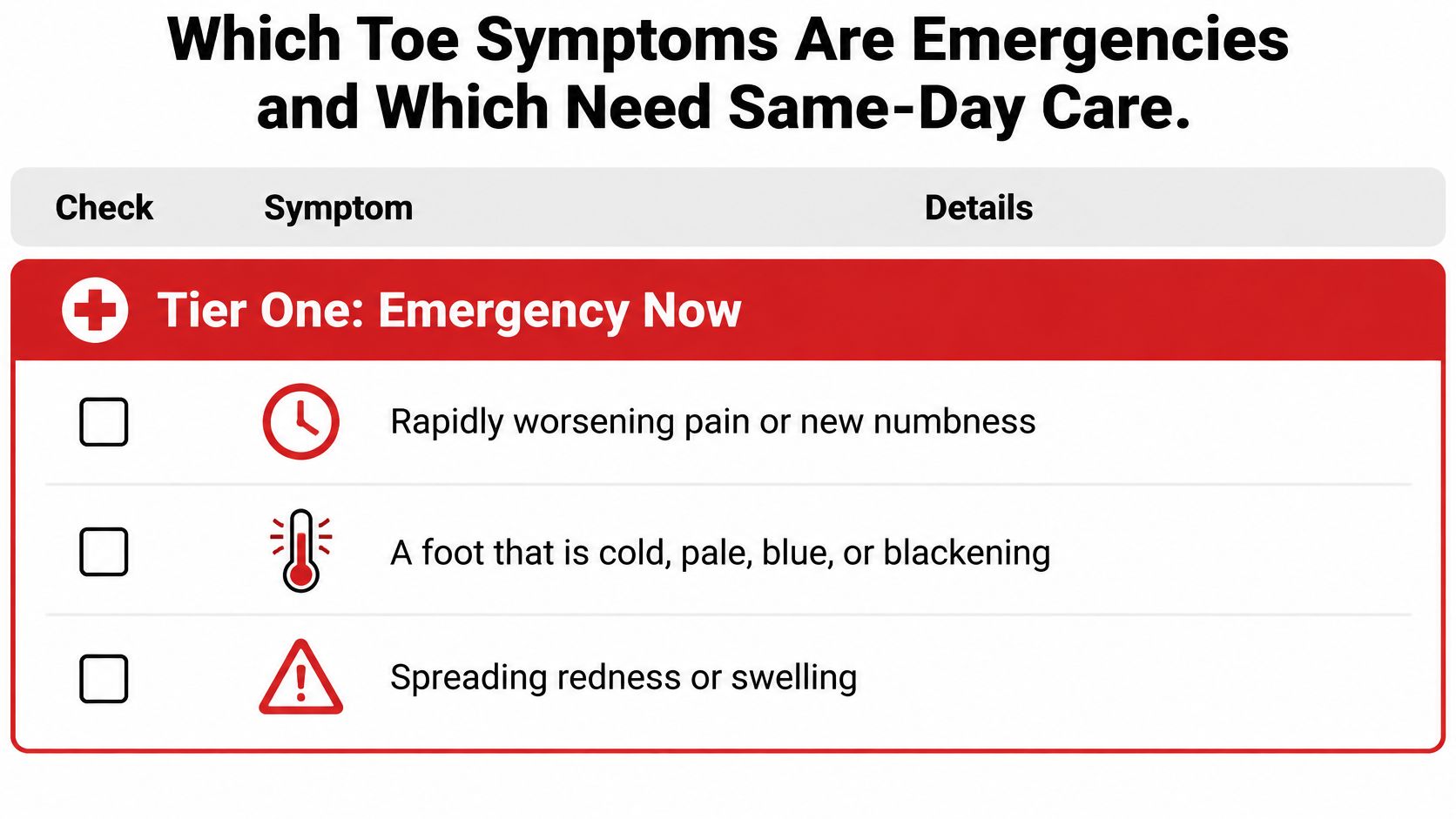
| Emergency now | Rapidly worsening pain or numbness; foot cold, pale, blue or blackening; spreading redness or swelling; foul-smelling drainage; fever, confusion or fast breathing | Call emergency services or go to the nearest emergency department now |
| Same-day specialist assessment | Cold or numb toe without severe pain; diminished pulses; night-time forefoot pain; nonhealing toe wound; dark or red toe without fever or spreading infection | Call a vascular, wound or podiatry clinic today; if none is reachable, go to urgent care or the emergency department |
| Never manage at home | Stable dark, dry-looking toe without other symptoms; considering cutting, scraping, peroxide or waiting for separation | Arrange medical evaluation within the day; don't wait for the toe to separate on its own |
Timing and progression matter as much as colour. Sudden coldness or new numbness is different from a longstanding sensation change, but either deserves attention when a toe looks abnormal. The emergency pattern means you shouldn't wait for a callback, an uploaded-photo review or a routine appointment.
Use this chart to keep the most urgent warning signs visible.
How to choose the right level of care
The Oregon Health & Science University PAD presentation describes gangrene and impaired toe circulation as findings relevant to limb-threatening arterial disease. That's why a toe without fever can still need urgent vascular assessment: a lack of infection symptoms doesn't establish that blood flow is adequate.
For a same-day call, describe the actual change rather than saying only that you have a toe problem. Say whether it's newly cold, numb, discoloured or draining, when it started, and whether you have diabetes or known artery disease.
A wound-care escalation pathway can help organise specialty review, but it isn't a substitute for emergency care.
Practical rule: If you can't confidently distinguish the urgency tiers, choose the faster option.
Don't cut or scrape the area, apply peroxide, or wait for a visible line of separation. A dry-looking surface doesn't make home observation a safe treatment plan.
Early Signs Easy to Miss Before a Toe Turns Black
Black isn't the required first warning sign. Searching for “early gangrene toe” pictures can create false reassurance when your own toe doesn't resemble an advanced photograph. The earlier concern may be reduced circulation, with tissue still threatened rather than visibly dead.
This illustration highlights changes worth noticing, not a way to diagnose gangrene.
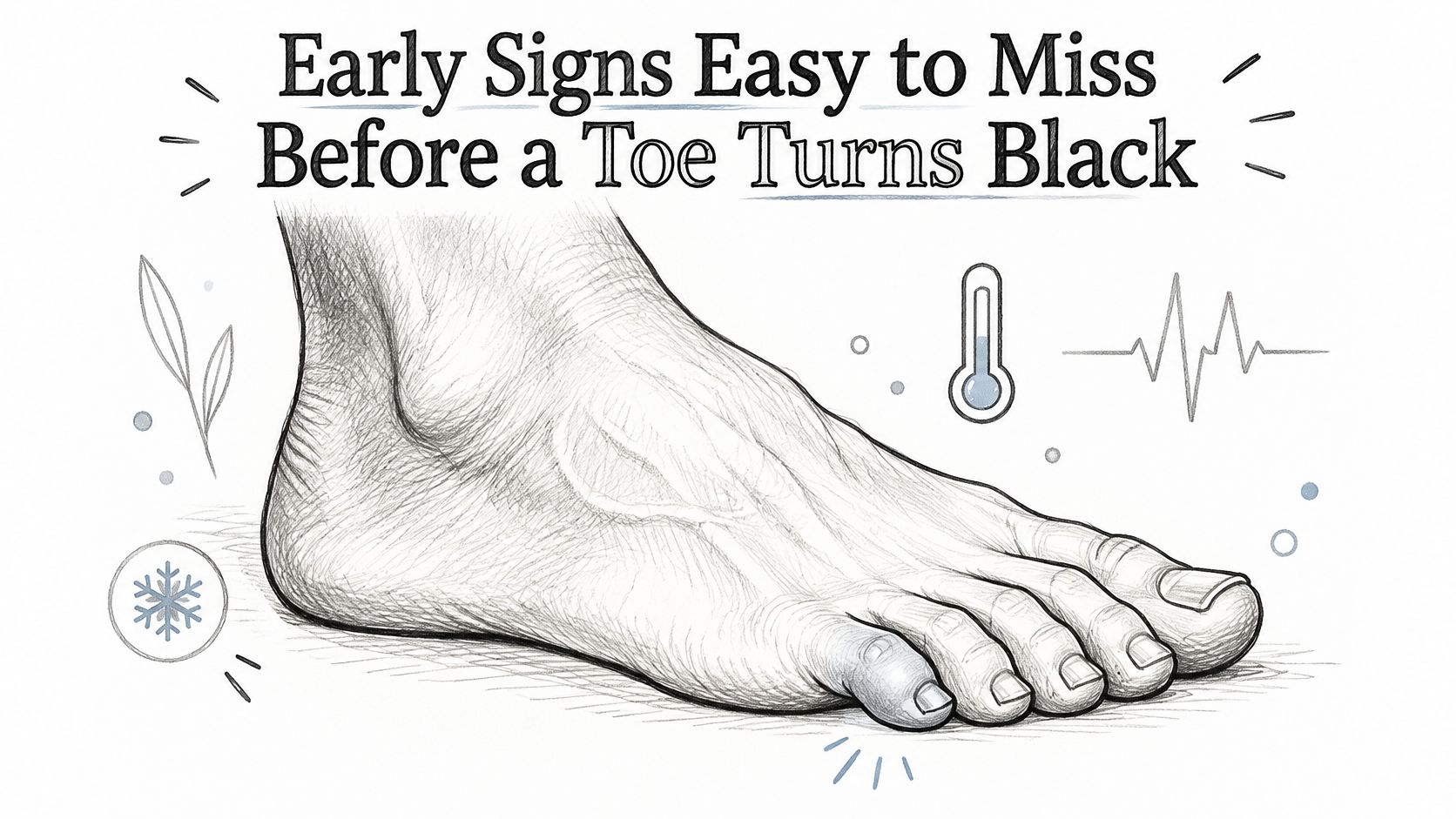
The European Wound Management Association factsheet identifies coolness, altered sensation, discolouration and diminished pulses as relevant findings when assessing compromised circulation. At home, the recognisable patterns include:
- A cooler toe: One toe or foot feels noticeably cooler than its counterpart.
- Reduced sensation: You notice numbness rather than the pain you expected.
- Changed foot pulses: A clinician finds diminished pulses. Don't rely on your own pulse check to clear the foot.
- Night-time forefoot pain: Pain interrupts sleep, eases when the leg hangs down, and returns when it's raised.
- Delayed healing: A small blister, corn-related wound or cut stops improving.
- Quiet discolouration: A persistent purple or red patch appears without dramatic swelling.
Why a painless toe still needs attention
Diabetic neuropathy, meaning nerve damage, can blunt the pain that would otherwise prompt someone to seek care. Calcified ankle arteries can also complicate circulation assessment, so clinicians may need toe-level measurements rather than relying on ankle findings alone.
For additional visual context, the video is below. Don't delay an assessment to finish watching it.
Compare both feet in the same light during your daily check, noting temperature, sensation and colour. Take dated photographs when something changes, but don't use photographs to decide that circulation is adequate.
Our wound conditions information can help you describe the concern. A changing pattern warrants assessment even when no single symptom seems dramatic.
How to Tell Dry Gangrene From Wet Gangrene
| Feature | Dry gangrene | Wet gangrene |
|---|---|---|
| Typical appearance | Black or purple, dry, mummified, with a demarcated edge | Swollen, moist, may drain fluid or smell foul |
| Main cause | Prolonged loss of blood supply | Infection, often combined with poor blood flow |
| Speed of progression | Usually develops over time | Can progress rapidly through deep tissue |
| Main risk | Tissue loss and infection if the area breaks down | Sepsis and deep spread of infection |
| Urgency | Prompt evaluation to identify the blood-flow cause | Urgent evaluation the same day or sooner |
| Share in a surgical study | 38.0%, representing 112 patients | 61.4%, representing 181 patients |
The final row describes a 2025 Romanian retrospective study published in Medicina of 295 diabetic patients who underwent surgery for foot lesions. It describes that selected surgical population, not the likelihood that any particular discoloured toe has either form.
Dry gangrene often looks shrunken and clearly separated from surrounding tissue. Wet gangrene involves infection and can destroy tissue more rapidly. The important distinction isn't dry versus damp skin alone, but whether infection, severely reduced circulation or both are present.
Why the surface can mislead you
A dry-looking toe can coexist with deeper infection, including osteomyelitis, an infection of bone. A clinician therefore needs more than a photograph of the black area to decide what treatment is safe.
A nationwide analysis of diabetic foot complications also places gangrene within the broader problem of advanced diabetic foot disease. Its findings support taking arterial assessment seriously rather than treating the toe as an isolated skin defect.
A sharply defined edge tells you where tissue looks different. It doesn't tell you whether the remaining foot has enough blood to heal.
Families sometimes assume that dead tissue should immediately be trimmed away. That decision belongs to the treating team: opening a stable dry covering before checking circulation can create a larger wound that cannot heal.
The opposite mistake is waiting when tissue becomes swollen, draining or foul-smelling. Those changes can indicate infection requiring hospital treatment, not merely a later stage of drying. Dry-looking doesn't mean harmless, and wet-looking doesn't mean a dressing alone will solve the problem.
Why a Gangrenous Toe Carries Limb-Level Risk
| Measure | Figure | What it means for an early gangrenous toe |
|---|---|---|
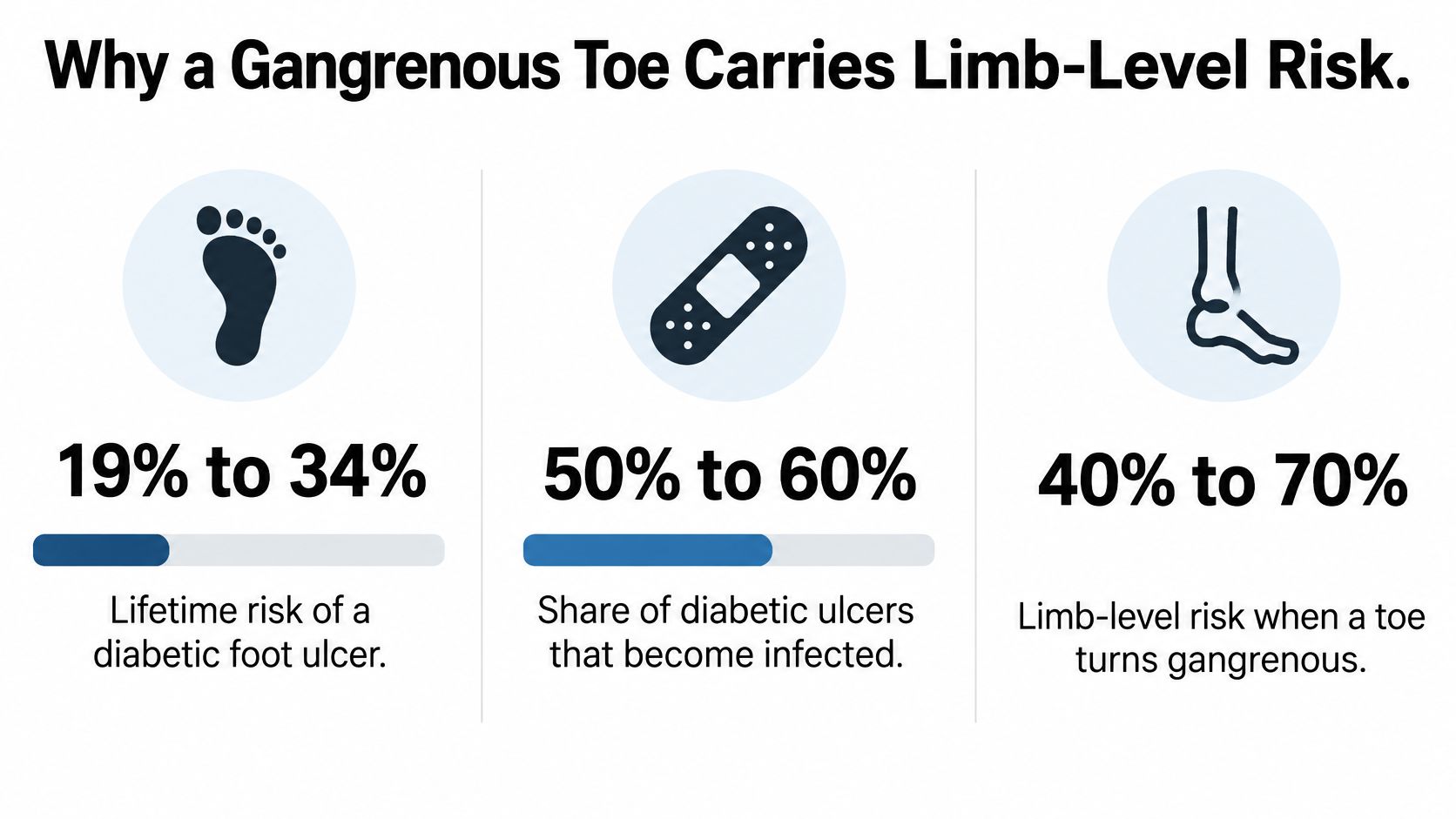
| Lifetime risk of diabetic foot ulcer | 19% to 34% | Foot wounds deserve early attention in diabetes |
| Diabetic ulcers that become infected | About 50% to 60% | An open wound needs monitoring for infection |
| Moderate-to-severe infections progressing to lower-extremity amputation | About 20% | Infection severity and timely treatment matter |
| US lower-extremity amputation rate among adults with diagnosed diabetes, 2016 | 4.9 per 1,000 | Amputation is a measurable diabetes-related outcome |
| Opposite-extremity amputation after an amputation | 19% to 53% within five years | Both feet need continued protection |
| Gangrene at presentation, beginning to end of a nationwide eight-year analysis | 14.7% to 11.3% | Gangrene marks advanced foot disease |
| Vascular interventions, beginning to end of the same analysis | 6.2% to 19.5% | Increased vascular treatment coincided with improved amputation outcomes |
The ulcer, infection and amputation estimates above are summarised in this review of diabetic foot disease. The trend rows describe the nationwide analysis discussed in the preceding section; they show an association, not proof that vascular intervention alone caused the improvement.
The most important distinction is that these are different patient groups and measures. The infection-to-amputation estimate isn't an individual prediction for someone with a purple toe. Your clinician must establish what is happening in your foot.
The following graphic puts the broader diabetic-foot burden in perspective.
Why the whole foot needs assessment
A small dead area may sit at the end of an arterial supply problem affecting much more tissue. Clinicians assess perfusion, meaning blood delivery, alongside infection depth, bone involvement and the amount of viable tissue remaining.
Pressure and repeated injury also matter. Treating the visible toe while ignoring footwear pressure, glucose management or arterial insufficiency leaves important contributors unresolved.
Early evaluation is therefore a limb-preservation step, not a cosmetic consultation. The purpose is to identify treatable problems while protecting the greatest amount of living tissue.
Tests That Confirm Poor Blood Flow in a Toe
| Test | Value suggesting severe ischaemia | Why it matters |
|---|---|---|
| Ankle-brachial index, ABI | Below 0.4 | Compares ankle and arm pressure; calcification can make it falsely high |
| Ankle pressure | Below 50 mmHg | Measures arterial pressure at the ankle |
| Toe pressure | Below 30 mmHg | Helps assess circulation when ankle arteries are calcified |
| Transcutaneous oxygen pressure, TcPO2 | Below 30 mmHg | Estimates oxygen availability at the skin |
| Pedal Doppler waveform | Monophasic or absent | Suggests impaired flow in foot arteries |
| Wound area change | Less than 50% reduction over four weeks despite appropriate care | Calls for reassessment of vascular status, rather than serving as a pressure measurement |
These thresholds and the wound-progress trigger come from the IWGDF peripheral artery disease guideline. Severe-ischaemia findings warrant urgent vascular-specialist assessment and consideration of treatment to restore circulation.
A pulse examination is useful, but it can miss disease farther down the arterial system. A clinician may combine pressure measurements, Doppler signals and oxygen testing rather than relying on a single reassuring finding.
What the measurements mean
ABI compares pressure at the ankle with pressure in the arm. Toe pressure focuses closer to the threatened tissue, which can be especially useful when diabetes-related arterial calcification makes ankle measurements difficult to interpret.
A Doppler waveform shows the pattern of arterial flow, not just whether a sound is detectable. TcPO2 estimates how much oxygen reaches the skin, helping clinicians judge healing potential.
Ask at the visit: Which measurement best reflects circulation to this toe, and does it suggest the wound can heal?
When intervention is being considered, imaging should show the below-knee and foot arteries so the vascular team can plan an appropriate route to improve blood supply. Clinicians may also use Wound, Ischaemia and foot Infection, or WIfI, staging to assess limb threat.
These results aren't home diagnostic cutoffs. They help professionals interpret the wound, symptoms and examination together.
A stalled wound also deserves a fresh look. Continuing the same dressings indefinitely isn't enough when appropriate infection care, glucose management and pressure relief haven't produced expected progress.
How Treatment Changes With the Cause
Treatment follows the underlying problem, not the darkest patch of skin. The team needs to decide what can recover, what is already dead and what must be treated immediately.
- Restore circulation when possible. A vascular specialist uses the examination, perfusion testing and arterial imaging to consider options such as angioplasty or bypass. The aim is to improve blood delivery to tissue that can still heal.
- Control infection at its source. An abscess may need drainage, and infected or necrotic tissue may need removal. The IWGDF/IDSA diabetes-related foot infection guideline supports early surgery, generally within 24–48 hours, combined with antibiotics for moderate or severe infection when indicated.
- Use antibiotics for the problem they treat. Antibiotics address bacterial infection. They cannot reopen an obstructed artery or replace drainage of a collection of pus.
- Time debridement carefully. Debridement means removing unhealthy tissue. Stable dry eschar, the dark covering over dead tissue, needs a different approach from infected wet necrosis when circulation is severely compromised.
When vascular and surgical care overlap
When diabetes, peripheral artery disease and infected gangrene coexist, surgical and vascular specialists should agree on the timing of drainage, tissue removal and circulation treatment. There isn't a safe universal rule that one procedure must always happen first.
Urgent surgical consultation is particularly important for extensive gangrene, severe infection, suspected deep abscess, necrotising infection or compartment syndrome. These are not situations for a prolonged trial of home wound products.
Minor amputation may be considered when tissue cannot be saved. Its purpose can be to remove an unsalvageable toe or limited area while protecting the remaining foot, but the resulting wound still needs adequate circulation and a coordinated healing plan.
A surgical wound evaluation helps determine whether intervention is appropriate. Evaluation doesn't automatically mean surgery, and a wound that stalls afterward needs reassessment rather than an assumption that the operation settled every contributor.
What to Gather and Do Before the Appointment
- Dated photographs: Include both feet in the same light, plus a closer image of the affected toe.
- Onset and progression: Record when the change began and what has changed since.
- Temperature and sensation: Note differences between feet without repeatedly pressing or poking the toe.
- Drainage or odour: Describe what you notice.
- Fever or chills: Include any general illness or unusual confusion.
- Diabetes history: Bring recent glucose information if available.
- Smoking history: Tell the clinician about current and previous use.
- Known artery disease: Include prior vascular procedures.
- Medicines: Bring an accurate list.
- Recent injury: Mention a cut, blister, tight shoe or other trauma.
Don't delay departure to complete the checklist. Existing information is helpful; emergency treatment is more important than perfect documentation.
What the clinician needs to establish
The examination includes the extent of redness, drainage, odour, sensory loss and temperature differences. Clinicians also look for exposed tendon or bone, a possible fluid collection, crackling beneath the skin and signs that illness is affecting the whole body.
Blood tests, cultures and imaging are selected according to the suspected problem. An X-ray, Doppler ultrasound, CT or MRI may help investigate bone infection, gas in tissue, deep infection or an arterial obstruction.
What to do today
- Emergency signs present: Use emergency services or the emergency department, not a virtual consultation.
- Stable but concerning toe: Request same-day vascular, wound or podiatry assessment. If that isn't available, use urgent care or the emergency department.
- Wound repeatedly stalling or reopening: Bring the treatment history so the team can assess why progress hasn't lasted.
At CWS, we review the history, wound, imaging and treatment response virtually, then a surgical wound-care nurse validates the findings in person. Findings that warrant closer review include dead tissue, persistent undermining, recurrent infection, exposed structures, persistent slough and repeated breakdown despite appropriate care.
An evaluation doesn't automatically lead to surgery. Outcomes vary with wound type, health history and the care plan, and urgent circulation or infection concerns still require prompt in-person assessment.
---
For a complex or stalled toe wound after urgent concerns have been addressed, Comprehensive Wound Services offers virtual and in-person specialty evaluation coordinated with your existing care team. Contact us to arrange a review of the wound history, images and treatment response, and to determine whether continued wound care or surgical evaluation is appropriate. Don't wait for that appointment if emergency warning signs develop.