
The leg wound looked manageable when you last changed the dressing. Now it feels hot, your family member winces when you touch nearby skin, and more fluid has soaked through the pad. You're trying to decide whether to call the clinic, arrange urgent care, or head straight to the hospital.
An infected leg wound doesn't automatically mean hospital admission. The important questions are whether the changes are staying local, spreading into surrounding tissue, or affecting the whole person. Deep, fast-moving, or unexpectedly painful changes need a different response from a stable wound with mild irritation.
## Table of Contents - Signs That a Leg Wound Has Become Infected - Read the pattern, not just the color - When to Seek Care Today Versus Within Days - Why some findings can't wait - Why Leg Wounds Become Infected and Who Is at Risk - Conditions that make healing harder - Why a long-open wound deserves review - How Clinicians Evaluate an Infected Leg Wound - What each test can answer - Preparing for the assessment - Antibiotics, Drainage and Surgery Compared - Antibiotics for clinical infection - Drainage for a pocket of pus - Debridement and surgery for damaged tissue - When an Infected Wound Stops Improving or Returns - Look for the reason treatment failed - What specialty review adds - Confirm Your Next Step Before the Wound Worsens - While arranging care
Signs That a Leg Wound Has Become Infected
Most open leg wounds carry bacteria, called colonization, without those bacteria causing an invasive infection. Infection means bacteria are damaging tissue and triggering changes such as spreading inflammation, increasing pain, pus, or illness.
The most useful comparison is with the wound's usual appearance and how the person normally feels. A dressing that suddenly needs changing more often, pain that interrupts sleep, or tenderness extending farther up the leg can matter more than a single photograph.
Signs of an infected leg wound and what they may indicate
| Sign | What It May Indicate |
|---|---|
| Redness spreading beyond the wound edge | Cellulitis spreading into surrounding skin |
| Warmth and swelling around the wound | Local inflammation, which may accompany infection |
| Pain that increases or does not ease | Infection or a collection of pus, called an abscess |
| Cloudy, yellow-green or foul-smelling drainage | Possible purulent infection, particularly when accompanied by increasing pain or inflammation |
| Wound edges opening or dark tissue forming | Tissue death, possible deeper infection |
| Fever or chills | Infection affecting the whole body |
| Red streaks running up the leg | Spread through lymph channels |
Read the pattern, not just the color
These signs aren't a diagnosis by themselves. Swelling can come from venous disease, redness can follow adhesive irritation, and odor can develop beneath an old dressing. But new changes occurring together, especially worsening pain plus spreading warmth or drainage, deserve clinical assessment.
Not every yellow layer is pus. A wound can contain yellow slough, which is tissue material attached to the wound bed, rather than thick fluid draining from a pocket. Don't scrape it away to find out.
Practical rule: Compare the wound with its own recent baseline, not with an internet photograph.
Redness can also be harder to recognize on darker skin. Look for changes in warmth, swelling, tenderness, and skin tone rather than expecting bright red skin.
People with diabetes, nerve damage, or poor circulation may show fewer obvious warning signs. Little pain doesn't guarantee a minor problem, and the absence of fever doesn't rule out infection. A new smell, unusual dressing soakage, or change in walking ability warrants attention even when the skin looks relatively unchanged.
When to Seek Care Today Versus Within Days
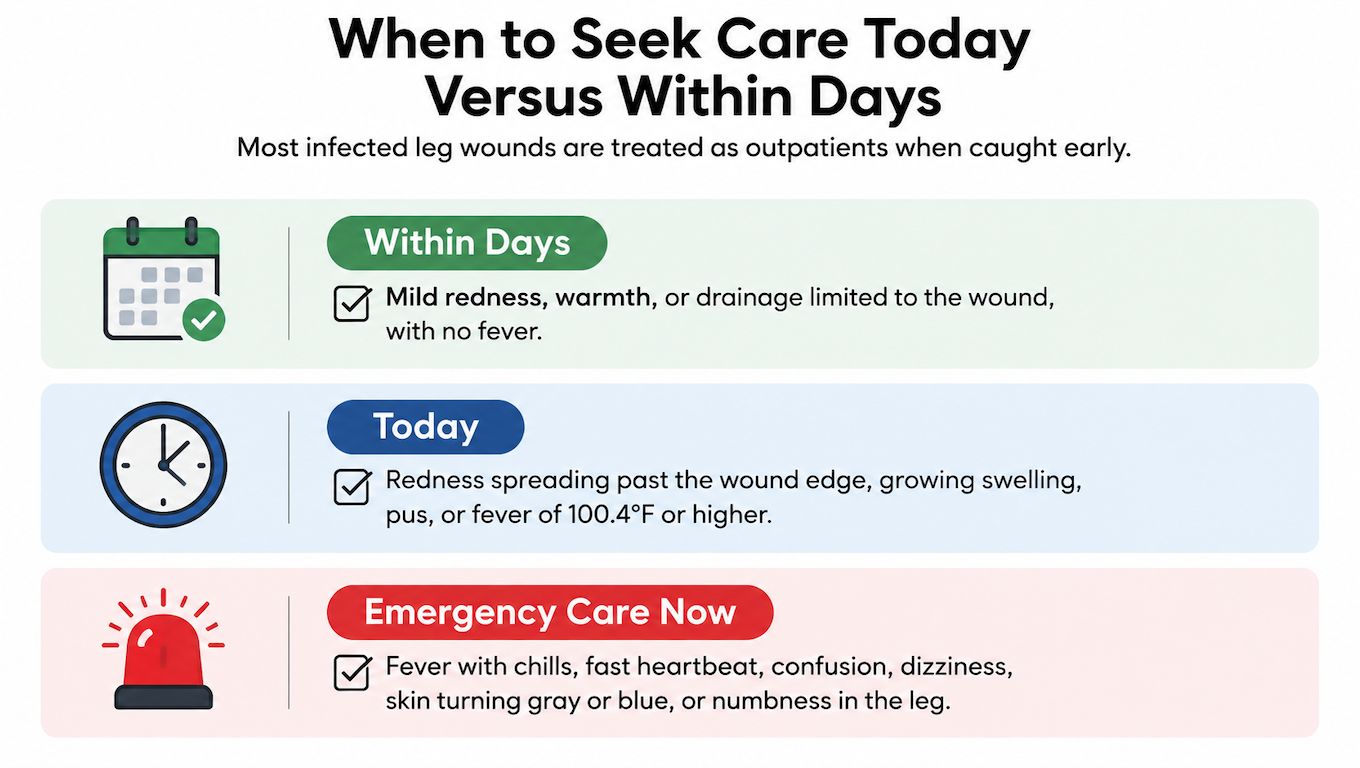
Use the most urgent matching row. Outpatient treatment can be appropriate when the person is otherwise well, but symptoms suggesting sepsis or deep tissue infection shouldn't wait for a routine wound appointment.
Urgency levels for an infected leg wound
| Finding | Action | Why |
|---|---|---|
| Confusion, unusual drowsiness or fainting | Call emergency services now | Possible sepsis |
| Fever with shaking chills, fast heartbeat, weak pulse or shortness of breath | Go to an emergency department now | Possible sepsis |
| Pain out of proportion to the wound, dusky or blistering skin, crackling under the skin | Emergency surgical assessment | Possible necrotizing infection |
| Spreading redness, swelling or red streaks with low-grade fever | Same-day clinician review | Infection may be spreading |
| Pus, increasing pain or warmth, no improvement after several days | Same-day or next-day visit | Local infection needing drainage or treatment change |
| Mild edge redness, no fever, otherwise well | Clinician contact within one to two days | Possible early local infection or irritation |
Use this visual guide alongside the symptoms and actions above.
Why some findings can't wait
Confusion, clammy skin, a weak pulse, and breathing difficulty can signal sepsis, a dangerous response to infection that can impair organ function. Don't wait for every symptom or for a high temperature before seeking help.
Severe pain despite a small-looking wound can mean the visible skin understates the damage underneath. The Infectious Diseases Society of America skin and soft-tissue infection guideline identifies disproportionate pain, rapid progression, blistering, and crackling beneath the skin as warning findings for necrotizing infection, which requires urgent surgical assessment rather than antibiotics alone.
If you're unsure which urgency level fits, choose the more urgent action and call.
A treated wound that suddenly worsens needs faster reassessment, not just another dressing change. For nonemergency referral planning, an escalation pathway for surgical wound evaluation can help organize specialist review. It isn't a substitute for emergency services.
Why Leg Wounds Become Infected and Who Is at Risk
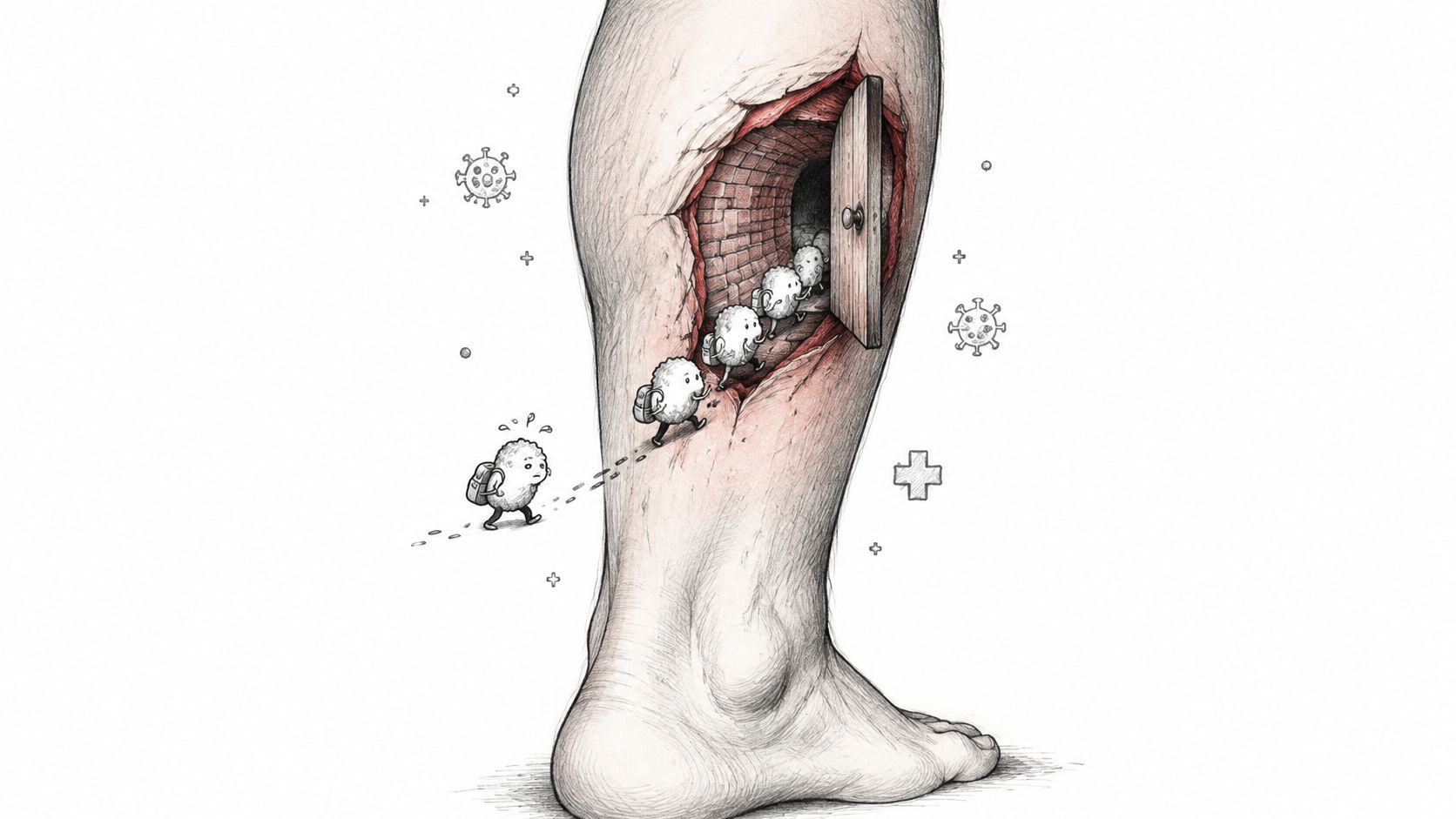
A wound is an open door in the body's protective wall. Infection becomes more likely when the opening persists, surrounding tissue is damaged, or blood flow can't deliver enough oxygen and immune cells.
This illustration shows that break in the skin's protective barrier.
Conditions that make healing harder
- Diabetes: High blood sugar can impair healing and immune function. Associated nerve damage may reduce pain, allowing an injury to worsen unnoticed.
- Venous disease: Blood pooling in the lower leg causes swelling and skin changes, often around the ankle. Persistently swollen tissue is easier to damage and harder to heal.
- Arterial disease: Restricted blood flow limits oxygen delivery and can make it harder for infection-fighting cells and antibiotics to reach affected tissue.
- Reduced mobility or pressure: Bedrest, poorly fitting devices, and casts can expose tissue to sustained pressure or friction.
- Obesity and poor nutrition: Swelling, difficulty repositioning, and inadequate protein or energy intake can interfere with repair.
- Recent antibiotic use: Previous treatment can change which bacteria are present and influence which medication is appropriate later.
Why a long-open wound deserves review
Chronic leg ulcers are particularly relevant in older adults. A peer-reviewed study in Diabetes/Metabolism Research and Reviews reports that chronic leg ulcers affect nearly 3% of people aged 60 years and older and more than 5% of those older than 80.
An open wound remains exposed to repeated contamination and injury. That doesn't mean every longstanding ulcer is infected, but a wound that's stalled for weeks deserves review even without dramatic redness or pus. The clinician needs to identify what is preventing closure, not merely choose a different dressing.
How Clinicians Evaluate an Infected Leg Wound
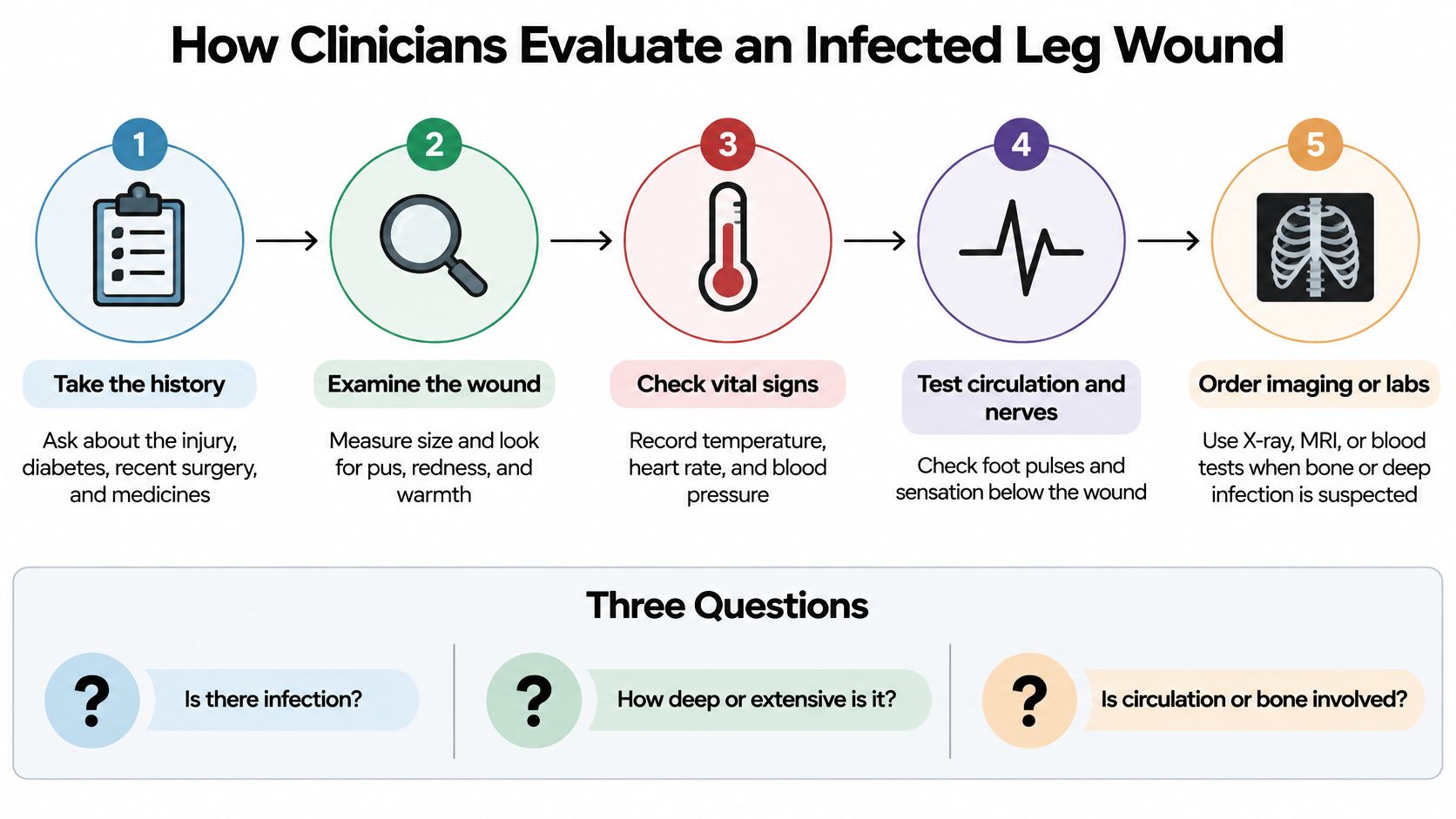
- Take the history. The clinician asks how the wound started, what's changed, and whether diabetes, circulation problems, surgery, or previous antibiotics could affect treatment. Describe the pain pattern, including pain at rest or with movement.
- Examine the wound. They assess its dimensions, depth, tissue color, drainage, and surrounding warmth. They also look for undermining, where damage extends beneath the visible skin edge.
- Check the whole person. Temperature, heart rate, blood pressure, breathing, and sometimes blood sugar help establish severity. Blood tests such as a white cell count and inflammatory markers may help when deeper or systemic illness is suspected.
- Assess circulation and sensation. Foot pulses, skin temperature, and nerve sensation provide useful clues. An ankle-brachial index, which compares ankle and arm blood pressures, may help investigate arterial disease.
- Select imaging when needed. Ultrasound can reveal a hidden abscess. X-ray or MRI may be appropriate when the examination raises concern about bone involvement or deeper infection.
- Obtain useful samples. Pus or deep tissue may be collected during drainage or surgery. Blood cultures may be needed when bloodstream infection or sepsis is suspected.
The evaluation follows a connected process rather than a fixed test package.
What each test can answer
| Assessment | Main Question It Helps Answer |
|---|---|
| Wound examination | Is the problem local, spreading, or deeper than it looks? |
| Vital signs and selected blood tests | Is the person becoming systemically unwell? |
| Pulse assessment and vascular testing | Is blood supply adequate for healing? |
| Ultrasound | Is there a drainable collection beneath the skin? |
| X-ray or MRI | Could bone or deeper structures be involved? |
| Appropriate cultures | Which organisms may be driving the infection? |
A superficial swab can collect bacteria living on the wound surface rather than those causing tissue damage. That's why a positive result doesn't automatically establish infection or identify the best antibiotic.
Laboratory results need interpretation alongside the examination, sample quality, and treatment history. Information about molecular wound testing can help readers understand another testing approach, but detecting an organism doesn't by itself establish that it needs treatment.
Preparing for the assessment
Bring the medication list, antibiotic names, relevant hospital records, and photographs showing change over time. Tell the clinician if a dressing has hidden a deeper opening or if the person has become less mobile.
Not every wound needs every test. The clinician chooses investigations to answer whether infection is present, how extensive it is, and whether circulation or bone involvement changes the plan.
This video provides additional wound-care context.
Antibiotics, Drainage and Surgery Compared
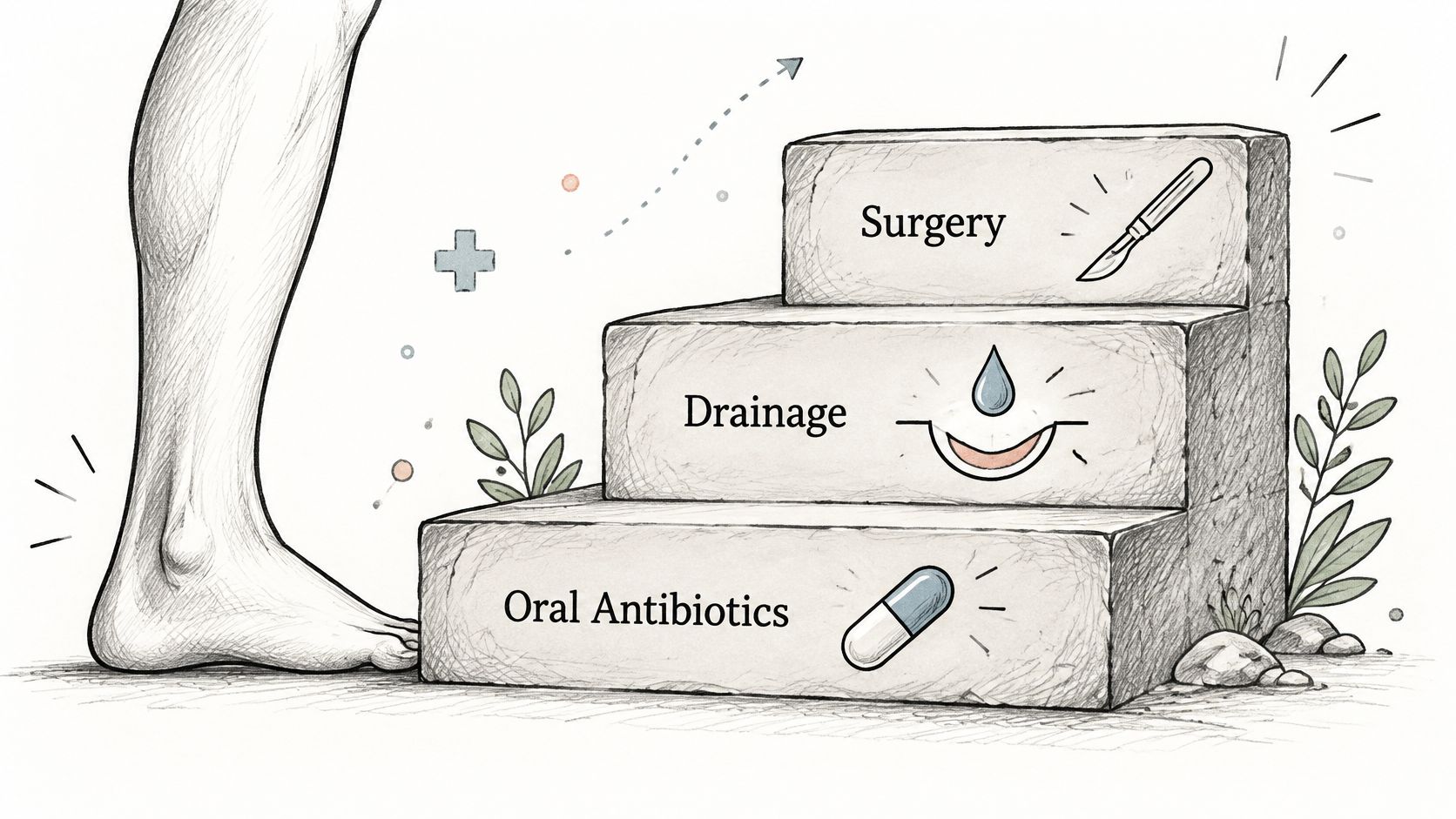
Antibiotics treat susceptible bacteria, drainage releases trapped pus, and debridement removes damaged tissue. These treatments aren't interchangeable, and a clinician may combine them when a wound has more than one problem.
The illustration shows the main treatment approaches.
Antibiotics for clinical infection
Oral medication is often appropriate when infection is mild, the person can take medicine by mouth, and they aren't severely unwell. The NICE leg-ulcer infection prescribing guideline uses a typical 7-day course and recommends reviewing intravenous treatment within 48 hours to consider a safe switch to oral therapy.
The prescription depends on allergies, kidney function, previous treatment, clinical severity, and local resistance patterns. Antibiotics won't make an uninfected ulcer close faster, and unnecessary use adds side effects and resistance pressure.
Drainage for a pocket of pus
An abscess is a collection that may need opening and drainage by a trained clinician. Say the skin opening is small but a tender lump sits beneath it: medication alone may not adequately address the trapped material.
Don't squeeze, puncture, or probe the area at home. Whether antibiotics are also needed depends on surrounding infection, the person's health, and systemic symptoms.
Treatment options for an infected leg wound
| Option | When It Fits | Typical Course or Note |
|---|---|---|
| Oral antibiotics | Mild infection, can swallow tablets, not severely unwell | Prescribed course adjusted to response and risk factors |
| IV antibiotics | Severely unwell or unable to take or absorb oral medication | Review for a safe switch to oral treatment |
| Incision and drainage | Collection of pus, called an abscess | May be the main treatment in selected cases |
| Debridement or surgery | Deep, spreading, or nonresponding infection involving damaged tissue | Urgent when necrotizing infection is suspected |
Debridement and surgery for damaged tissue
Debridement means removing nonviable tissue. Some procedures can take place in a clinic, while extensive or deep infection may require an operating room, anesthesia, and more thorough exploration.
A surgical wound evaluation helps determine whether a procedure is appropriate. Evaluation doesn't automatically mean surgery.
The treatment should match what the clinician finds, not simply the label “infected.”
Dressings still protect the wound and manage moisture, but they can't substitute for releasing pus or removing dangerously infected tissue.
When an Infected Wound Stops Improving or Returns
Another antibiotic course isn't always the answer to a wound that remains painful, draining, or open. Before changing medication, the clinician needs to check whether the original treatment addressed the underlying problem.
Pus may remain trapped, dead tissue may persist, or pressure may repeatedly injure the area. Poor circulation, uncontrolled diabetes, and an organism not covered by the prescription can also prevent improvement.
Look for the reason treatment failed
The Intermountain Healthcare clinical pathway recommends soft-tissue ultrasound when an abscess isn't obvious. That's a useful distinction: a hidden collection may need drainage rather than only a different antibiotic.
Resistance can matter too, but findings from specialized infection populations shouldn't be treated as a prediction for every leg wound. Recent antibiotic exposure, previous culture results, and the care setting help the clinician decide whether targeted sampling is needed.
Request reassessment for these changes:
- No clear improvement: Pain, warmth, drainage, or surrounding inflammation aren't beginning to settle during treatment.
- Repeated reopening: The wound closes and then breaks down again.
- New tissue damage: Dark tissue, persistent slough, or a deeper opening appears.
- A prolonged stall: The wound has stopped shrinking despite an appropriate care plan.
- New urgent symptoms: Rapid progression, severe pain, or whole-body illness develops.
What specialty review adds
A wound specialist examines drainage, tissue viability, pressure, blood supply, and the likely organisms together. Persistent undermining or exposed tendon or bone may require a different plan from a shallow wound that mainly needs moisture and swelling control.
At our wound care service, we weigh findings such as no measurable size reduction, dead tissue, persistent undermining, recurrent cellulitis, exposed tendon or bone, and recurrent breakdown when deciding whether surgical evaluation is appropriate.
Don't restart leftover tablets, borrow antibiotics, or change the prescribed dose yourself. Contact the treating clinician with a clear description of what's changed, and use emergency care rather than waiting for a specialist appointment if serious warning signs appear.
Confirm Your Next Step Before the Wound Worsens
Check the urgency table against both the wound and the person. Emergency findings need immediate help; new local infection signs warrant prompt clinician contact, while a repeatedly reopening or stalled wound needs specialist reassessment.
Bring a written timeline, dated photographs, medications, antibiotic history, and blood sugar records if relevant. For home-health or assisted-living caregivers, document who will contact the treating clinician, who will arrange transport, and when unresolved concerns must escalate.
While arranging care
- Protect the dressing: Keep its outer surface clean and dry, and follow the existing dressing plan.
- Leave the tissue alone: Don't squeeze, probe, or pack the wound unless a clinician has specifically instructed you.
- Track spreading redness: Mark its edge on intact skin and note the time, without delaying assessment.
- Avoid leftover medication: Don't self-start antibiotics.
In our Washington, DC practice, a wound surgeon can review history, images, and the wound by video, usually within days. We then use in-person validation by a surgical wound-care nurse to confirm findings, and arrange transportation when surgical intervention is needed.
This guide can't replace a clinician's assessment, and a virtual appointment isn't an emergency-care service.
---
This practice evaluates complex, stalled, and recurrent wounds virtually or in person, with surgical treatment considered only when clinically appropriate. Visit Comprehensive Wound Services to request an evaluation and help clarify the next step for a wound that isn't improving.