
You're changing a dressing when something seems different. The wound looks wetter, the surrounding skin feels warmer, or the person you care for winces even though they say it doesn't hurt. You're trying to decide whether this is part of healing or a reason to call for help.
Signs of infection are best understood as a pattern of change, not a diagnosis made from a photograph. That's especially important when someone has reduced sensation, dementia, or difficulty describing symptoms. Your observations can help a clinician recognize trouble, but you don't need to prove there's an infection before asking for an assessment.
## Table of Contents - Local Signs of Infection in a Wound at a Glance - Local signs of wound infection - Emergency Signs and How Fast to Act - Recognize whole-body warning signs - Look beyond surface redness - How Clinicians Confirm an Infected Wound - What the examination establishes - What to bring to the appointment - Why Signs Hide in Diabetes, Neuropathy and Frailty - Notice quieter changes - Build a usable baseline - What a Positive Swab Does and Does Not Prove - Read the result in context - Use testing to answer a clinical question - Next Steps and When to Involve a Wound Specialist - Prepare for a useful review
Local Signs of Infection in a Wound at a Glance
Infection can cause changes at the wound and symptoms affecting the whole body. Because a local infection can progress to serious illness, pay attention to what's new, what's spreading, and what's getting worse.
Some inflammation can accompany healing. The more concerning pattern is a wound that becomes increasingly painful, warm, swollen, or draining instead of following the recovery course your care team described.
Local signs of wound infection
| Sign | What you may see | Why it matters |
|---|---|---|
| Spreading redness | Redness or another color change extending beyond the wound or incision edge | Inflammation may be spreading |
| Warmth | Surrounding skin feels hotter than nearby skin | Can indicate local inflammation |
| Swelling | Puffiness or firmness around the wound | Fluid and inflammation may be increasing |
| Tenderness or pain | Pain increases or spreads rather than settling | Worsening pain deserves assessment |
| Delayed healing | The wound stops shrinking or closing as expected | Infection can interfere with healing |
| Wound separation | Edges open or pull apart | Tissue breakdown needs prompt review |
| Drainage | Thick, cloudy, or foul-smelling fluid | May suggest pus or bacterial activity, but doesn't prove infection alone |
After surgery, symptoms commonly appear three to seven days later, although surgical-site infection definitions can cover 30 or 90 days, depending on the procedure, according to Cleveland Clinic's surgical wound infection guidance. That guidance also reports the CDC estimate that surgical-site infections affect approximately 1 to 3 out of every 100 surgical patients in the United States.
These time frames aren't instructions to wait. A concerning change needs attention whenever it develops, including after an incision initially seemed to be healing.
Practical rule: Describe the direction of change, not just the appearance. “The drainage has become thicker and the surrounding skin is warmer” gives a clinician more useful information than “It looks bad.”
When checking the wound, notice whether changes stay near the edge or extend outward. Also ask how the person feels overall. Chills, sweating, or rapid deterioration make a local wound concern more urgent, particularly when they occur alongside spreading inflammation or drainage.
Emergency Signs and How Fast to Act
Choose the response according to the most serious symptom, not the wound's size. A small wound doesn't make confusion or breathing difficulty less urgent.
| Situation | Timing | Action |
|---|---|---|
| Confusion, breathing trouble, low blood pressure, or markedly reduced urine, especially with fever or other signs of infection | Emergency now | Call emergency services |
| Rapidly spreading redness, severe or disproportionate pain, skin discoloration, blisters, or crackling beneath the skin | Emergency now or same day | Seek emergency assessment for rapid progression or severe symptoms; don't wait for a routine appointment |
| Spreading redness, new warmth, swelling, or pus with worsening pain | Same day | Contact the clinician treating the wound |
| Wound separation or exposed tendon or bone | Same day | Arrange urgent wound review; use emergency care if severe symptoms accompany it |
| Thick, cloudy, or smelly drainage, or no healing progress, without spreading changes or whole-body illness | Prompt review | Contact the wound team to arrange a clinical check |
| Mild change, otherwise stable wound, no whole-body symptoms | Next scheduled visit only if consistent with the care plan | Record and monitor; call sooner if uncertain or worsening |
The timing categories are a practical guide, not permission to delay when someone looks seriously unwell. Fever alone doesn't establish sepsis, but fever with a concerning wound warrants prompt clinical advice.
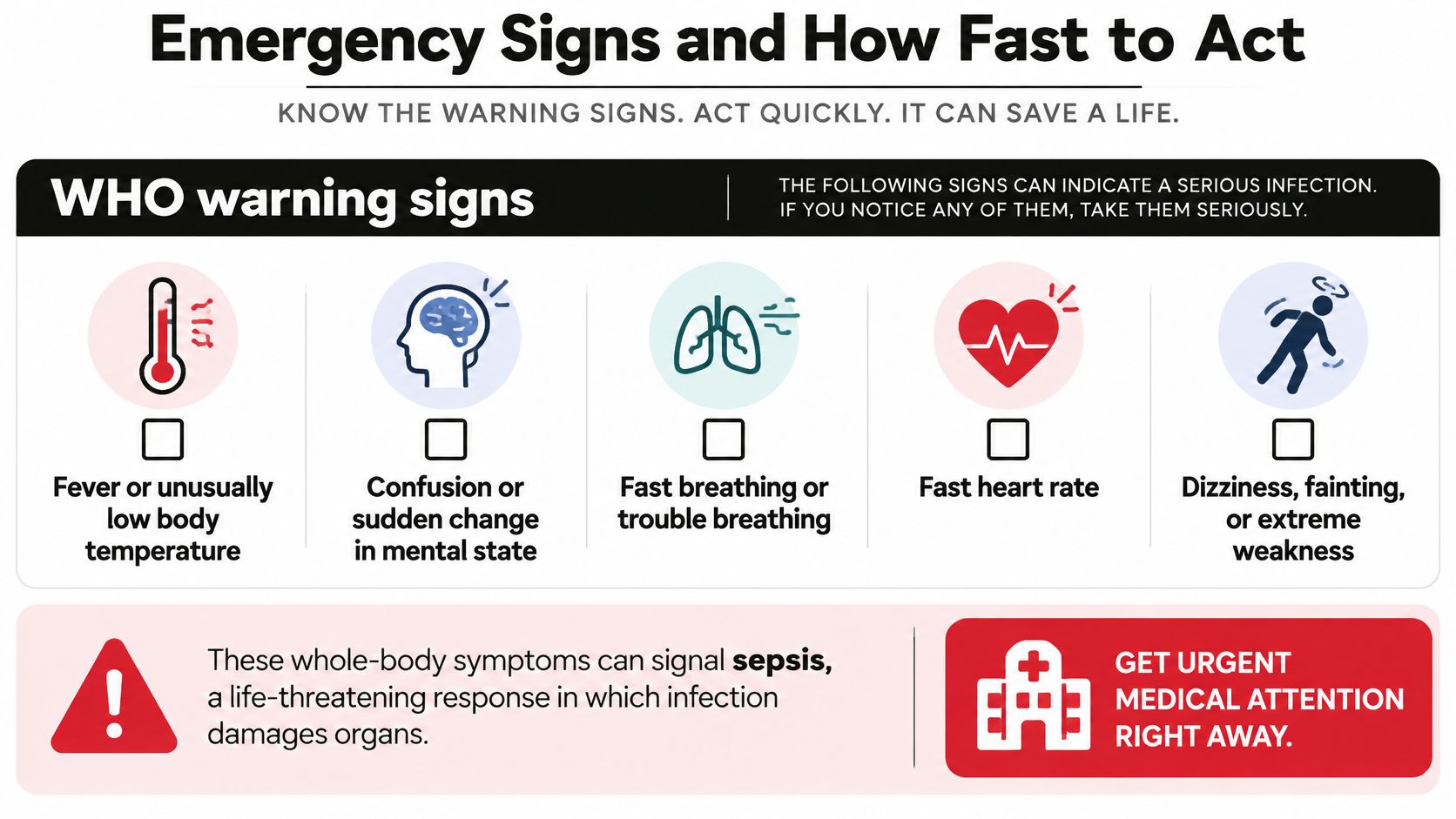
Recognize whole-body warning signs
Sepsis is a life-threatening response to infection involving organ dysfunction. The World Health Organization's sepsis fact sheet reports an estimated 48.9 million cases and 11 million sepsis-related deaths worldwide in 2017.
Warning signs include:
- Temperature changes: Fever, an unusually low temperature, or shivering.
- Breathing changes: Fast breathing or difficulty breathing.
- Circulatory changes: A fast heart rate, weak pulse, low blood pressure, or cold extremities.
- Mental changes: New confusion or a sudden change in alertness.
- Other deterioration: Clammy skin, severe body pain, or reduced urine output.
A person doesn't need every symptom, and fever may be absent. Pale or mottled skin, worsening confusion, or much less urine than usual can be important even when a thermometer reading seems reassuring.
Look beyond surface redness
Deep infection can require more than a dressing change. The IWGDF classification guideline identifies concerning findings including rapidly expanding inflammation, pain out of proportion to appearance, crackling beneath the skin, discoloration, blisters, exposed bone, persistent undermining, and dead tissue.
Undermining means a pocket extends beneath the wound's skin edge. Don't probe a wound yourself to check its depth or look for bone. A clinician may need imaging, surgical assessment, or a properly collected tissue or bone sample to investigate a deep abscess, bone infection, or other serious problem.
Don't wait for a wound to look dramatic when the person's breathing, circulation, or mental state is changing.
For stable wounds, conservative treatment remains the foundation. Our escalation pathway begins with conservative care, recognizes when progress stops, uses virtual consultation for surgical judgment, and moves directly to care when intervention is appropriate. Suspected emergencies bypass routine scheduling; moderate or severe infection may require early surgery with antibiotics to remove infected or dead tissue.
How Clinicians Confirm an Infected Wound
Clinicians diagnose wound infection through the history, examination, and overall clinical picture. A laboratory result can support that judgment, but it can't replace it.
For diabetes-related foot wounds, the IWGDF/IDSA infection guideline defines local infection using at least two inflammatory findings, including swelling or hardening, localized tenderness or pain, increased warmth, pus, or redness extending more than 0.5 cm but less than 2 cm around the wound, after alternative causes are excluded.
Those alternatives matter. Trauma, gout, fracture, blood clots, venous stasis, and acute Charcot changes can produce findings that resemble infection. The criteria were developed for diabetes-related foot infection, so they shouldn't become a home diagnostic checklist for every wound type.
What the examination establishes
The clinician assesses how far inflammation extends, how deep the wound is, and which tissues are involved. They also look for undermining and evaluate the person's whole-body condition before classifying severity.
Nerve damage, poor circulation, and impaired immune responses can make familiar symptoms less obvious. A new combination of warmth, firmness, drainage, and changing wound edges may therefore be more informative than whether the person reports pain.
At our practice, we review the history, wound, imaging, and treatment response virtually. A surgical wound care nurse then validates the wound in person to confirm what was seen. Video and photographs support assessment, but they don't substitute for every part of a hands-on examination.
What to bring to the appointment
Make a short record that someone unfamiliar with the wound can understand:
- A symptom timeline: When the change began and whether it spread, settled, or returned.
- Photographs: Dated images that show the wound and surrounding skin.
- Temperature readings: Include when they were taken and any accompanying symptoms.
- Medication information: Current prescriptions, recent antibiotics, and medication allergies.
- Relevant health history: Diabetes, reduced sensation, circulation problems, and previous wound treatment.
Bring the dressing instructions or care plan if you have them. Explain what has been used, including any missed treatments or practical difficulties with pressure relief. This helps the clinician distinguish a possible infection from other reasons healing has stalled, without blaming the patient or caregiver.
Why Signs Hide in Diabetes, Neuropathy and Frailty
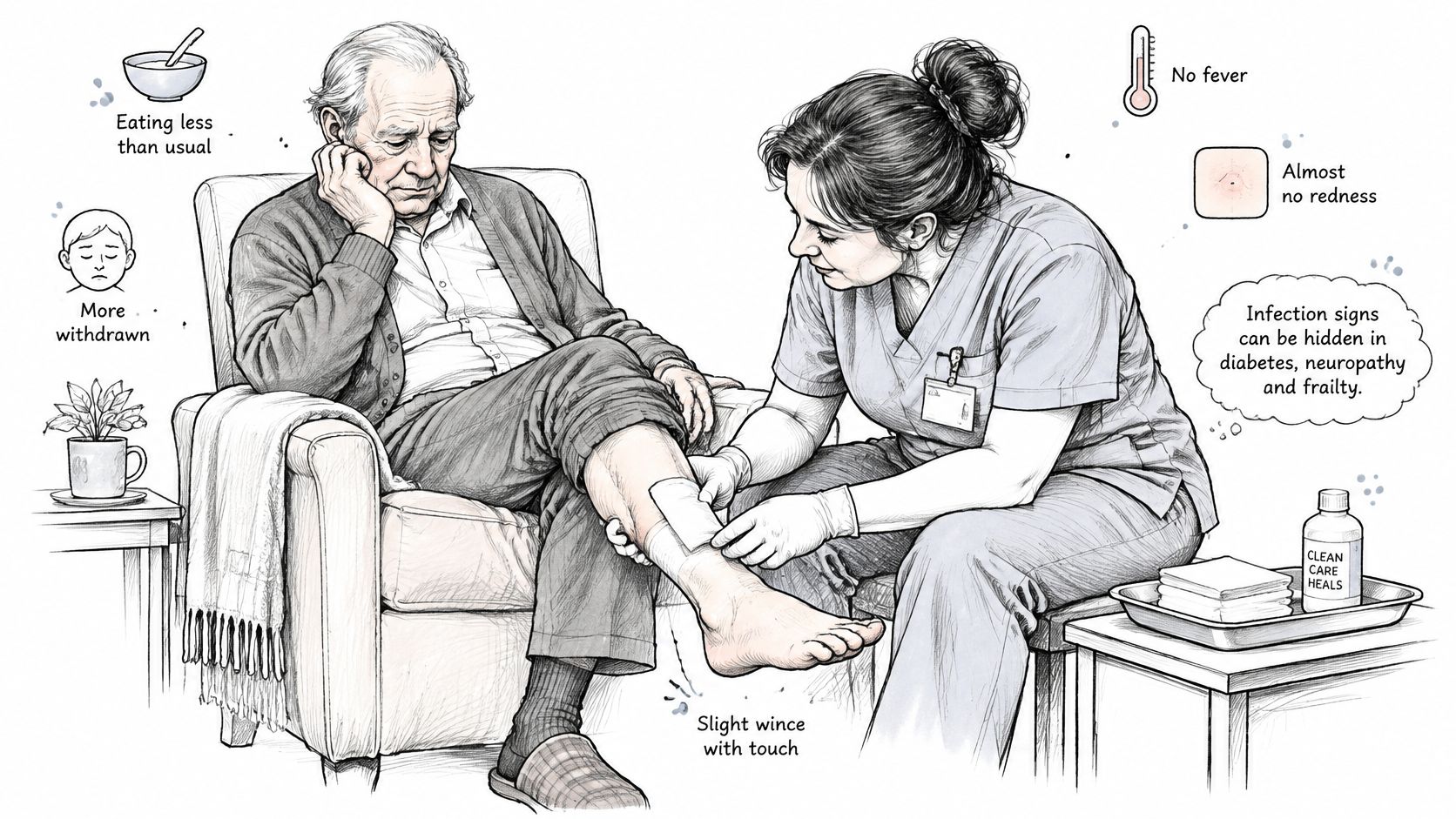
An older relative with diabetes is quieter than usual during a dressing change. They say the wound doesn't hurt, but they pull their leg away when you touch nearby skin. There's little visible redness and no obvious fever, yet the dressing is wetter than it was before.
That scenario doesn't establish infection. It does show why the person's usual behavior and the wound's baseline matter when classic symptoms are unreliable.
Notice quieter changes
Nottinghamshire NHS wound infection guidance identifies altered behavior, nonverbal pain, fragile or bleeding granulation tissue, wound-bed discoloration, altered tenderness, and delayed healing as potentially important findings. These can be particularly useful observations when someone can't reliably feel or describe pain.
Watch for changes that are easy to overlook:
- Pain behavior: Wincing, guarding the limb, or resisting care that was previously tolerated.
- Tissue changes: Repair tissue becomes fragile, bleeds easily, changes color, or grows excessively above the wound surface.
- Wound structure: New pockets or spaces develop at the edges.
- Fluid changes: More drainage reaches the dressing, or its character or odor changes.
- Daily function: The person behaves differently or becomes less willing to move or participate in care.
Build a usable baseline
At planned dressing changes, record the wound's appearance and drainage using the same simple terms. Take photographs from a consistent angle and under similar lighting, with consent, and store them securely. Follow the wound team's instructions for measuring rather than touching or probing the wound unnecessarily.
Write down the first day something differs. A brief note such as “usually comfortable during dressing removal, now pulling away” preserves information that a photograph can't show.
Caregiver insight: “No pain” is less reassuring when the person has reduced sensation. Compare behavior and tissue changes with what's normal for them.
Trends help, but don't wait through repeated checks when a concerning change appears. Seek same-day clinical advice for new pain behavior, sudden behavioral change, or clear wound deterioration. Sudden confusion or severe illness requires emergency assessment.
What a Positive Swab Does and Does Not Prove
A swab shows bacteria, the wound smells unpleasant, and healing has stalled. For a caregiver, those clues may seem to point to infection, especially when the person cannot describe how they feel. A positive swab alone does not establish a clinically significant infection.
Colonization means bacteria are present without causing active infection. Clinicians interpret a result alongside the wound's appearance, changes over time, the person's overall health, and other clinical signs.
Read the result in context
A wound-care document discussing NICE guidance describes infection as a clinical judgment based on signs, symptoms, and the wound's history. It also notes that persistent drainage, fragile repair tissue, low-level redness, ongoing inflammation, or failure to heal may warrant reassessment.
These features cannot confirm biofilm by sight alone. They do show why one swab result should not dictate treatment. The clinician can consider the wound's condition, possible underlying causes, and whether a sample would help guide care.
Use testing to answer a clinical question
- Assess the whole picture: Compare the wound and the person's condition with their usual baseline.
- Sample when indicated: How a sample is collected and what tissue is sampled affect how useful the result may be.
- Review stalled healing: If progress stops, ask the treating team to reassess rather than changing antibiotics independently.
Ask whether a test would change the treatment plan. Information about molecular testing in wound care may help frame that conversation, but any result still needs interpretation alongside the examination.
Do not start leftover antibiotics or use someone else's prescription. If antibiotics are prescribed, follow the directions and contact the prescriber if symptoms worsen or expected improvement does not occur.
Next Steps and When to Involve a Wound Specialist
Start with the person, then the wound. If they're acutely confused, struggling to breathe, or showing signs of circulatory deterioration, call emergency services rather than arranging a routine wound appointment. If they're otherwise stable but the wound is spreading, breaking down, or becoming more painful, seek same-day clinical advice.
For a wound that remains stalled without an immediate emergency, specialist review can help determine why the current plan isn't producing progress. Repeated reopening, persistent undermining, dead tissue, or exposed tendon or bone deserve assessment rather than indefinite dressing changes.
Prepare for a useful review
Keep your photographs, symptom timeline, temperature readings, medication list, and relevant health history together. Add the current dressing plan and explain any difficulty with pressure relief, mobility, or carrying out treatment at home. A concise handover helps the receiving clinician understand what needs attention.
- Clarify the concern: Say whether you're calling about possible infection, stalled healing, or a new structural change.
- Describe treatment response: Explain what improved, what didn't, and what has recently worsened.
- Identify the next contact: Know who to call if symptoms change before the appointment.
Our advanced wound care approach includes reviewing wounds that haven't improved despite appropriate treatment. We offer virtual consultations in which a wound surgeon reviews the patient's history, images, and wound by video, usually within days, while coordinating with existing providers.
An evaluation doesn't automatically lead to surgery. Individual results vary with wound type, health history, and care plan; the purpose of assessment is to identify the level of care that's clinically appropriate.
---
Wound Services offers virtual and in-person specialty evaluation for complex, stalled, and recurrent wounds, with surgical care considered when appropriate. If you're concerned about changing signs of infection or a wound that isn't progressing, visit Comprehensive Wound Services to request an evaluation and share your wound history and photographs. Don't wait for a scheduled consultation if emergency symptoms develop.