
You're changing a dressing when you notice more drainage than yesterday. The skin feels warmer, the sore area seems wider, and your relative doesn't want breakfast. Their temperature is normal, so you wonder whether it's safe to wait for the next wound appointment.
Signs of infection spreading are best judged by what's changing, how quickly it's changing, and how the person is functioning. A wound's appearance matters, but so do worsening pain, reduced mobility, unusual sleepiness, and changes in urination. Home observations can help a clinician make decisions, but they shouldn't delay care when someone is deteriorating.
## Table of Contents - Emergency Signs That Need Care Right Away - Spreading infection signs and the action for each - Why a small-looking wound can still be dangerous - How Local Wound Changes Reveal Spreading Infection and What to Track at Home - Compare the wound with the person - Keep a practical home log - Body-Wide Signs of Sepsis and Severe Infection - Systemic severity thresholds for wound infection - Look beyond the thermometer - Why Infection Signs Are Easy to Miss - What looking alone can miss - Use function when appearance is uncertain - When a Wound Is Not Improving on Treatment - Separate infection response from wound closure - Why the same treatment may not be enough - Deciding Whether to Call, Visit or Go to the Emergency Room - Choose the appropriate action - What specialty assessment can add
Emergency Signs That Need Care Right Away
A wound that worsens rapidly over hours, or a wound accompanied by serious body-wide symptoms, needs emergency assessment rather than the next routine appointment. Don't wait for every warning sign to appear. Severe pain or a sudden change in skin color can be enough to justify immediate care.
The Infectious Diseases Society of America skin and soft-tissue infection guideline recommends prompt surgical consultation when clinicians suspect an aggressive infection with systemic toxicity, necrotizing fasciitis, or gas gangrene. Necrotizing infection means an infection that destroys tissue.
Spreading infection signs and the action for each
| Sign | What It May Indicate | What to Do |
|---|---|---|
| Pain much greater than the visible wound | Deep or necrotizing infection | Emergency assessment now |
| Rapidly spreading redness or swelling | Infection extending through tissue | Emergency assessment now |
| Dusky, blistered, dark, purple or gray skin | Tissue injury from poor blood supply or necrosis | Emergency care now |
| Numbness in the affected area | Deep tissue involvement | Emergency care now |
| Crackling or crepitus under the skin | Gas in tissue | Emergency care now |
| Streaking redness running up the limb | Lymphangitis, infection tracking along lymphatic vessels | Same-day clinical review; emergency if fever or fast spread |
| Fever, shivering, confusion or fast breathing | Possible sepsis, especially when symptoms occur together | Emergency care now |
| Dizziness, fast heartbeat or low urine output | Possible sepsis or organ stress | Emergency care now |
| Increasing or foul-smelling drainage | Worsening infection | Same-day clinical review; emergency with any other red flag |
Why a small-looking wound can still be dangerous
Infection can travel along the layers of tissue beneath the skin. As blood supply becomes compromised, deeper tissue can become injured or die before the surface looks dramatically different. That's why pain far beyond what you'd expect from the visible wound is particularly concerning.
Crepitus means a crackling sensation caused by gas within tissue. Don't press repeatedly to look for it, and don't assume that new numbness means the wound is improving. Loss of sensation alongside worsening skin changes needs emergency attention.
Safety rule: Don't probe, cut, squeeze, or aggressively drain a concerning wound at home.
Emergency clinicians determine whether the person needs imaging, samples for testing, intravenous antibiotics, fluids, or an operation. These aren't decisions a photograph or home dressing change can settle.
Call emergency services or go to an emergency department when an emergency sign appears. Bring a written symptom timeline if it's readily available, but don't delay departure to prepare one.
How Local Wound Changes Reveal Spreading Infection and What to Track at Home
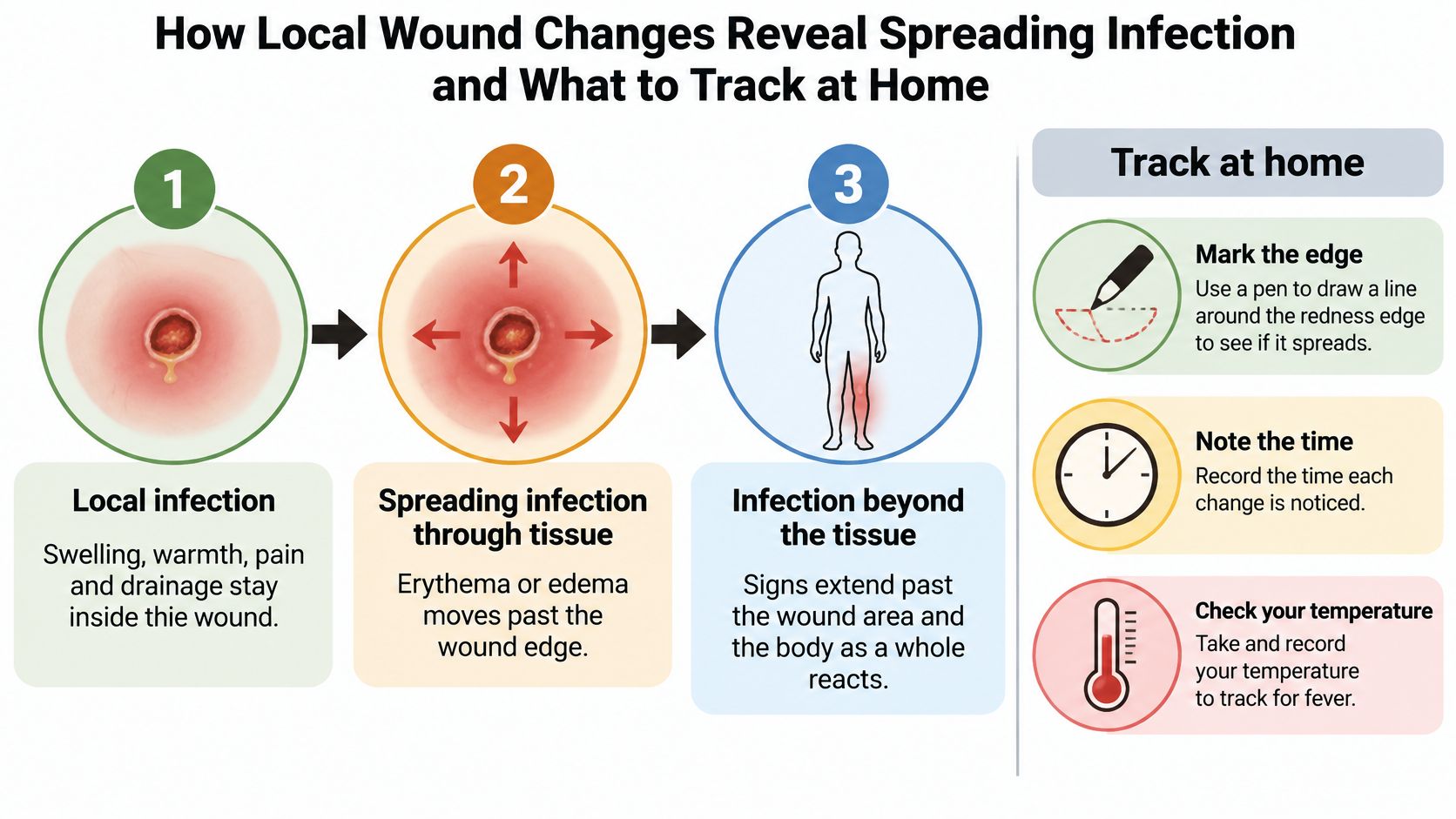
A wound's direction of change often tells you more than its appearance at a single dressing change. Compare the affected area with its previous condition, and compare the person's activity, appetite, and alertness with their usual baseline.
A systematic review of chronic-wound diagnostic studies associated spreading infection with extending redness or swelling, lymphangitis, worsening wound condition, malaise, lethargy, and appetite loss. Diagnostic performance varied, so no isolated finding reliably settles whether infection is spreading.
Compare the wound with the person
Local infection causes changes centered on the wound and immediately surrounding skin, such as warmth, tenderness, swelling, or pus. Local doesn't mean harmless, but it differs from a pattern that's moving outward.
Spreading tissue infection may produce advancing erythema, meaning redness, or edema, meaning swelling. Red streaks may indicate lymphangitis, inflammation involving the lymphatic vessels. Systemic involvement means the person's body is reacting beyond the wound area, with changes such as altered alertness or breathing.
These aren't predictable steps that everyone passes through. Someone can become seriously ill without an obvious sequence of skin changes.
Keep a practical home log
Use a notebook or shared digital record during routine checks. Don't postpone an appointment to collect more observations.
- Date and time: Record when each change began.
- Wound dimensions: Note visible length and width using the same method. Leave depth assessment to a trained clinician; never insert a tool.
- Skin boundary: If your clinician recommends it, mark intact skin at the redness edge and date it.
- Drainage: Describe the amount, color, thickness, and odor.
- Pain: Use a consistent rating and note pain during movement or rest.
- Temperature: Record the reading, not “normal.”
- Appetite and mobility: Note missed meals or new difficulty standing or walking.
- Alertness and urination: Document departures from the person's usual pattern.
Say a diabetic heel ulcer develops an advancing inflamed border, thicker drainage, and reduced appetite. That combination deserves prompt clinical review, not another photograph alone. By contrast, a sacral wound that remains unchanged across repeated visits may need specialist reassessment even without an acute infection pattern.
Our remote wound-monitoring guidance explains how records can support communication between visits. Patients may optionally share photos with our care team through Vorra, a separate photo-log service requiring a mobile-number sign-in and Vorra's consent. Sending photos doesn't book a visit.
CWS identifies eight reasons to consider surgical evaluation: no measurable size reduction; dead tissue; persistent undermining, or pockets beneath the wound edge; infected tissue or recurrent cellulitis; exposed tendon or bone; persistent slough, or nonviable tissue covering the wound; recurrent breakdown; and minimal improvement despite appropriate care. Conservative treatment remains the foundation, but a stalled wound deserves another look.
Body-Wide Signs of Sepsis and Severe Infection
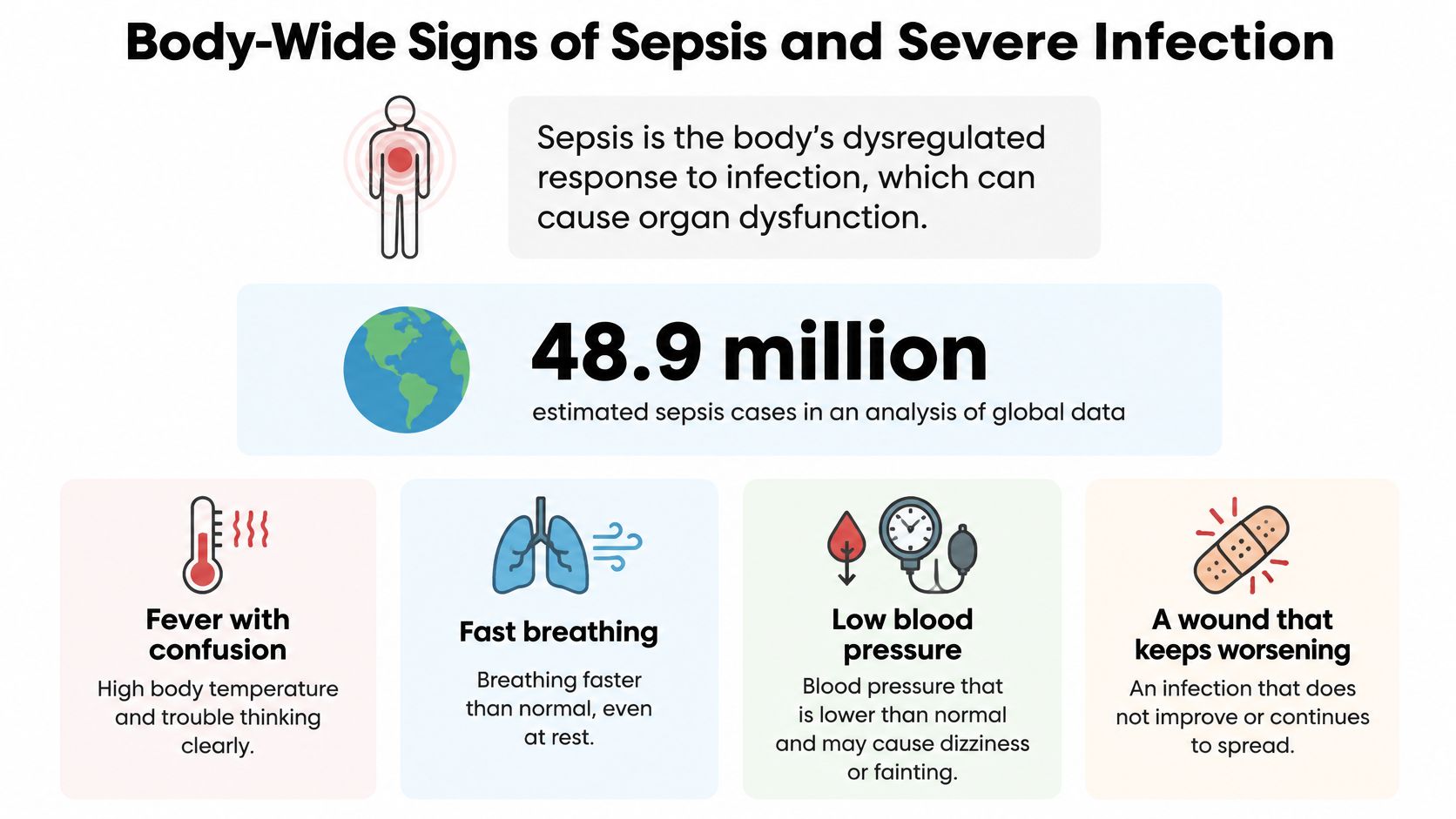
Sepsis is the body's dysregulated response to infection causing organ dysfunction. In plain language, the response to an infection starts harming the body's own organs. It isn't another name for pus, fever, or bacteria in the bloodstream.
The World Health Organization's sepsis fact sheet reports that Global Burden of Disease researchers estimated 48.9 million sepsis cases worldwide in 2017 and 11.0 million sepsis-related deaths, representing 19.7% of all global deaths.
Systemic severity thresholds for wound infection
The following concerning values are drawn from the infection-severity criteria summarized in the NICE diabetic-foot guidance: temperature above 38°C or below 36°C, heart rate above 90 beats per minute, breathing rate above 24 breaths per minute, and white blood cell count above 12,000/µL or below 400/µL.
| Measure | Concerning Value | Basis |
|---|---|---|
| Temperature | Above the upper or below the lower limit stated above | Severe infection criteria |
| Heart rate | Above the stated threshold | IDSA severity criteria |
| Breathing rate | Above the stated threshold | IDSA severity criteria |
| White blood cell count | Outside the stated limits | IDSA severity criteria |
| Mental status | New confusion or drowsiness | Escalation sign with no fixed number |
These values are clinical warning indicators, not a home test that confirms or excludes sepsis. A clinician interprets them alongside the examination, medical history, and other tests. White blood cell count requires a blood test and isn't something caregivers can assess by looking at the wound.
Look beyond the thermometer
A person with a wound infection may develop shivering, marked weakness, clammy skin, a weak pulse, low blood pressure, shortness of breath, or reduced urine output. New confusion can look like difficulty following a conversation, unusual behavior, or an inability to stay engaged.
An unusually low temperature matters too. Don't treat the absence of a high reading as permission to ignore other signs of serious illness.
At routine checks, record temperature, pulse, breathing, wound measurements, the skin boundary, and mental state when you can do so safely. The purpose isn't to gather a perfect set of numbers. It's to recognize deterioration and communicate clearly.
For someone with a diabetic foot ulcer, fever or symptoms of sepsis require immediate hospital assessment, particularly when deep infection or impaired blood supply is suspected. Sepsis itself isn't contagious, although the infection causing it may be transmissible depending on its cause.
Why Infection Signs Are Easy to Miss
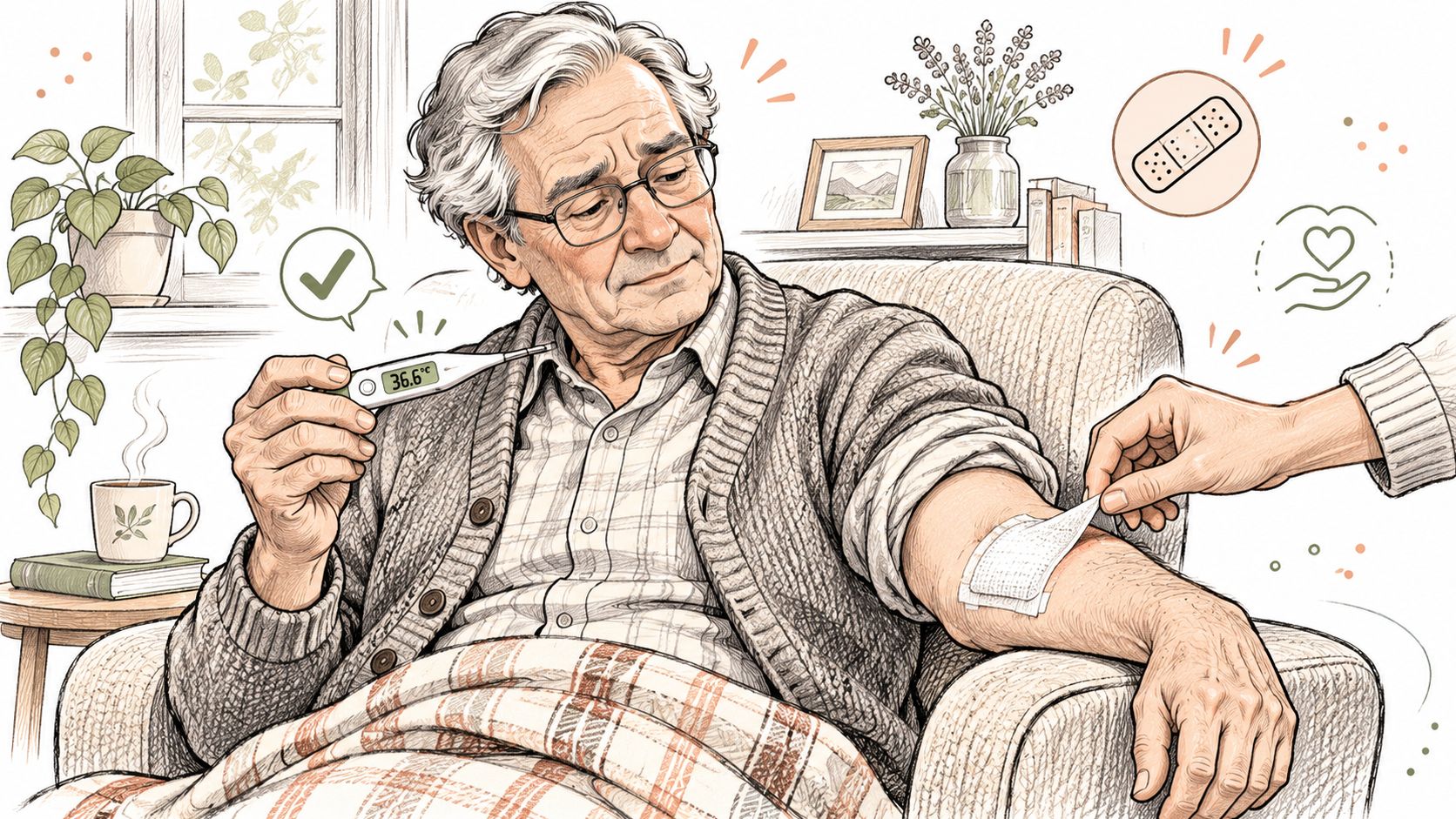
A normal temperature and a clear photograph don't rule out a serious wound infection. Older adults and people with weakened immune responses may not develop an obvious fever. Redness may also be difficult to distinguish on darker skin, making warmth, swelling, tenderness, and drainage especially important observations.
What looking alone can miss
A 2025 wound-assessment study reported that autofluorescence imaging detected clinically significant wound bioburden in 74.5% of wounds, compared with 52.5% under standard practice. Bioburden means the microorganisms present in a wound; detecting them isn't the same as diagnosing sepsis or proving deep infection.
The useful lesson isn't that everyone needs a specialized device. It's that even an apparently careful visual assessment can miss information relevant to treatment.
A photograph can show changes in surface appearance, dressing saturation, and surrounding skin. It can't reliably establish what's happening beneath an edge, whether a deeper pocket is infected, or how well blood reaches the tissue. Nor can a wound image establish whether the person is systemically ill.
A better photograph can improve communication. It can't make an unsafe situation safe to monitor at home.
Use function when appearance is uncertain
Compare the person's behavior and abilities with their baseline rather than expecting a textbook picture.
- Movement: New inability to bear weight or move normally needs prompt assessment.
- Interaction: Declining alertness or difficulty staying awake is an emergency concern.
- Daily intake and output: Reduced drinking, appetite, or urination adds important context.
- Speed: Rapid expansion matters even when the exact color boundary is hard to see.
Biofilm, a community of microorganisms attached to a surface, is another source of confusion in chronic wounds. You can't reliably identify it from a photograph or a home checklist.
Virtual review is useful for triage, reviewing treatment response, and coordinating an examination. If the concern involves deep tissue, uncertain blood supply, or a worsening wound that needs hands-on assessment, an in-person visit is necessary. Serious body-wide symptoms require emergency care, not a wait for a video appointment.
When a Wound Is Not Improving on Treatment
Clinical worsening despite treatment is itself a reason to escalate. Taking an antibiotic or using a prescribed dressing doesn't guarantee that the underlying problem is controlled. Finishing a course isn't the same as the wound improving.
At the start of treatment, agree with the treating clinician on what improvement should look like and when reassessment must happen. Use a dated improvement clock based on that plan, rather than an assumed universal waiting period.
Separate infection response from wound closure
Improvement in infection may mean less pain, less surrounding inflammation, and decreasing drainage. Complete wound closure is a different process and shouldn't be expected on the same timetable.
Watch for these signs that the plan needs review:
- Outward progression: The inflamed boundary advances or swelling increases.
- Uncontrolled symptoms: Pain rises or drainage becomes thicker or more abundant.
- Tissue deterioration: New dusky areas or dead tissue appear.
- Declining health: Fever returns, appetite falls, or alertness and urination change.
- Stalled healing: Repeated measurements show no progress despite appropriate care.
Don't change antibiotics, add leftover medication, or stop prescribed treatment on your own. Contact the treating clinician so they can reassess the cause and adjust the plan safely.
Why the same treatment may not be enough
An antimicrobial may not cover the organism involved. A pocket of pus may require drainage, or a deeper infection may need a different approach. Poor blood supply, pressure on the wound, and underlying illness can also prevent progress despite appropriate surface care.
An examination helps distinguish these possibilities. The clinician may consider a culture, imaging, assessment of circulation, or removal of nonviable tissue rather than repeating the original prescription.
Treatment checkpoint: Worsening overrides the planned review date. Stable but unimproved symptoms still deserve contact by the clinician's agreed checkpoint.
For a wound that remains stalled across visits, our advanced wound-care approach preserves conservative care while assessing whether another level of treatment is appropriate. Bring the home log, medication names, exact treatment start dates, and details of dressing or pressure-relief changes to that review.
Deciding Whether to Call, Visit or Go to the Emergency Room
Choose the level of care according to severity and speed, not how convenient the next appointment happens to be. Don't wait for a wound to look dramatically worse before reporting a meaningful change.

Choose the appropriate action
- Emergency now. Call emergency services or go to an emergency department for rapidly destructive changes, disproportionate pain, serious breathing difficulty, confusion, faintness with deterioration, or other signs of possible sepsis. Don't wait for an outpatient response.
- Same-day clinical contact. Call the treating team for gradually spreading inflammation, increasing drainage, new odor, or worsening local symptoms without emergency features. Explain what changed and when, rather than saying only that the wound “looks infected.” Fever with a diabetic foot ulcer requires immediate hospital assessment.
- Scheduled specialist review. A stable but stalled or repeatedly reopening wound needs reassessment of the treatment strategy. Any one of CWS's surgical-evaluation indicators is enough to ask for an evaluation, but the appointment doesn't automatically lead to surgery.
If you can't reach the treating team and the condition continues to worsen, seek urgent in-person care. A message left in a portal isn't confirmation that someone has reviewed the situation.
What specialty assessment can add
At Wound Services in Washington, DC, our virtual consultation process allows a wound surgeon to review the patient's history, images, and wound by video, usually within days. An in-person assessment can follow when needed. That process is intended for specialty evaluation, not emergency stabilization.
Our wound-care escalation pathway connects evaluation with intervention when clinically appropriate and coordination with the existing care team. Conservative treatment remains the foundation, and individual results vary with wound type, health history, and care plan.
Bring the home log to every visit, along with the current medication list and treatment dates. Before the appointment ends, make sure you understand who to contact for deterioration, what changes should trigger a call, and when the wound will next be reassessed.
---
Our Wound Services team offers virtual and in-person specialty evaluation for complex, stalled, and recurrent wounds, with treatment coordinated alongside your existing care team. If your wound isn't progressing, visit Comprehensive Wound Services to request an evaluation and share your treatment history and symptom log. If emergency signs are present, seek emergency care rather than waiting for a consultation.