Current smokers had an adjusted odds ratio of 3.60 for tissue necrosis compared with nonsmokers, more than three and a half times the odds, in a 2012 systematic review and meta-analysis published in JAMA Surgery. That same review found adjusted odds of 2.07 for delayed healing or wound dehiscence, 1.79 for surgical-site infection, 2.27 for overall wound complications, and 2.44 for failure of fistula or bone healing.
Those figures are about groups of surgical patients, not a verdict on one wound. Smoking and wound healing still belongs in the same conversation as dressings, infection checks, and whether a procedure can wait. A longer break from cigarettes helps more. A shorter break still counts. A stalled wound should be reviewed while quitting support starts, not after a perfect abstinence date.
## Table of Contents - Smoking and Wound Healing Odds at a Glance - Five outcomes, side by side - How to read an odds ratio - How Smoke Starves Repair and Raises Infection Risk - Jobs that need oxygen - What fracture operations add - What to write down at the next check - When Quitting Still Helps Before a Procedure - Windows you can actually use - Elective timing versus a worsening wound - Vaping Gum and Other Nicotine While Healing - Smoke-free is not risk-free - Wound Findings That Need a Specialty Look - How review actually runs - Ask for Cessation Support and Wound Review
Smoking and Wound Healing Odds at a Glance
The scale shows up before anyone debates a single cigarette. Across surgical specialties, people who were still smoking had higher odds of both infectious and noninfectious healing problems than people who did not smoke. Former smokers generally fared better than people who kept smoking. Four randomized controlled trials in that review, covering 416 patients, reported combined healing complications in 15.9% of participants, or 66 patients.
Five outcomes, side by side
| Complication | Adjusted odds ratio | Plain reading |
|---|---|---|
| Tissue necrosis | 3.60 | More than three and a half times the odds |
| Delayed healing or wound dehiscence | 2.07 | About twice the odds |
| Surgical-site infection | 1.79 | Nearly 80 percent higher odds |
| Overall wound complications | 2.27 | More than double the odds |
| Failure of fistula or bone healing | 2.44 | More than double the odds |
Necrosis is the starkest row. Tissue at a suture line, flap, or graft edge can die when blood and oxygen fall short. Dehiscence means the closed wound pulls apart. Infection is more common too, though the jump is smaller than the jump for dead tissue. Fistula and bone findings matter because the pattern is not limited to skin. A person healing a pressure injury and a person healing an operative incision are not the same case, and individual results vary with wound type, health history, and the care plan.
How to read an odds ratio
An odds ratio of 2.07 means a bit more than twice the odds of that complication in the smoking group versus the nonsmoking group. It is not a promise that this wound will split, and it is not a percent chance for one person.
Plain reading: Treat the ratio as a risk flag for the care team, not as a forecast printed on your chart.
Say two neighbors have similar operations. One still smokes a pack most days. The other quit years ago. The neighbor who still smokes sits in the higher-odds group for necrosis, separation, and infection. The neighbor who quit is not guaranteed an easy recovery, but the review's pattern is that former smokers do better than current smokers. Age, diabetes, the operation itself, and how the wound is cared for still move the result.
Bring the smoking history to the visit the same way you would bring a medication list. Name cigarettes, cigars, smokeless tobacco, vapes, gum, and patches, plus the last time each was used. Ask for help stopping while dressing changes, pressure relief, and infection checks continue. The circulation story explains why those odds exist, and the calendar explains why quitting this week is still worth doing.
How Smoke Starves Repair and Raises Infection Risk
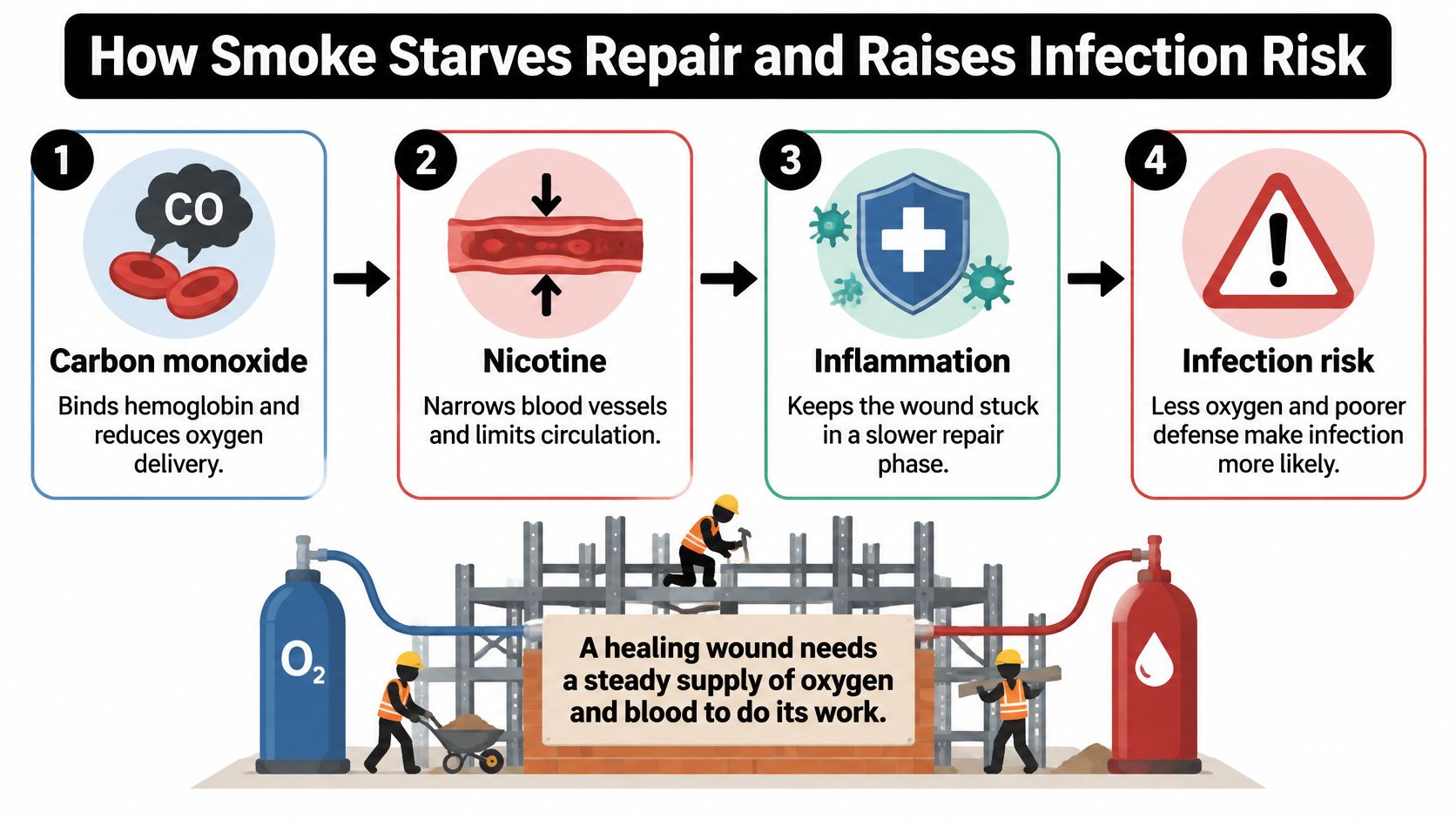
A healing wound works like a small construction site. Crews can frame, weld, and fight leaks only if trucks keep arriving with oxygen and supplies. Cigarette smoke interferes with that delivery in four overlapping ways, and nicotine accounts for only part of the damage.
A peer-reviewed account of these mechanisms, summarized on PubMed, lines the hits up in a set order.
Carbon monoxide binds hemoglobin, so less oxygen reaches the injury. Cigarette-smoke oxidants raise oxidative stress in tissue that is already working hard. Those first two hits come from combustion, from the smoke itself. Nicotine, a fast-absorbed alkaloid, can turn on the sympathetic nervous system, release catecholamines, narrow peripheral vessels, and leave a patch of local ischemia. Endothelial injury and thrombogenesis, along with thicker blood and more platelet clumping, further restrict the tiny vessels that feed the wound edge. Smoke products and nicotine act through different pathways, and each one costs the wound something.
Jobs that need oxygen
Those hits land on work that cannot run on a thin oxygen budget. White blood cells kill bacteria less effectively. Collagen needs hydroxylation to become strong. Fibroblasts, the cells that lay down repair tissue, slow down. New vessels, the angiogenesis step, form poorly. A wound can look clean at a dressing change and still fail to build granulation or move skin across the gap, because the edge is underfed.
Lab and clinical evidence associates smoking with weaker inflammatory and repair activity inside wound tissue. In practical terms, the wound lingers in the inflammatory phase and reaches the tissue-building phase late. That slow handoff between phases, rather than any single dressing choice, explains much of why similar wounds can heal at different speeds.
What fracture operations add
Soft-tissue experiments and bone operations point the same direction. A meta-analysis of 17 studies and 14,365 patients, reported in eClinicalMedicine00459-4/fulltext), found smokers had about twice the odds of deep surgical-site infection after fracture treatment, with an odds ratio of 2.04 and a 95% confidence interval of 1.68 to 2.48. People who kept smoking had 2.70 times the odds of postoperative wound infection compared with patients who had stopped for at least four weeks before surgery.
Repair is an oxygen-hungry job. Every cigarette narrows the supply line that feeds it.
What to write down at the next check
Marginal perfusion is why a wound can be washed, covered, and offloaded and still stall. A useful note captures more than "patient smokes."
- Exposure: current cigarettes, vaping, or other nicotine use, including roughly how much.
- Trajectory: whether the wound is smaller, unchanged, or larger over recent weeks.
- Tissue: viable edges versus dusky, black, or non-bleeding areas.
- Infection: new drainage, odor, spreading redness, or fever.
- Perfusion: pulses, color, temperature, and any vascular testing already done.
Persistent necrosis, undermining, exposed structures, or no improvement despite appropriate care should trigger a specialty reassessment while cessation support starts. Whether a nicotine replacement product fits the plan is a separate decision from whether someone keeps inhaling smoke, and both belong in the note.
When Quitting Still Helps Before a Procedure
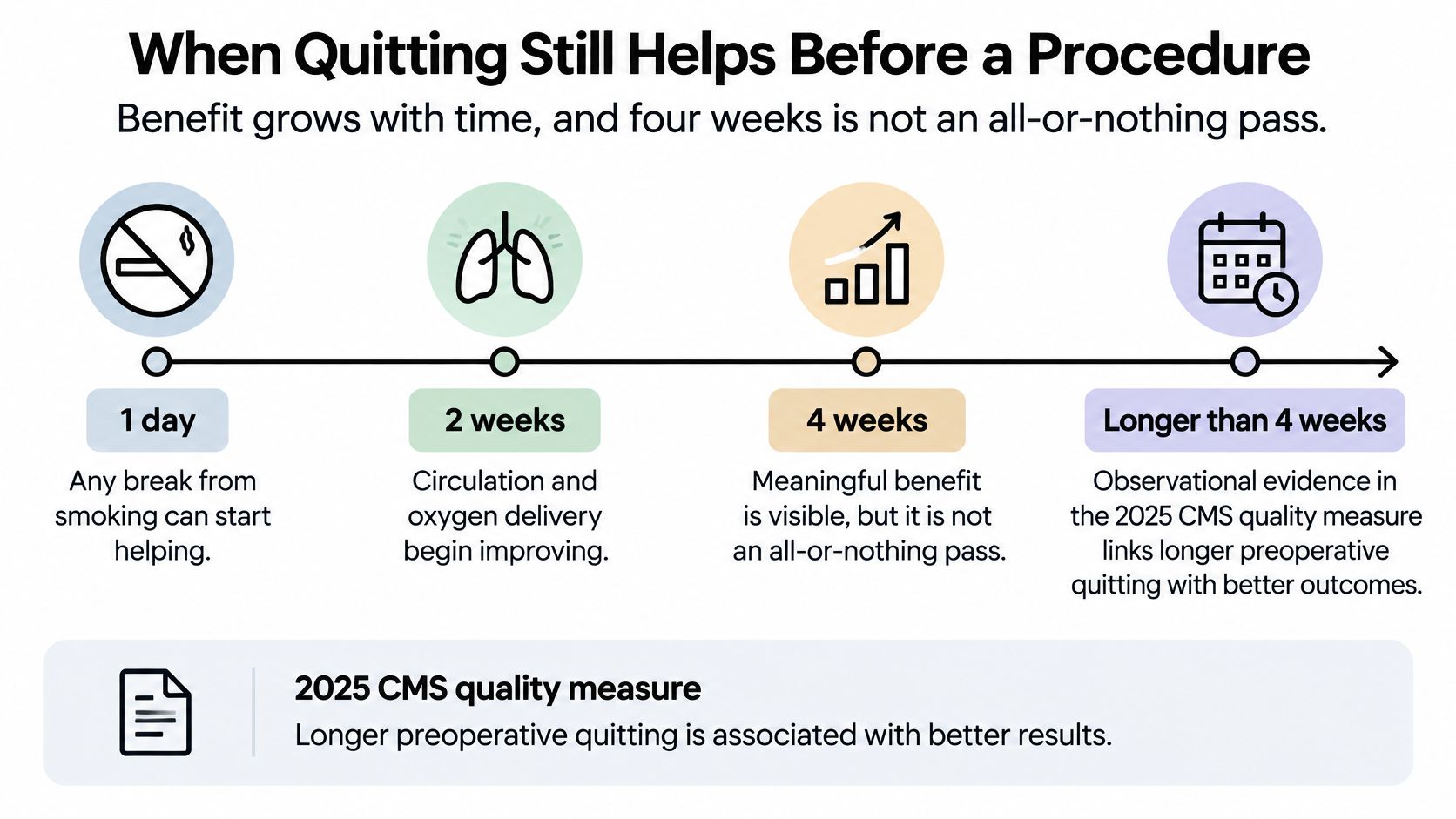
Patients often ask how long they need to stop before a wound procedure, and whether quitting still helps when the date is close. It does. The benefit builds with each smoke-free week, so a shorter run still counts. The preoperative window works more like a dimmer than a switch: quitting late adds less benefit than quitting early, and it adds real benefit all the same.
The 2025 CMS quality measure states that observational evidence links longer preoperative abstinence with fewer respiratory and wound-healing complications. Randomized trials cited in the measure support cessation interventions lasting 4 to 8 weeks. It also states that interventions can begin at any point before or after surgery without increasing complication rates.
Windows you can actually use
| When smoking stops | What guidance supports | What to do with the wound |
|---|---|---|
| Today, even if surgery is within days | Support can start at any point before or after surgery without raising complication rates | Still quit, and do not delay urgent assessment |
| About 4 to 8 weeks before an elective procedure | Randomized trials support cessation interventions of this length | Use this window when the procedure can safely wait |
| After the procedure | Cessation support can begin or continue after surgery under the same measure | Keep the quit plan going alongside wound care |
Quitting on a Monday when a procedure is Thursday is not wasted. A multi-week program delivers more, and a last-minute quit delivers less. Neither extreme decides whether the wound gets examined. Support after the operation matters alongside the weeks before it, and the same measure treats postoperative starts as safe.
Elective timing versus a worsening wound
For an elective procedure that can safely wait, use the longest realistic smoke-free run, ideally the 4 to 8 week window the trials support. Tell the scheduling team the quit date so anesthesia, wound care, and follow-up line up.
For a complex or worsening wound, do not hold specialty review until that date arrives. Waiting can prolong infection, necrosis, undermining, or tissue loss. Smoking status does not, by itself, decide conservative care versus surgery. A surgical wound evaluation looks at the wound in front of the team rather than a calendar checkbox.
If the wound is getting worse, the quit plan and the exam start together.
Disclose cigarettes, cigars, smokeless tobacco, and any nicotine product, including the last time each was used. Smoke and nicotine are different exposures, and the team needs the full list to plan oxygen, infection surveillance, and counseling without guessing.
Vaping Gum and Other Nicotine While Healing
Switching products is not a free pass, and stopping every form of nicotine is a different decision from stopping cigarettes. Neither choice should be settled by a blog post. It belongs in a conversation with the clinician managing your wound.
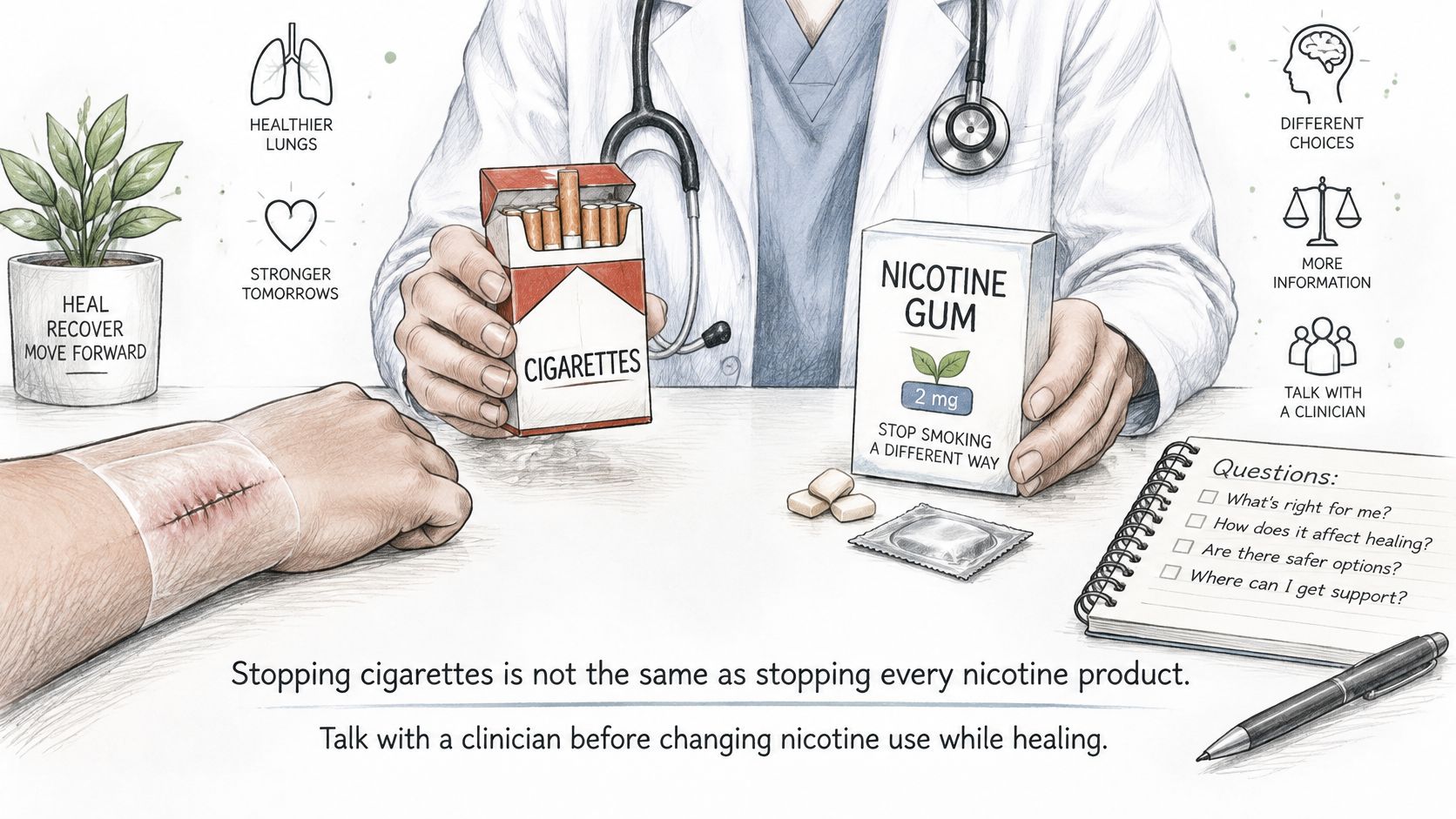
MedlinePlus advises stopping smoking and other nicotine products, including e-cigarettes, before surgery, because nicotine can interfere with surgical-wound healing, and it does not encourage nicotine gum around surgery for the same reason. Research on nicotine and wound repair is still developing, and its findings do not set the same level of risk for every product or every person.
Smoke-free is not risk-free
Combustible cigarettes deliver carbon monoxide and a long list of toxic combustion products on top of nicotine. Vaping and nicotine replacement carry different exposures, which is why a clinician may weigh them differently from a pack-a-day habit. For some people they are the practical route off cigarettes. That does not make them harmless. Vapor still contains nicotine, and gum or patches are not automatically safe beside a fresh incision just because they are sold as quit aids.
The key decision balances nicotine-related healing concerns against relapse, withdrawal, mental health, and the urgency of the wound. A person who goes back to smoking a pack a day after a difficult nicotine-free week may be worse off than someone following a planned replacement. A person preparing for elective flap surgery might also be asked to pause the gum. Both choices can be reasonable. Only the clinician familiar with the wound and medications can determine which is appropriate.
Write the details down before the visit.
- Product: cigarette brand pattern, cigar, chew, vape device, gum, lozenge, or patch.
- Dose: milligrams on the gum or patch, pods per day, or cigarettes per day.
- Frequency: steady all day, or clustered at night and after meals.
- Timing: the clock time of the last use, not "recently."
That list turns a vague "I quit" into numbers the team can plan around. Do not hold review of a stalled or possibly infected wound while the product question gets sorted. A worsening wound does not wait for a perfect switch date. Bring the list, and let the clinician coordinate cessation support around it.
Wound Findings That Need a Specialty Look
A practical stall test is simple. A wound that should be getting smaller over a few weeks is not, or it closes and then reopens. Shame about smoking should not keep that wound off a specialist's list.
We look for eight indicators that a wound may deserve surgical evaluation:
- No measurable size reduction. Length, width, and depth are unchanged after an appropriate trial of care.
- Necrotic or dead tissue. Black, brown, or firmly adherent dead tissue remains.
- Persistent undermining. A lip of skin hides a pocket that dressing changes do not reach.
- Infected tissue or recurrent cellulitis. Redness, drainage, or soft-tissue infection keeps returning.
- Exposed tendon or bone. Structures that should stay covered are visible.
- Persistent slough. Yellow or tan debris rebuilds after each cleaning.
- Recurrent wound breakdown. The site opens again after it seemed closed.
- Minimal improvement despite appropriate evidence-based care. Offloading, moisture balance, nutrition, and infection control are in place, and the wound still sits still.
These signs matter because marginal blood supply and oxygen shortfalls leave tissue unable to fill, cover, and stay closed. Results still depend on wound type, health history, and the plan already tried.
How review actually runs
We specialize in complex, stalled, and surgically appropriate wounds. Review has two steps, and neither step is an automatic trip to the operating room.
First, a wound surgeon reviews the history, the wound, imaging, and treatment response virtually. Second, a surgical wound care nurse validates the wound in person to confirm what was seen, so the plan matches the wound that is there. Conservative care stays the base when it is working. Surgery is considered only when it is clinically appropriate.
Start cessation support at the same time as that reassessment, not after a quit date is met. Caregivers, home-health nurses, and facility staff can request this review through our escalation pathway without waiting for a completed quit attempt.
Ask for Cessation Support and Wound Review
You can use a short script today. You do not need perfect wording.
Step 1. Tell the clinician exactly what is used, how much, and when it was last used. Cover cigarettes, cigars, smokeless tobacco, vapes, gum, and patches.
Step 2. Ask for cessation support alongside wound treatment, not instead of it, and ask that it continue after any procedure. Name what you want considered: behavioral counseling, a quitline, and medication options the clinician is willing to discuss. You are asking for a plan, not confessing a failure.
Step 3. If the wound shows any stall sign, request specialty review now rather than after a quit date. Infection, dead tissue, and exposed structures do not pause while a counseling appointment is booked.
Step 4. One concrete route is our direct wound care service, which includes a referral path and virtual consultations. A wound surgeon reviews the history, images, and the wound by video, usually within days. Confirm current availability and timing with the practice. The surgeon who evaluates the wound is the surgeon who operates when intervention is appropriate, and who follows the healing after. Surgery is only considered when it is clinically appropriate.
This article does not replace advice from the treating clinician. Bring the exposure list, the wound measurements, and your questions to that visit.
---
If a wound is stalled, recurrent, or possibly surgical, Wound Services can review smoking history alongside perfusion, tissue viability, and whether conservative care is still the right base. Virtual and in-person evaluation, coordinated with your current clinicians, is available without waiting for a completed quit. Visit Comprehensive Wound Services to ask about a wound review and cessation support together.