
You're changing a dressing when you notice a gap where the incision edges used to meet. There may be a little pink fluid on the gauze, or the opening may look wider than it did earlier. It's unsettling, but the next step isn't to guess whether you need another operation. It's to get the wound's depth and warning signs assessed.
Surgical wound opening, also called surgical wound dehiscence, can involve the skin alone or the stronger layers beneath it. That difference determines how quickly you need help. A small-looking opening still deserves a call, and certain signs mean you shouldn't wait for a callback.
## Table of Contents - Urgent Signs After a Surgical Wound Opens - Work down the warning signs - Gather details without delaying care - Superficial Gaps Versus Deep Separation - Ask whether the fascia is intact - Understand what serious outcome figures mean - How Common Wound Opening Is After Different Surgeries - Reported wound opening rates by procedure - Use percentages as context, not reassurance - Why Some Wounds Open and Others Do Not - Factors you can help manage - Factors outside your control - How Clinicians Assess a Reopened Wound - What happens during assessment - Findings that deserve surgical review - Treatment Paths From Dressings to Surgery - Care pathway by clinical situation - Understand the treatment terms - Caring for the Wound While You Wait - Protect the area without manipulating it - Make changes easier to report - Choose Your Next Step Today - Prepare for the conversation
Urgent Signs After a Surgical Wound Opens
| Sign | What It May Indicate | How Fast to Act |
|---|---|---|
| Small gap, clear or pink drainage, no fever | Superficial skin separation | Call the surgical team the same day |
| Increasing separation, growing drainage, fever, spreading redness | Possible infection or deeper separation | Call promptly, don't wait for a routine visit |
| Worsening pain that does not settle | Possible infection, hematoma or deeper problem | Call promptly |
| Yellow-green pus or foul smell | Possible surgical-site infection | Call promptly |
| Exposed tissue, dark or dead tissue | Necrosis or deeper structures | Urgent review by a surgical-wound clinician |
| Visible bowel or deep structures, rapid widening | Deep fascial failure | Emergency care now |
| Severe bleeding, shock symptoms, uncontrolled pain | Serious complication | Emergency care now |
A wound most commonly separates 3 to 10 days after surgery, according to the international postoperative wound consensus. An opening outside that window still needs attention. The calendar can help explain what's happening, but it can't establish whether the wound is safe.
Work down the warning signs
A small gap with clear or pink drainage may involve only the surface. Call the surgical team the same day, even without fever, because you can't confirm the deeper layer is intact by looking at the skin.
Increasing separation, more drainage, fever or spreading redness requires a prompt call rather than waiting for your next appointment. Pain that keeps worsening also matters, even when the opening hasn't visibly changed. Yellow-green pus or a foul smell raises concern for infection, but an opening alone doesn't prove infection or automatically mean you need antibiotics.
Exposed tissue or dark, dead-looking tissue needs urgent professional review. If you can see bowel or deep structures, or the wound is widening rapidly, seek emergency care now. Severe bleeding, uncontrolled pain, dizziness, fainting or a racing heartbeat also warrant emergency help.
Gather details without delaying care
Before calling, note what you can see safely:
- Timing: The operation date and when you first noticed the opening.
- Appearance: The visible length of the gap and whether it seems deeper or wider.
- Drainage: Its colour, amount and smell.
- Symptoms: Your temperature reading and changes in pain or general wellbeing.
Don't insert anything into the wound to measure its depth. If you're unsure which level of help fits, the wound escalation pathway provides a framework for discussing the next step with your care team.
Decision rule: Waiting is reasonable only after a clinician has judged the opening superficial and given you a monitoring plan, a review date and clear reasons to call sooner.
Superficial Gaps Versus Deep Separation
Think of an abdominal incision as a seam. The skin is the outer covering, while the fascia, the strong connective tissue beneath it, acts like the stitching inside a bag strap that carries the weight. A gap in the outer fabric and failure of the load-bearing stitching aren't the same problem.
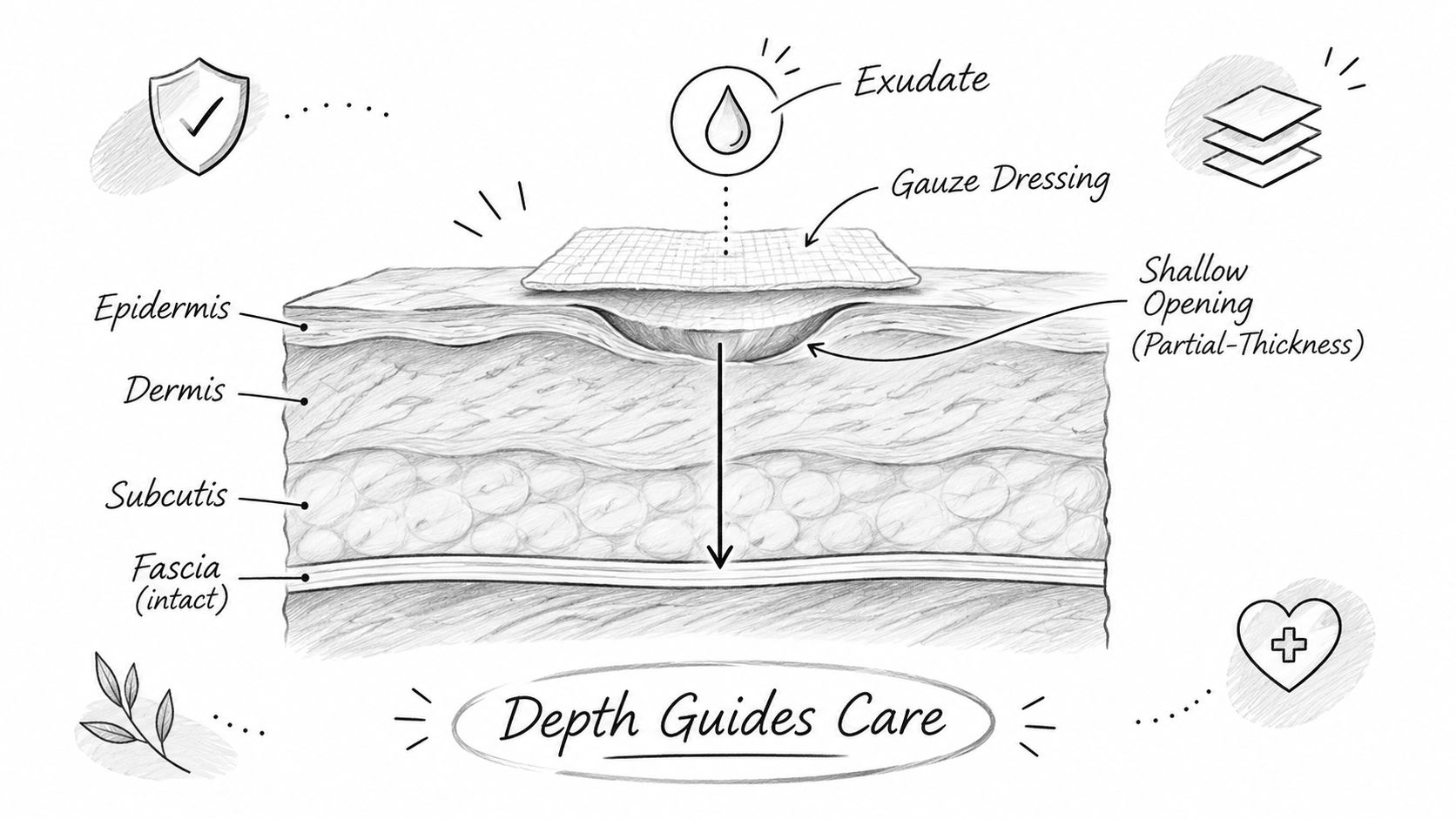
Superficial separation involves the skin and tissue directly beneath it. Deep fascial separation means the supporting layer has failed. In an abdominal wound, that can allow internal contents to protrude through the opening, a complication called evisceration.
Ask whether the fascia is intact
This is the central clinical question. A narrow opening can extend far inward, while a longer skin gap may leave the fascia intact. Neither the visible length nor the amount of pain reliably answers it.
Healing tissue needs collagen, the protein that helps rebuild strength. Infection and poor blood supply can interfere with that rebuilding. Coughing, vomiting, straining, a bowel that has stopped moving or fluid collecting in the abdomen can then increase pressure against tissue that's already weak.
For example, a small skin gap after abdominal surgery may be managed with a supervised dressing plan if the fascia is sound. A similarly sized opening with fascial failure requires an entirely different response.
Understand what serious outcome figures mean
In a National Surgical Quality Improvement Program study of 5,246 patients undergoing abdominoperineal resection, 2.7% developed dehiscence, which independently increased the odds of death within 30 days by 2.69 times. Those patients also experienced more readmissions and reoperations. These findings concern a particular major operation, not every patient with a small skin gap.
A 2024 review in Annals of Medicine and Surgery reported mortality of 25% associated with fascial dehiscence after abdominal surgery. That figure describes a severe complication, not superficial separation.
Delayed surgical evaluation can allow infection to progress and lead to emergency admission. In lower-extremity wounds, delayed evaluation can also contribute to amputation, particularly in underserved communities. That broader concern shouldn't be mistaken for the expected outcome of every reopened incision.
Depth, not the length of the visible gap, drives urgency. Ask the clinician whether the fascia is intact rather than trying to judge severity from a photograph alone.
How Common Wound Opening Is After Different Surgeries
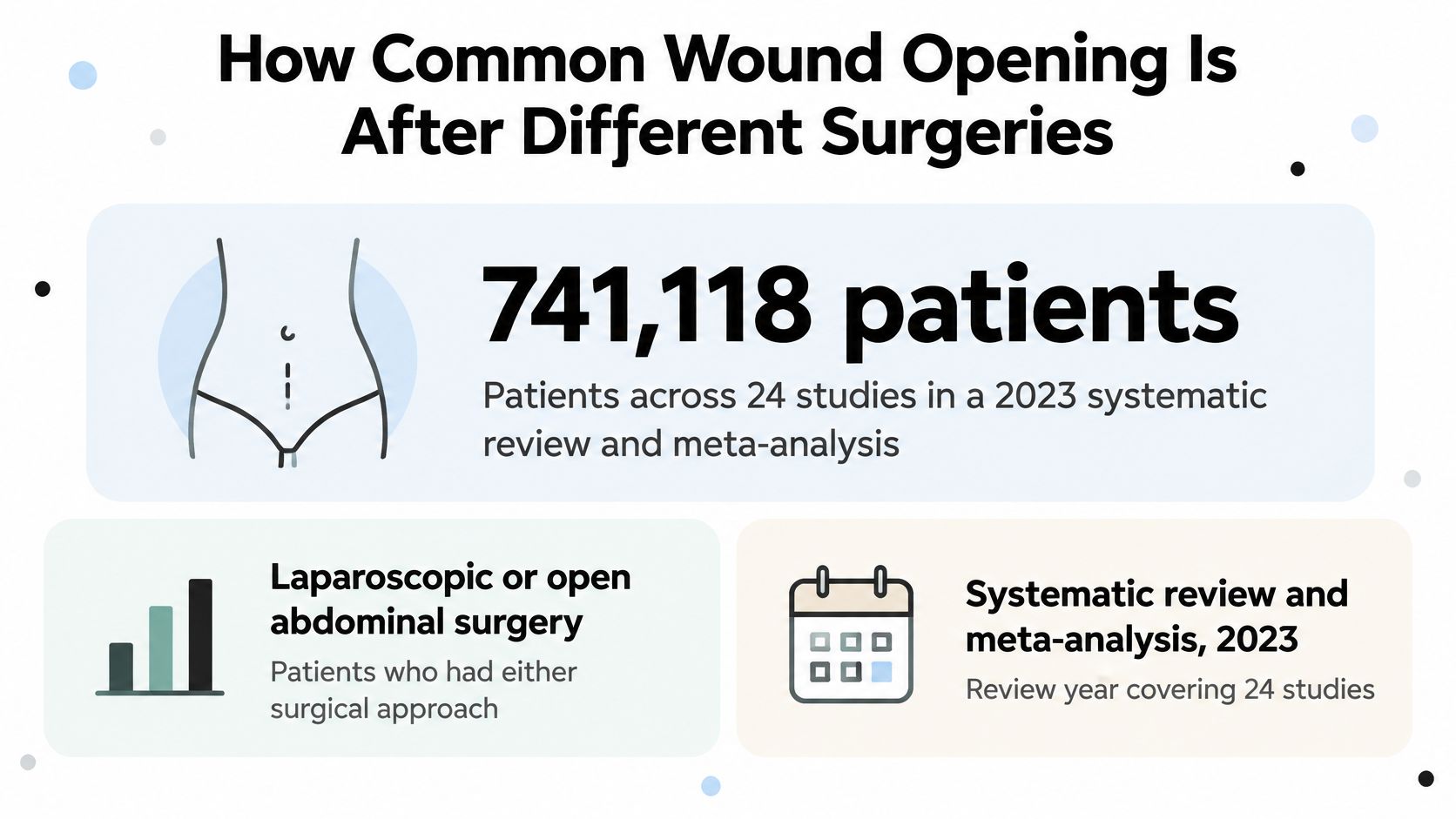
A 2023 systematic review and meta-analysis in the Journal of Wound Care pooled 24 studies covering 741,118 patients undergoing laparoscopic or open abdominal surgery and found a pooled 30-day cumulative incidence of about 1%. Within that review's own comparison of abdominal procedures, hepatobiliary operations, involving the liver, gallbladder or bile ducts, carried the highest incidence at approximately 3%.
The scale of that review helps put surgical wound opening in perspective. Out of every hundred abdominal surgery patients in the pooled data, roughly one experienced a wound opening within 30 days.
Reported wound opening rates by procedure
The review also discusses earlier procedure-specific estimates, summarised below. These are separate estimates across surgical populations, so treat them as typical ranges rather than directly comparable results from a single group of patients.
| Procedure | Reported Incidence |
|---|---|
| General abdominal or laparoscopic surgery, 30 days | About 1% |
| Hepatobiliary surgery | About 3% |
| Abdominal surgery, superficial separation | About 2% |
| Abdominal surgery, deep fascial separation | About 0.3% |
| Cesarean delivery | About 3% |
| Sternal wounds | About 3% |
| Hip prosthesis surgery | About 3% |
| Saphenous-vein harvesting | Up to 9.3% (10 of 108 patients) |
Two patterns stand out. First, superficial separation is far more frequent than deep fascial failure in abdominal surgery, roughly 2% compared with 0.3%. Second, the incision's location matters as much as the operation itself: vein harvesting in the leg reaches up to 9.3%, the highest figure in the table, because leg incisions heal under different circulation and tension than abdominal ones.
Use percentages as context, not reassurance
These figures tell you that reopening is uncommon overall, but its frequency differs by operation, incision location and the definition used. A study counting any skin-edge separation will capture a different set of problems from one counting only deep failure or reoperation.
A population percentage also isn't your personal probability. Think of these rates the way you'd treat a regional weather average: useful background, but no substitute for looking at your own sky. Your surgical team can interpret the operation, tissue condition and recovery together. Once an opening has appeared, the useful question isn't how unlikely it was. It's what has separated and what care is needed now.
The table can't account for your circulation, infection, nutrition, medications or pressure on the incision. Those interacting factors help explain why apparently similar operations can have different healing courses, and they're the reason a low percentage should never talk you out of having a new opening examined promptly.
Why Some Wounds Open and Others Do Not
A reopened incision isn't proof that someone provided poor care at home. Patients can follow every instruction and still develop a healing complication. Risk depends on both tissue biology and the circumstances of the operation.
An abdominal-surgery study found significant associations with male sex, emergency surgery, albumin below 3.5 g/dL, hemoglobin below 10 g/dL, contaminated wounds and operations lasting more than two hours. Longer operations occurred in 64.4% of dehiscence cases versus 26.1% of controls. These associations don't establish a single cause in an individual patient, but they show why blaming home care misses important contributors.
Factors you can help manage
You don't need to solve every medical issue yourself. Your role is to follow an agreed plan and flag barriers before they become harder to address.
- Smoking: Tell the team if you smoke and request cessation support rather than hiding it out of embarrassment.
- Nutrition: Report poor appetite, vomiting or difficulty obtaining food. Regular meals with protein support tissue repair.
- Blood sugar: Follow your diabetes plan and report readings outside the range your clinician has set.
- Pressure and strain: Follow lifting restrictions and ask for help with constipation or persistent coughing.
- Medication concerns: Share your full medication list, including steroids. Don't stop prescribed treatment on your own.
These factors can overlap. Someone with diabetes who is eating poorly and coughing frequently may need coordinated support rather than another reminder to keep the dressing clean.
Factors outside your control
An emergency operation may leave little time to improve nutrition or treat other conditions beforehand. The procedure itself, contamination, blood supply and tension at closure can also affect healing.
Older adults and people with diabetes, malnutrition, vascular disease, long-term steroid exposure or previous healing problems may need closer assessment. These conditions don't mean the wound will reopen, and they don't justify accepting deterioration as unavoidable.
Prevention reduces avoidable strain; it doesn't eliminate all risk. Early evaluation remains worthwhile even when the underlying risks can't be removed. Tell the team what's difficult, whether that's controlling a cough, getting meals, checking glucose or reaching appointments, so the plan fits your actual circumstances.
How Clinicians Assess a Reopened Wound
A clinician needs more than a photograph of the skin gap. The assessment combines the operation history, the wound's condition and how you're feeling overall. A clinical review of surgical wound dehiscence describes the importance of depth, drainage, systemic symptoms, nutritional status and healing risks.
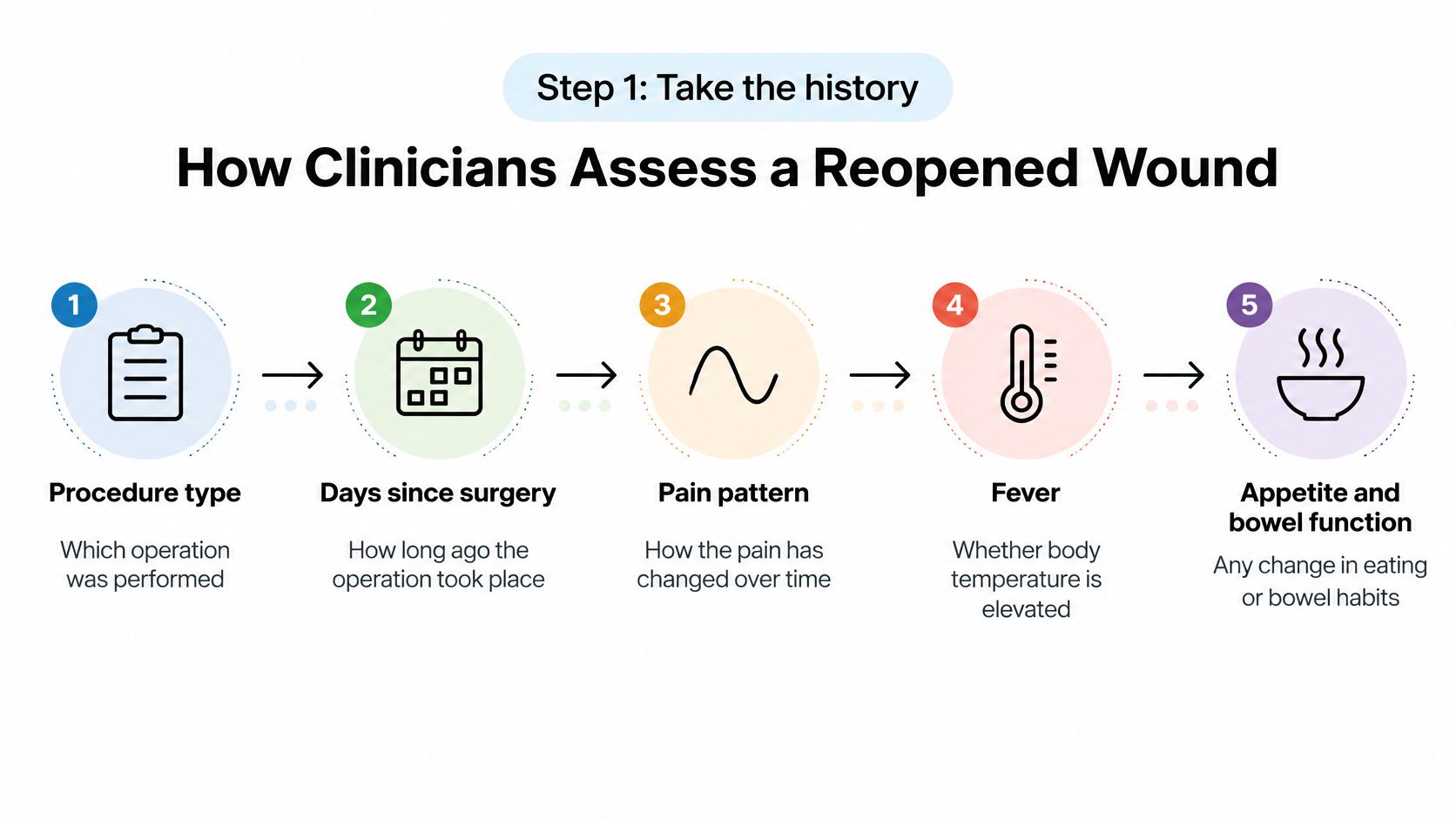
The history begins with a few focused questions.
What happens during assessment
- Take the history. The clinician asks which operation you had, when it occurred, how pain has changed and whether you've had fever, reduced appetite or altered bowel function.
- Examine the opening. They measure it safely and assess depth, exposed tissue and undermining, where a pocket extends beneath the skin edge.
- Describe drainage. Amount, colour and smell help the team understand what's changed.
- Look for infection and dead tissue. Spreading redness, warmth, infected tissue, slough and necrosis can affect the treatment plan.
- Check your overall condition. Temperature, circulation, hydration, nutrition and relevant blood tests may help explain delayed healing.
- Record contributing risks. Diabetes, smoking, obesity, steroid exposure and coughing or other pulmonary strain all matter.
Findings that deserve surgical review
Our surgical evaluation criteria identify these indicators:
- No measurable size reduction: The wound isn't getting smaller.
- Necrotic tissue: Dead tissue remains in the wound.
- Persistent undermining: Pockets beneath the edges continue.
- Infected tissue or recurrent cellulitis: Infection persists or returns.
- Exposed tendon or bone: Important deeper structures lack coverage.
- Persistent slough: Unhealthy tissue continues to cover the wound bed.
- Recurrent breakdown: The wound closes and opens again.
- Minimal improvement despite appropriate care: Treatment hasn't produced the expected progress.
The video below provides another format for learning about wound evaluation.
Fascial separation or visible internal organs requires immediate surgical escalation, not routine dressing care. A superficial opening still needs assessment for infection, dead tissue or hidden pockets. Evaluation doesn't commit you to surgery, it gives the team enough information to choose safely.
Treatment Paths From Dressings to Surgery
A small gap along a healing incision raises the same question for many patients and caregivers: is another week of the same dressing reasonable, or has that plan expired? Size does not answer it. Depth, infection, and whether the wound is still changing do.
Treatment follows depth and infection, not wound size alone. The National Wound Care Strategy Programme's surgical wound complication recommendations support assessing contamination, drainage, tissue condition and contributing factors before selecting treatment.
For a superficial opening with intact fascia, the team may control drainage and protect the wound while deciding whether it should heal gradually or be closed again. Waiting is a timed choice, not the automatic plan. The diagram shows a surface opening. It is not a diagnosis you should make yourself.
Care pathway by clinical situation
| Situation | Typical Approach | Who Leads |
|---|---|---|
| Superficial opening, intact fascia, no infection | Control drainage; choose a dressing or negative-pressure device by depth, area and drainage; consider secondary closure when tissue and source control allow | Surgical team or wound specialist |
| Suspected infection or contamination | Assess for surgical-site infection, then drain or debride as needed | Surgical team |
| Necrotic tissue, undermining, exposed tendon or bone | Specialist review with debridement and advanced wound care as appropriate | Wound surgeon |
| Deep fascial dehiscence | Urgent operative management to prevent evisceration | Emergency surgical team |
| Limited improvement despite appropriate care | Reassess treatment response; consider intervention or a different level of care | Wound specialist with referring team |
Understand the treatment terms
Secondary closure means closing the wound again after assessment and preparation. Healing by secondary intention means allowing it to fill in and develop new skin gradually. Secondary closure works like repairing a seam after the edges have been cleaned and lined up. Healing by secondary intention works like letting that fabric knit itself back, which takes longer and needs steady protection. When healthy tissue and control of infection or contamination permit, the team may choose secondary closure rather than a longer open-wound healing course.
Negative-pressure wound therapy uses a sealed dressing connected to suction. It may support selected open wounds, but its definitive benefit remains uncertain. It cannot replace checking for untreated infection or deeper failure. Suction is a tool for a prepared wound bed, not a reason to skip that check.
A wound with ongoing breakdown or poor progress may need reassessment of its advanced wound-care options, not more time with the same dressing.
An early documented baseline examination gives clinicians something reliable to compare against later. Ask for a clear description of the wound, the treatment goal, and the date when progress will be reviewed. That date is the decision rule. If the opening has not improved as expected by then, the path changes: infection or contamination moves toward drainage or debridement, stalled tissue moves toward specialist review, and deep fascial separation moves to urgent surgery.
Not every wound needs surgery, but every wound that stops healing deserves another look.
Caring for the Wound While You Wait
Home care protects the wound while you arrange assessment. It doesn't establish that waiting is safe, and it should never delay emergency treatment. Follow your surgical team's instructions if they differ from general advice.
Protect the area without manipulating it
- Cover it: Use a clean, dry dressing unless your team has prescribed something different. Wash your hands before handling dressing materials.
- Reduce strain: Gently support the area with a folded pillow or your hand when coughing, sneezing, rising or laughing. Don't press directly onto exposed tissue.
- Respect activity limits: Avoid lifting beyond your postoperative instructions. Ask the team about constipation rather than repeatedly straining at stool.
- Leave the opening alone: Don't probe, pack, pull at or attempt to close the wound yourself. Don't remove stitches or staples, or add unprescribed creams or antiseptics.
If organs protrude, don't push them back inside. Call emergency services and follow the dispatcher's instructions.
Make changes easier to report
Once you have a clinician-approved monitoring plan, keep a simple record:
- Photographs: Take a daily picture in similar lighting, with a ruler beside the wound without touching it. Don't remove a dressing against instructions just to take a photograph.
- Symptoms: Record temperature, pain and drainage colour and amount. Note whether redness or the opening is spreading.
- Food and fluids: Maintain intake within your medical restrictions, and follow your glucose-management plan if you have diabetes.
- Escalation: Check new symptoms against the warning signs each time you update the log. A new urgent sign overrides the planned follow-up date.
A useful log describes change rather than saying the wound looks bad. For example, note that drainage soaked through the dressing or that pain increased despite prescribed medication. Don't wait to collect a complete record before calling.
Choose Your Next Step Today
A superficial skin split works like a crack in paint. A separation that reaches fascia or deeper structures works like a split in the wall behind it. They need different timed responses, so overnight waiting is not the automatic plan.
Visible bowel or other deep structures, rapid widening, severe bleeding, shock symptoms, or uncontrolled pain means call emergency services now. Use emergency care, not a routine or virtual wound appointment.
For a new gap without emergency signs, call the surgical team the same day. Describe increasing drainage, spreading redness, fever, odour, or worsening pain plainly. If you cannot reach the team and the wound is deteriorating, seek urgent in-person care.
Prepare for the conversation
Have the procedure date, surgeon's name, days since surgery, temperature reading, and drainage description available. Share the visible length of the opening, but leave depth measurement to a clinician. The team may arrange an examination or first review your history, photographs, and readings by phone or video.
Your operating surgeon, primary care clinician, and any home health provider can help coordinate specialist input. At Wound Services, we also offer virtual consultations in which a wound surgeon reviews your history, images, and the wound by video, usually within days. That option is for clinically appropriate assessment, not emergency triage.
When surgery is needed through our pathway, a nurse validates the wound in person, transportation is arranged, and the patient moves straight to our own ambulatory surgical center. Evaluation itself does not mean an operation is required.
Use a decision rule, not waiting by default: emergency signs mean emergency care, and other new openings mean same-day contact plus a clinician-directed plan.
Our team evaluates complex, reopened, and stalled surgical wounds, with virtual and in-person assessment coordinated with your existing care team. For a wound that needs specialty review rather than emergency treatment, visit Comprehensive Wound Services to request an evaluation and discuss whether continued wound care or surgical intervention is appropriate.