Six weeks ago the ulcer on your father's shin looked like it was finally closing. The nurse measured it at the weekly visit, wrote a number in the notes, and everyone relaxed. Then the numbers stopped moving. Dressings kept getting changed, appointments kept coming, and nobody said the sentence that needed saying out loud: this wound has stalled, and it's time to find out why.
That gap between doing something to a wound every week and changing its direction is where most of the frustration in complex wound care lives. Families assume the dressing is the treatment. Clinicians know the dressing is only the delivery mechanism for a plan that has to address the reason the wound isn't closing.
Two decisions get blurred together in these conversations. Is this wound stalled? And does it need surgery? They're different questions with different answers, and keeping them apart is the whole point of what follows.
## Table of Contents - What Complex Wound Care Really Means - Eight Signs a Wound Deserves Specialty Evaluation - How to Measure Whether a Wound Is Stalling - Treatment Options From Conservative Care to Surgery - Who Treats Complex Wounds and What to Expect - Virtual Evaluation and When It Is Enough - Keeping Care Coordinated Across Providers and Settings - Your Next Step for a Wound That Is Not Healing
What Complex Wound Care Really Means
Complex wound care brings together treatment of the wound and treatment of whatever is preventing it from closing. Dressings protect the surface, but healing also depends on blood flow, pressure relief, nutrition, and control of underlying conditions. A wound can receive regular attention while those barriers remain unresolved.
“Chronic” and “complex” describe different aspects of the problem. A chronic wound has not healed within the expected time. A complex wound has barriers that make healing harder, such as poor circulation, infection, unrelieved pressure, poor nutrition, or exposed tendon or bone. Those categories can overlap. Neither label, by itself, means surgery is needed.
A stalled wound resembles a car that will not start: changing its paint cannot fix the battery. The useful question is what is preventing progress, rather than which dressing to try next.
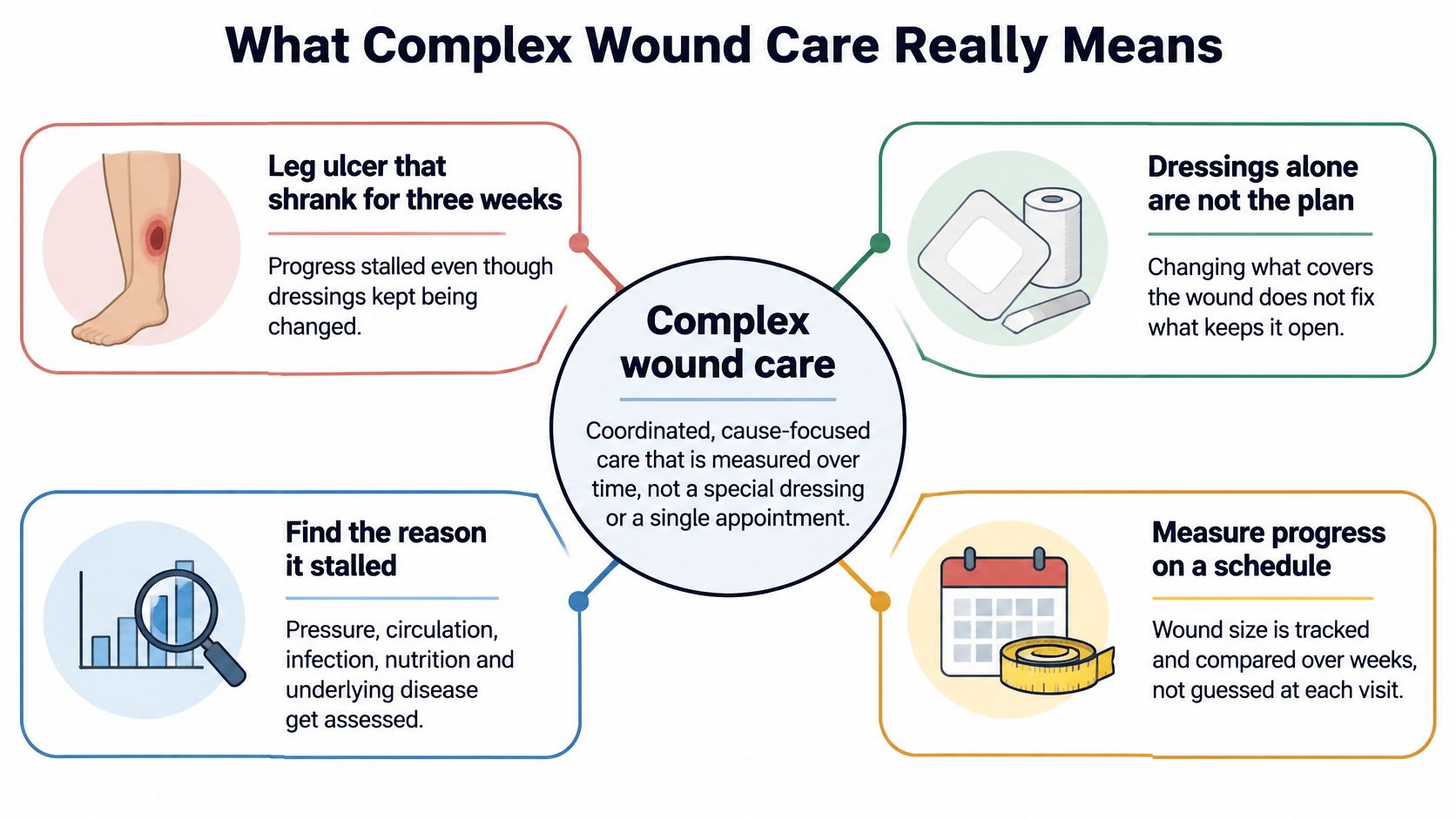
Four barriers help organize that assessment: the underlying cause, perfusion (blood flow to the tissue), infection, and tissue viability (whether tissue is living or dead). These checks guide treatment rather than automatically triggering an operation. Poor blood flow and ongoing pressure, for example, need attention alongside care of the wound itself.
The burden extends beyond the dressing change. A systematic review of complex wound burden reported that at least 1% of people living in high-income countries will experience a complex wound during their lifetime, estimated more than 6.5 million people in the United States were affected, and described annual North American management costs of approximately $10 billion, with pressure-ulcer care accounting for about 4% of annual NHS expenditure in the United Kingdom.
Access to care matters too: an analysis of claims data examined changes in wound-care access during the pandemic.
Specialized Wound Services in Washington, DC, focuses on complex, stalled, and surgically appropriate wounds. Conservative care remains the foundation. Early virtual or in-person evaluation helps determine whether intervention is appropriate, while coordination with the patient's existing care team keeps specialty review connected to ongoing care. A stalled wound deserves reassessment; surgery is a separate clinical decision.
Eight Signs a Wound Deserves Specialty Evaluation
Read the table below against the wound you're looking at, row by row. It's a triage tool, not a diagnosis, and it works best when someone measures rather than eyeballs.
| Finding | What it signals | Action to take |
|---|---|---|
| No measurable size reduction | Stalled healing despite care | Measure against the 4-week threshold, then escalate to specialty review |
| Necrotic or dead tissue | Devitalized tissue concealing wound extent | Perfusion check, then selective sharp or surgical debridement |
| Persistent undermining | Unexplored cavity or ongoing pressure source | Probe, document depth, review offloading and support surface |
| Infected tissue or recurrent cellulitis | Bacterial burden or biofilm | Culture, antimicrobial review, consider surgical evaluation |
| Exposed tendon or bone | Deep structural involvement | Urgent specialty or surgical evaluation |
| Persistent slough | Biofilm and moisture imbalance | Debridement, moisture management, reassess dressing plan |
| Recurrent wound breakdown | Unresolved cause such as pressure or venous disease | Cause-directed therapy and specialty evaluation |
| Minimal improvement despite appropriate care | Misdiagnosis or untreated barrier | Specialty referral for full reassessment |
Two rows carry most of the risk. Necrotic tissue and persistent slough both hide what's underneath, and a wound bed you can't see is a wound you can't measure, stage, or plan for. A consensus statement on wound debridement makes the sequence explicit: assess etiology, perfusion, infection, tissue viability, and healing potential before choosing a method, not after.
The order matters because debridement on a limb without adequate blood flow can enlarge the defect instead of speeding healing. Check perfusion first. When necrosis, slough, undermining, exposed structures, or plain lack of progress blocks the view of the wound bed, selective sharp or surgical debridement is the relevant technique, and complex or nonresponsive cases may need an alternative or operative approach.
After a complete sharp or surgical debridement, the consensus recommends collecting a specimen for microbiological analysis. Clinical evidence of deeper or systemic infection should prompt antimicrobial treatment and consideration of hospitalization.
The habit that changes outcomes: five fields, every visit. Dimensions, tissue type, exudate, pain, surrounding skin. Without them, "it looks about the same" is the only sentence anyone can honestly say.
Documentation is what turns a stack of visits into a trend, and a trend is what tells you whether conservative care is still working or whether escalation is now the safer choice.
How to Measure Whether a Wound Is Stalling
The benchmark most clinicians use for a diabetic foot ulcer is percentage area reduction at four weeks. The International Working Group on the Diabetic Foot guideline recommends reassessing vascular status and seeking vascular-specialist input when a wound deteriorates, or achieves less than 50% area reduction within 4 weeks despite appropriate infection control, glucose management, wound care, and offloading.
That threshold earns its place because a reduction above 50% by week 4 predicts healing by roughly 12 weeks. Miss it and you're not dealing with a dressing problem. Persistent ischemia, infection, excessive mechanical loading, a large starting wound size, and inadequate offloading each suppress granulation and epithelial migration.
The stakes are why the four-week mark isn't pedantry. Global burden estimates for diabetic foot disease put roughly 18.6 million new diabetic foot ulcers each year worldwide, with five-year mortality after a diabetic foot ulcer estimated at about 30%.
Assessment after a failed benchmark means perfusion testing, a clinical infection review, wound measurement, depth assessment, and verification that pressure redistribution is being delivered rather than prescribed. Ankle-brachial index and ankle pressures can support vascular assessment, but the guideline cautions that these are weak predictors of healing in diabetes, where arterial calcification can produce falsely high values. Inconclusive bedside results call for advanced vascular testing.
| Wound type | Measure | Reassess at | Threshold that triggers escalation | Why it matters |
|---|---|---|---|---|
| Diabetic foot ulcer | Percent area reduction | 4 weeks | Less than 50 percent reduction, or any deterioration | Predicts healing by about 12 weeks; may indicate ischemia |
| Venous leg ulcer | Area and compression adherence | 2 and 4 weeks | No measurable reduction or persistently large area despite compression | Needs vascular and compression reassessment |
| Pressure injury | Stage, depth, undermining | Every dressing change | Stage progression or new undermining | Signals unresolved pressure or support-surface failure |
| Surgical wound | Depth, dehiscence, drainage | 1 to 2 weeks | Increasing depth or separation | Suggests infection or tension complication |
| Arterial or mixed ulcer | Perfusion study before debridement | At assessment | Any deterioration or absent healing | Debridement without perfusion can enlarge the defect |
Measurement doesn't need equipment beyond a ruler and a phone. Mark the wound edge, photograph it from the same distance each time with a scale reference in frame, date every image, and file it with the numbers. Consistency beats precision here.
The short rule: if you can't say whether the wound is smaller than it was four weeks ago, you can't yet decide whether the plan is working.
Treatment Options From Conservative Care to Surgery
Treatment climbs a ladder, and each rung depends on the one below it. The mistake is skipping to the top because the wound looks dramatic, or staying on the bottom rung because nobody wants to raise the question.
Rung one is the conservative foundation: dressings, offloading, compression, nutrition, pressure relief, and treatment of the underlying conditions. Wound Services builds care from this base, and for good reason. A pressure injury that never gets true pressure relief, or a venous ulcer without working compression, will stall no matter what product sits on top of it. This rung fails when the cause goes untreated, so the first clinical question is always whether the underlying driver is being managed.
Rung two is debridement, selective sharp or surgical, when devitalized tissue or an unseen wound bed is holding progress back. It sits between conservative care and advanced therapy because it makes everything above it possible: a graft cannot take on dead tissue, and no measurement is honest when slough hides the true wound margins.
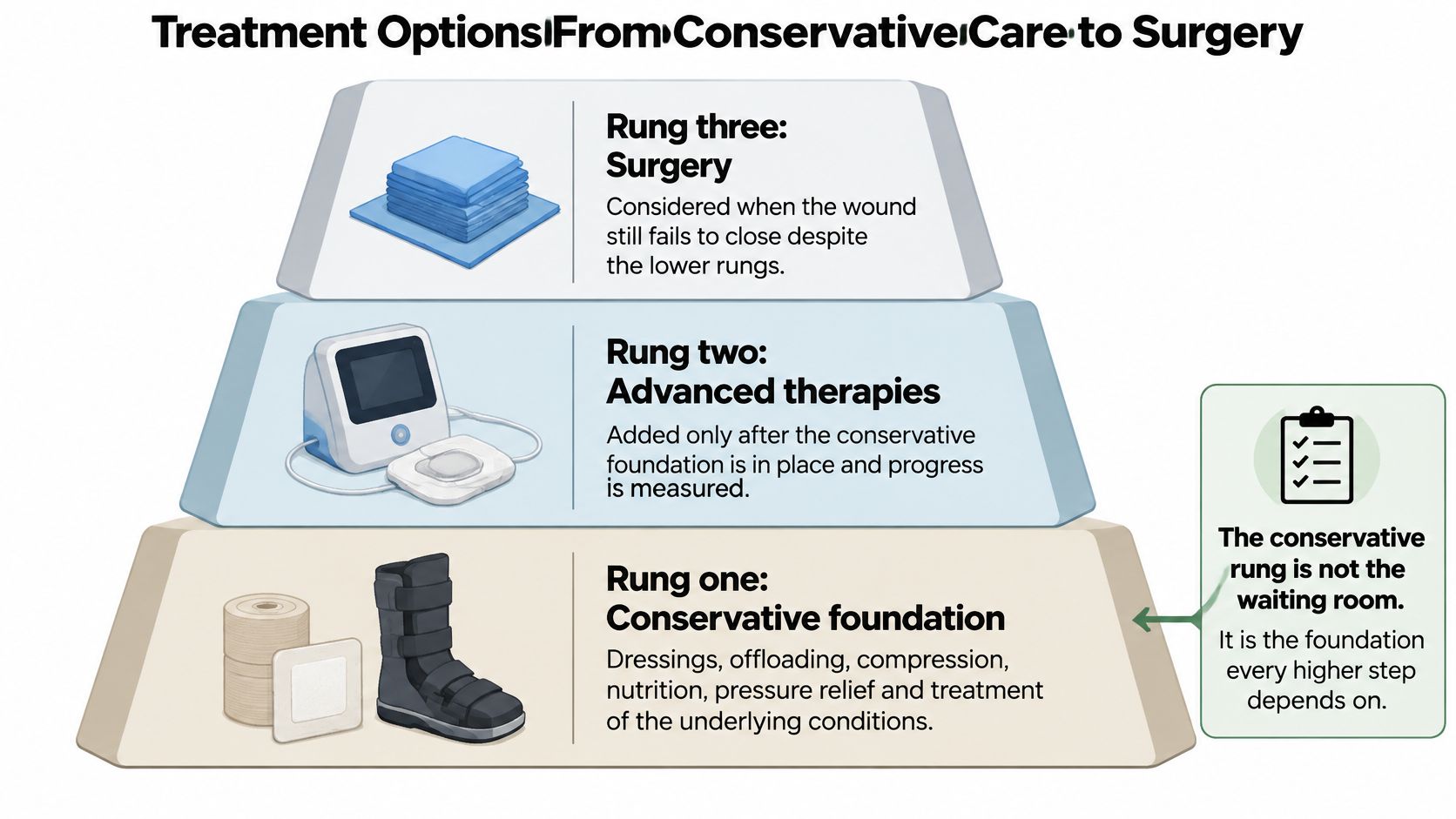
Rung three is advanced therapy: negative-pressure wound therapy, skin substitutes, and growth-factor products. The numbers here are striking but specific. In one 2025 randomized study published in Surgery of 450 participants with diabetic foot ulcers, complete ulcer closure occurred in 87% of patients receiving negative-pressure wound therapy and 29% receiving advanced moist wound therapy. Treat that as a strong signal in selected diabetic foot ulcers, not a universal result. A 2025 systematic review pooling eight randomized controlled trials with 1,099 participants comparing negative-pressure therapy with conventional dressings found the evidence base remains heterogeneous, which is why patient selection carries so much weight.
Rung four is surgery: operative debridement, reconstruction, and closure when the wound and the patient are right for it. Selection matters more than the technology. A surgical wound evaluation is how that selection gets made, and it works as a conversation, not an automatic booking. Some wounds that reach this rung turn out to heal once the lower rungs are corrected.
No advanced dressing overcomes an untreated cause. No product substitutes for a correct diagnosis. The ladder only works when each rung earns the next one, and the measurement habits from the previous section are what tell you when to climb.
Who Treats Complex Wounds and What to Expect
Readers often don't know which specialist to ask for, so here's the map. Wound care physicians and nurse wound specialists manage dressings, debridement, offloading, and infection. Vascular specialists assess perfusion and arterial or venous disease. Plastic and reconstructive surgeons handle deep defects and complex closure. Infectious disease specialists advise on resistant or deep infection. Your primary care clinician, home health nurse, and podiatrist usually stay central to daily care, and that continuity matters.
The first specialty visit follows a predictable shape. The clinician takes the wound history and reviews medications, glucose control, smoking, nutrition, and what has already been tried. The wound gets measured and photographed. Perfusion is examined through pulses and, where indicated, ankle-brachial index or further vascular imaging. The wound is probed for undermining and depth, and the offloading or compression in use is checked rather than assumed.
Expect a written plan that names the suspected cause, the next measurement date, the escalation triggers, and who carries out each task.
Three questions worth asking out loud: Which specialist owns this wound? Which tests are planned, and when will I get results? Which finding would change the plan?
If the answers are vague, that's information too.
Virtual Evaluation and When It Is Enough
A virtual wound consultation is more than a video call about a bandage. A wound specialist reviews the medical history, dated wound images, imaging results, and how the wound has responded to treatment, then looks at the wound itself by video. For patients who live hours from a specialist, or residents of a nursing home with limited transport, that review can happen in days rather than months.
Prepare like a clinician would. Bring dated photographs with a scale reference, a list of current dressings and how often they're changed, recent labs and imaging, a medication list, and one honest answer to whether the wound is smaller than it was four weeks ago.
Then the limits. A 2025 rural diabetic-foot-ulcer study found no statistically significant difference between nurse-led telemedicine and usual care for wound healing at 12 weeks (32% versus 28%; p=0.58) or amputation (23% versus 25%; p=0.80). That supports remote review for triage, monitoring, local coordination, and reduced travel. It is not proof that every complex wound can be managed remotely, and high-quality evidence on healing rates and patient-reported outcomes is still thin.
Some findings need hands and eyes. Suspected undermining, exposed tendon or bone, necrosis, fluctuance, and recurrent infection can't be reliably confirmed from a photograph, because a picture flattens depth and hides what's under the wound edge.
That's the model we use at Wound Services. A wound surgeon reviews the history, images, and the wound by video, usually within days, and a surgical wound care nurse then validates the wound in person to confirm what was seen remotely. Virtual consultation can come before travel without automatically leading to surgery, and red-flag findings should trigger urgent escalation rather than another dressing change.
Keeping Care Coordinated Across Providers and Settings
The dressing often gets the attention. The bigger problem is usually ownership. One clinician measures the wound, another changes the dressing, a third orders imaging, and no one is sure who will decide whether the plan is working. Pressure relief may be prescribed in the hospital and lost after a transfer. Escalation may be noted in a chart, then wait for the next visit. Think of care coordination like a relay race. The baton is the wound story, and it has to stay visible.
A 2025 nursing-home telehealth protocol identifies workforce shortages, fragmented care, and limited local services as access barriers. Reviews of dressing approaches also show wide variation in study designs and care settings, with no clear infection difference between the approaches studied. More products cannot rescue a plan with no owner.
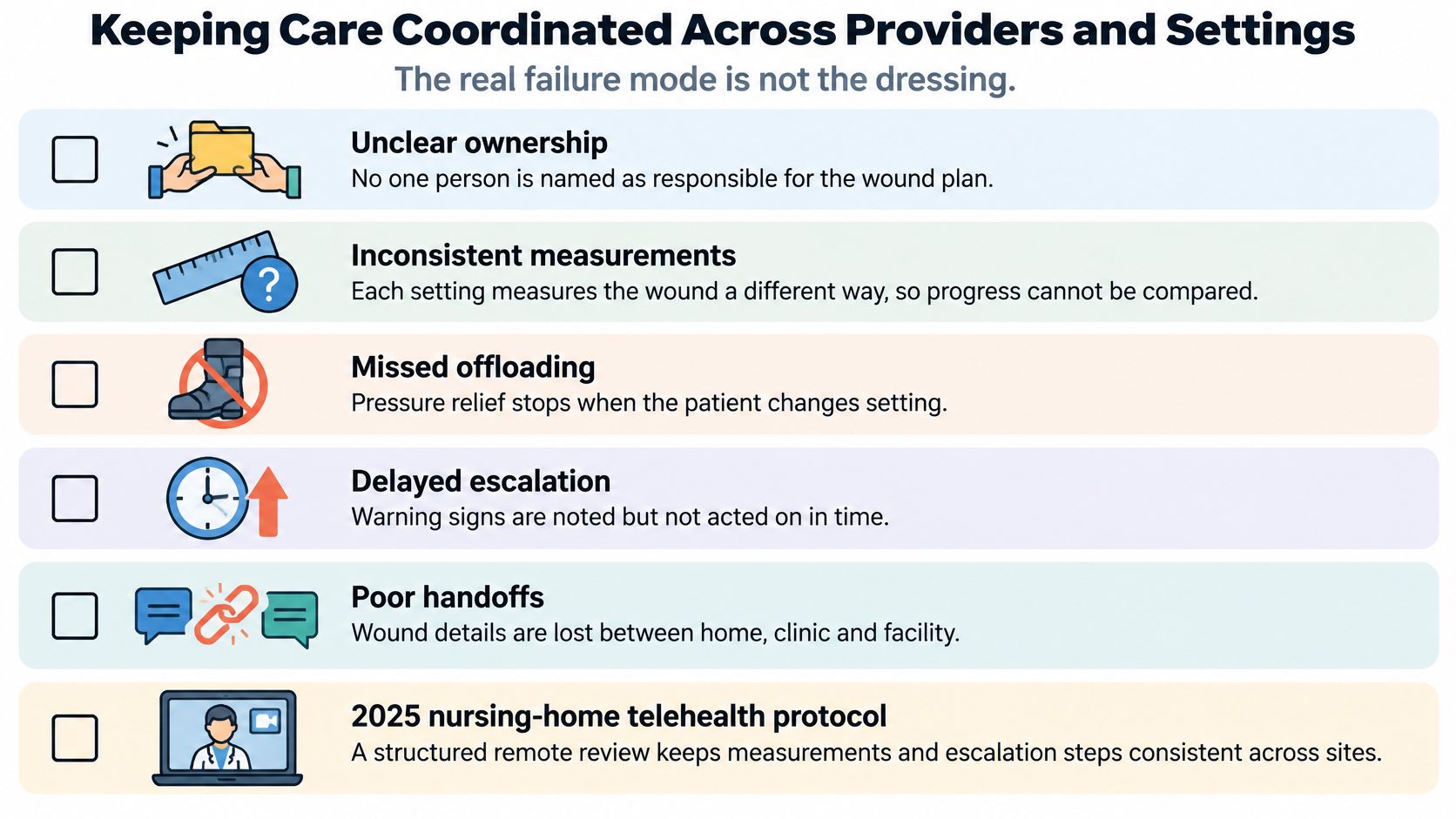
Use this handoff checklist before the next visit, and again after any specialty encounter:
- Measurement owner: who records dimensions and photographs, and how often?
- Diagnosis owner: who confirms the cause and the working diagnosis?
- Improvement definition: what counts as meaningful progress, and on what date will the plan be reconsidered?
- Communication loop: who sends changes to the original provider after a specialty review or procedure?
- Offloading verification: who confirms pressure relief is being delivered, not just prescribed?
- Logistics: who owns transportation, insurance, and caregiver capability?
A useful specialty review should make the existing plan clearer. It should return structured notes, specific recommendations, and a follow-up path that continues toward closure. Remote wound monitoring helps keep measurements consistent when the patient moves between settings. Wound Services works alongside the existing care team, validates the wound in person before intervention when needed, arranges transportation when surgery is appropriate, and sends recommendations back to the original providers. Continuity works like a bridge between the bedside, the clinic, and home, so the wound does not have to start a new story at every stop.
Your Next Step for a Wound That Is Not Healing
A nurse calls on a Thursday because a heel wound looks about the same as it did a month ago. Dressings were changed twice this week. The chart still does not say who will decide, and by what date, that "same size" means the plan has stalled. Two questions sit under that call. Has healing stopped, and does this wound need surgery? They are not the same decision.
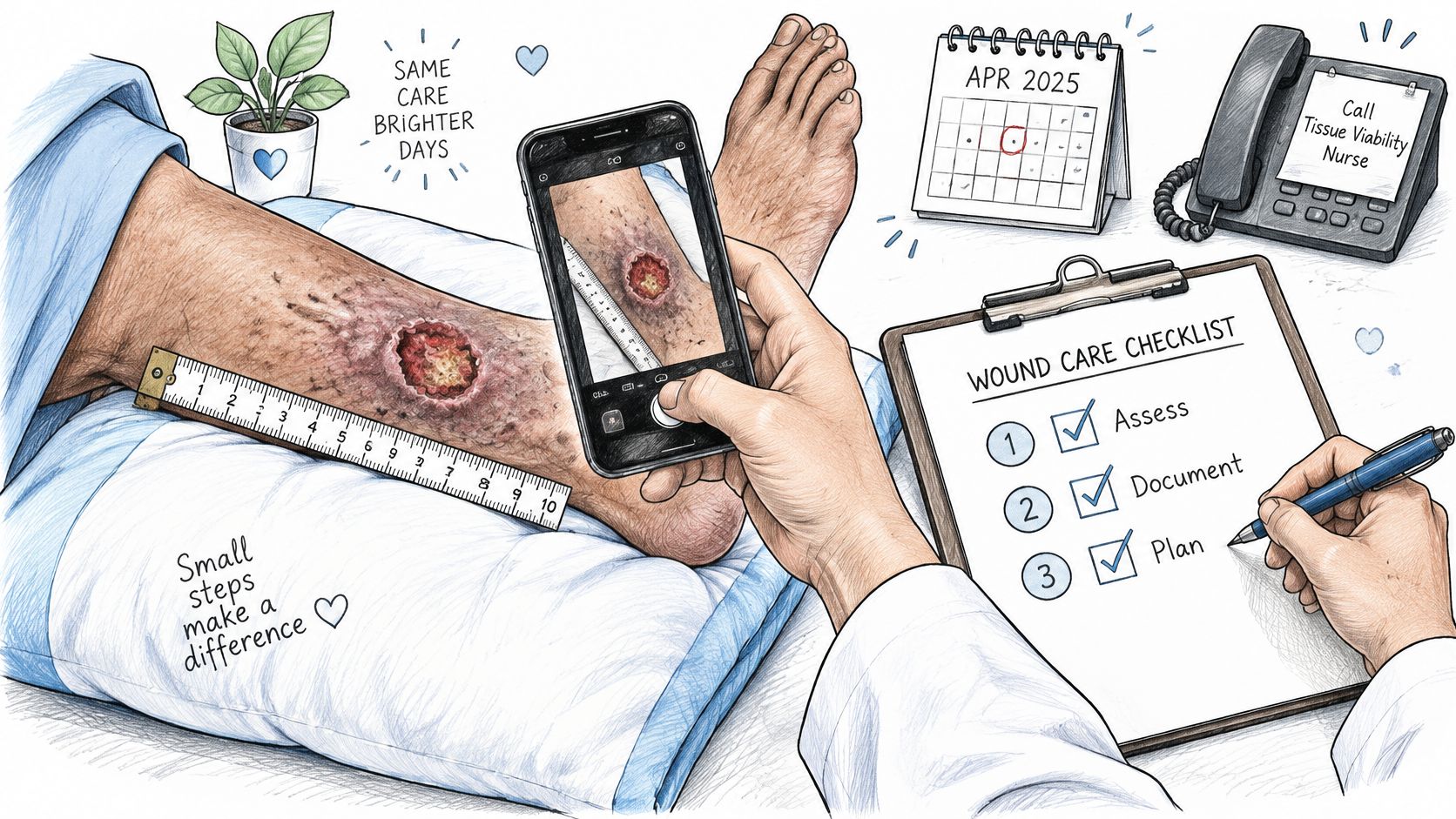
Measure and photograph the wound today, then set those numbers beside the reading from four weeks ago. Yesterday is too short a window. Check the result against the signs already reviewed and the 50% four-week threshold. Both apply to the same wound. Call the current provider with those numbers and ask for a specialty referral or a second look.
If the answer is another dressing change, ask for the date the plan will be reconsidered and the specific finding that would trigger escalation. Assemble the history, images, and recent measurements so a specialist can review them before anyone travels. The escalation pathway follows that same order, so a referral continues the record instead of starting the story over.
When you choose where to send a wound, weigh these criteria:
- Wound-specific credentials, not general surgical experience alone.
- Speed of evaluation, measured in days rather than months.
- A virtual review that can precede travel, so the trip is worth making.
- Surgery offered only when clinically appropriate, never as the default.
- Notes returned to the original team, so home health and primary care stay in the loop.
- Follow-up that continues to closure, not to the first post-operative visit.
Wound Services is one option: virtual or in-person evaluation usually within days, wound-certified surgical specialists, and an ambulatory surgical center in the same building at Capital Surgical Center in Washington, DC for cases that need it.
A wound that stops healing deserves another look. Surgery is one possible result of that review, not the starting assumption. Timelines differ by patient, wound type, and health history.
Specialized Wound Services offers virtual or in-person specialty evaluation for complex and stalled wounds, surgical intervention at Capital Surgical Center when it is clinically appropriate, and coordinated follow-up that returns recommendations to the existing care team. If a wound has stopped shrinking, the most useful next step is a measured second look rather than another dressing change. Visit Comprehensive Wound Services to start an evaluation, usually within days.