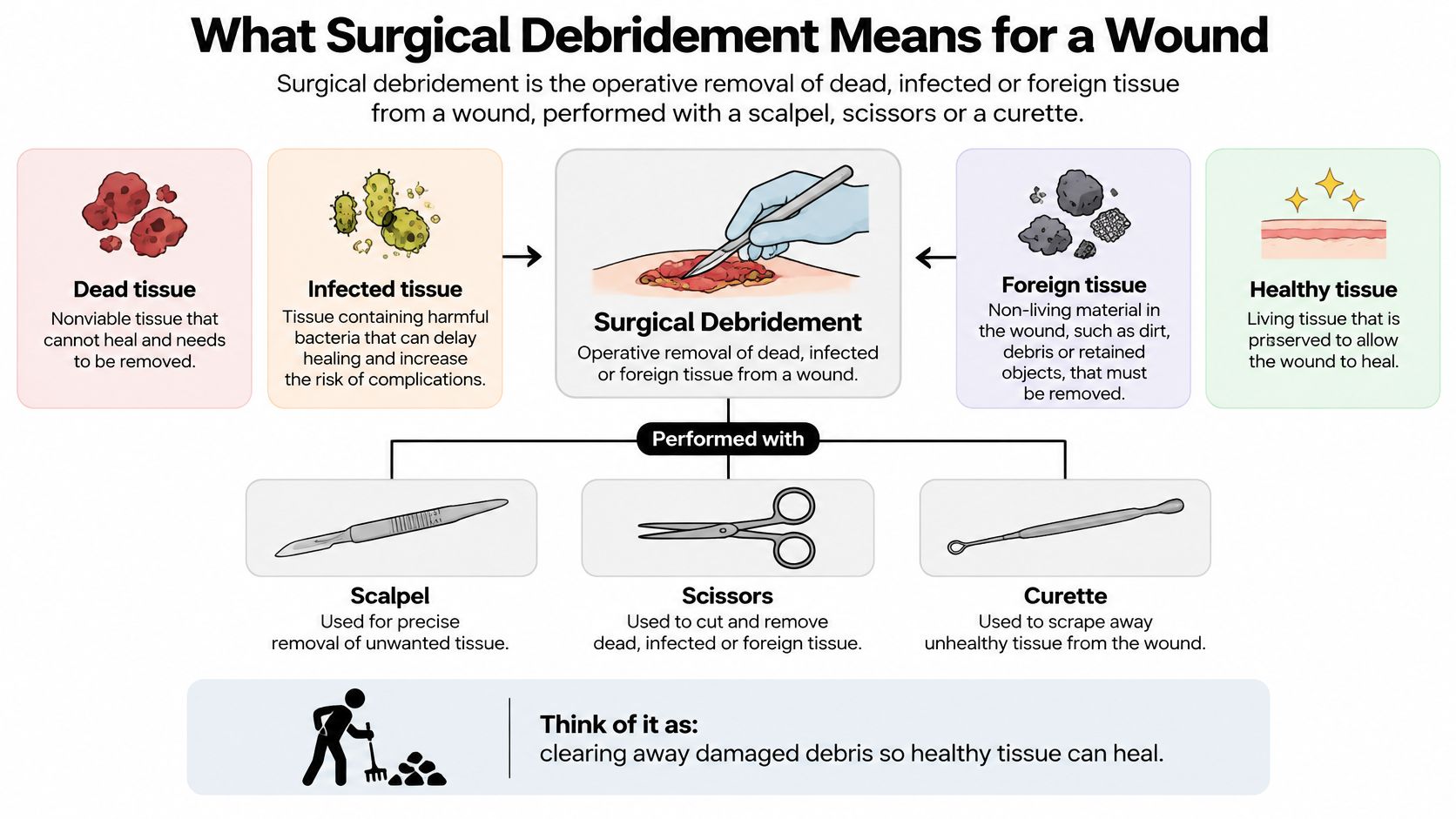
Surgical debridement is the operative removal of dead, infected or foreign tissue from a wound using sharp instruments such as a scalpel, scissors or curette. If you've just been told that you or a family member needs it, the word surgery can sound alarming, especially when the wound already looks painful or hasn't healed for weeks. The central point is simple. Removing dead tissue clears an obstacle, but it doesn't by itself fix poor blood flow, pressure, infection or the other reasons a wound may have stalled.
## Table of Contents - What Surgical Debridement Means for a Wound - Why the tissue has to go - What makes it surgery, not cleaning - Surgical Debridement Compared With Other Methods - What Happens During the Procedure Step by Step - Six stages you can picture - Where Surgical Debridement Is Used in Practice - Burns and full-thickness wounds - Infected joints and deeper spaces - When Surgeons Choose It and When They Wait - The clearest stop sign - Care that surrounds the operation - What to Expect Before, During and After Surgery - Pain, bleeding and repetition - What the evidence does and doesn't show - Confirm Whether Debridement Fits Your Wound
What Surgical Debridement Means for a Wound
Think of pruning dead branches from a tree. You don't prune to make the tree look tidier. You remove wood that can't grow so living tissue isn't shaded, drained or exposed to disease moving inward. What is surgical debridement in wound terms works on the same principle, though the surgeon is deciding, layer by layer, what can stay and what can't support healing.
Why the tissue has to go
Dead or infected material gives bacteria a protected place to multiply. It also hides the true depth of the wound, so dressings and medicines may treat the surface while disease continues underneath.
The National Center for Biotechnology Information StatPearls resource on debridement describes four core purposes. Removal lowers local bacterial burden, takes away a potential source of sepsis, allows accurate deep-tissue cultures, and creates a healthier wound bed for healing, a skin graft or a flap. It also reported operative mortality of approximately 2% in one debridement study, while long-term mortality reached as high as 68%, reflecting the severe illnesses of patients who needed operative care rather than proving debridement caused those later deaths.
What makes it surgery, not cleaning
The surgeon must distinguish nonviable tissue from viable skin, tendon, muscle, blood vessels and bone. Cutting too conservatively leaves infected material behind. Cutting too widely can damage structures the wound needs to close and function.
Risks include:
- Bleeding: Viable edges bleed because they have a blood supply, and bleeding must be controlled.
- Injury to healthy tissue: The boundary between dead and living tissue isn't always obvious.
- Anesthesia complications: These depend on whether local, regional or general anesthesia is used.
- Recurrent infection: New tissue can break down if the underlying cause persists.
Debridement is targeted removal, not a cosmetic tidy-up, and it's one step in a larger treatment plan.
Surgical Debridement Compared With Other Methods
All debridement methods aim to remove tissue that blocks healing. They differ mainly in speed, control, pain, setting and how selective they are.
| Method | How it removes tissue | Typical speed | Usual setting |
|---|---|---|---|
| Sharp surgical debridement | Scalpel, scissors or curette cut away nonviable tissue | Fast, large amounts removed in one session | Clinic procedure area or operating room |
| Autolytic debridement | Moisture dressings let the body's own enzymes soften tissue | Slow, days to weeks | Clinic or home dressing care |
| Enzymatic debridement | Topical agents break down necrotic tissue | Moderate, applied over several days | Clinic or home with dressings |
| Mechanical debridement | Wet-to-dry gauze, hydrotherapy or pulsed lavage physically lifts debris | Variable, repeated sessions | Clinic or bedside |
| Biological debridement | Sterile maggots consume devitalized tissue | Moderate, used over several days | Clinic under specialist supervision |
Autolytic debridement is usually the gentlest option. A moisture-retentive dressing keeps wound fluid against dead tissue so your own enzymes soften it gradually. That protects healthy tissue, but it takes time and isn't ideal when infected tissue needs to come away quickly.
Enzymatic debridement applies a prescribed topical agent that breaks down necrotic material over repeated dressing changes. It offers a middle path, more active than waiting for natural softening but slower than surgery. Mechanical methods use physical force, including wet-to-dry gauze, hydrotherapy or pulsed lavage. They can lift loose debris, though force can't always distinguish fragile new tissue from dead tissue.
Biological debridement uses sterile maggots that consume devitalized tissue. It can be selective, but it requires specialist supervision, suitable wound conditions and a patient who's comfortable with the method.
Surgical debridement gives the clinician direct control and removes a large amount in one session. The trade-off is that it may need anesthesia or sedation, sterile equipment and closer bleeding control. That's why teams often discuss it within advanced wound care when depth, infection or urgency makes slower methods less suitable.
Practical rule: Choose the fastest method only when speed matters clinically. Otherwise, the gentler method that preserves viable tissue may fit better.
No single method is best for every wound. The decision turns on depth, infection, blood supply, pain tolerance and whether you can safely undergo a procedure.
What Happens During the Procedure Step by Step
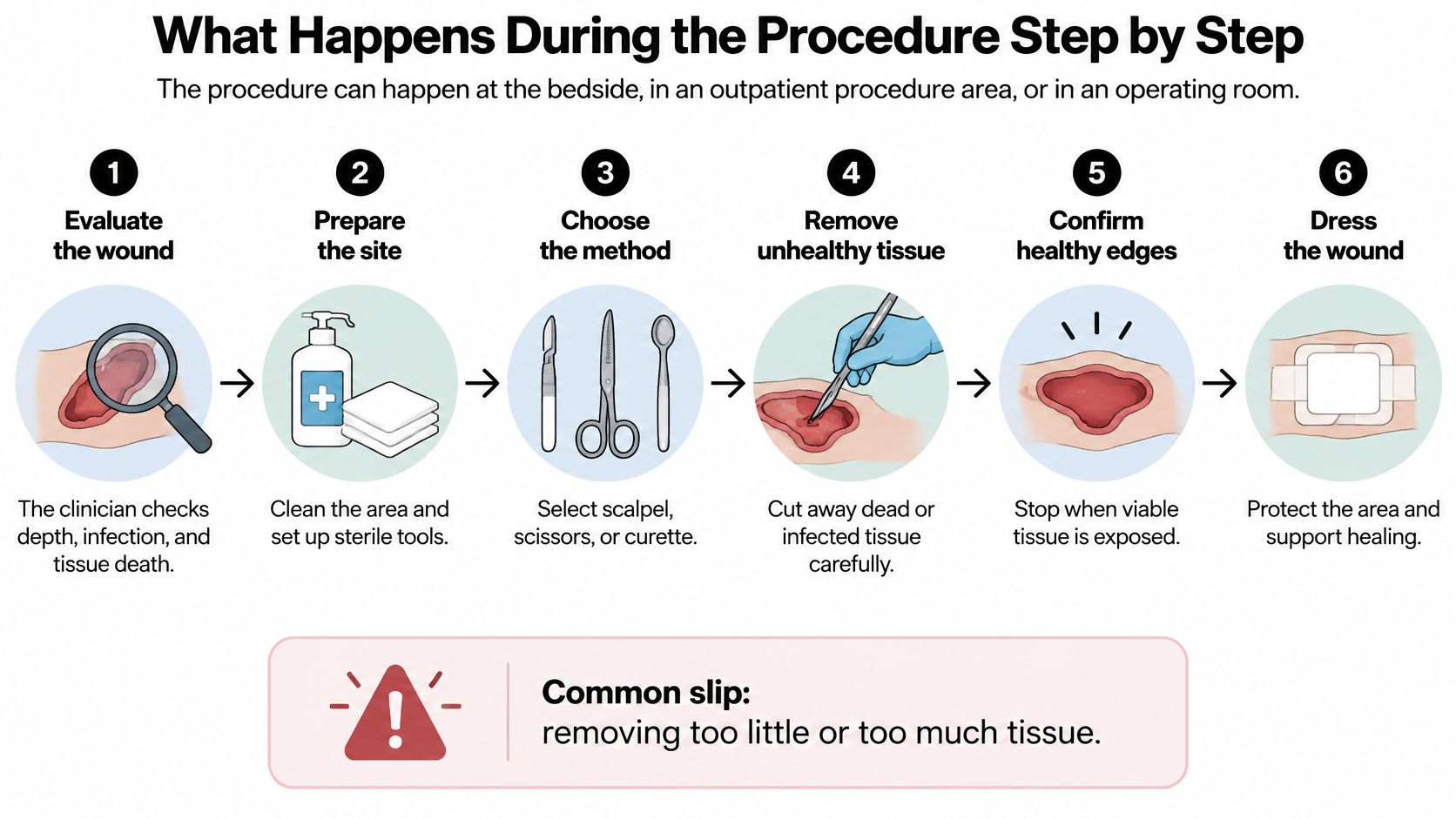
The setting comes first. Surgical debridement may happen at the bedside, in an outpatient procedure area or in an operating room, depending on wound extent, pain control, anesthesia needs, bleeding risk and whether reconstruction might follow.
Six stages you can picture
- Assess the wound and confirm pain control. The team checks depth, undermining, odor, drainage, surrounding skin and circulation, then agrees on anesthesia or sedation. Skipping this assessment is a common slip because surface appearance can underestimate deeper disease.
- Identify what must be preserved. The surgeon locates exposed tendon, nerve, vessel or bone before cutting. This protects function and helps decide how aggressive removal can safely be.
- Remove devitalized tissue layer by layer. Using a scalpel, scissors or curette, the surgeon removes necrotic tissue, slough, eschar and infected material until viable tissue remains.
- Take deep tissue for culture when infection is suspected. A sample from tissue remaining in the wound is more useful than wiping the surface, where ordinary skin bacteria can mislead treatment.
- Control bleeding, irrigate and dress the wound. Irrigation washes out loosened debris, then a dressing manages moisture and protects the newly exposed bed.
- Plan the next step. The wound may need repeat debridement, continued dressings, closure, grafting or reconstruction once the bed is ready.
The endpoint is usually healthy-looking tissue with punctate bleeding, meaning tiny points of blood show living tissue. The Journal of Wound Care best practice guidance on debridement explains that this endpoint must be balanced against injury to tendon, nerve, vessel or bone. Removing too little leaves material where bacteria can persist. Removing too much enlarges the defect and can damage structures needed for movement or closure.
Watching the sequence can make the distinction between firm dead tissue and viable bleeding tissue easier to understand.
This isn't just cleaning. One procedure can reveal depth, reduce necrotic material, provide a better culture sample and prepare the wound for granulation or reconstruction.
Where Surgical Debridement Is Used in Practice
Say a heel ulcer has turned black at the center. The surrounding skin is increasingly red, the wound probes deeper than expected, and drainage has become foul. Dressings can't show what's happening under that black cap, and antibiotics may not penetrate dead tissue well. Sharp removal enters the conversation because the team needs to see the wound bed, drain infection and remove material that cannot recover.
Burns and full-thickness wounds
In burn care, surgeons remove burned, devitalized skin so the remaining wound can be assessed and prepared for healing or grafting. Full-thickness wounds may also need surgery when necrosis is extensive, deep structures are involved, contamination is severe or tissue extends under apparently intact skin.
Facial injuries require a different kind of judgment. The goal is not only to remove damaged tissue but also to preserve tissue essential for appearance, eyelid or lip movement, and future repair. A 2023 retrospective study in Medicine of complex facial lacerations included 252 patients, with 121 receiving conventional surgical debridement and 131 receiving surgical debridement adjusted by the surgeon. That comparison concerns how surgeons customize removal, not whether every facial wound needs debridement.
Infected joints and deeper spaces
Surgeons also use incision and debridement when infection collects in a joint or deeper tissue space. The aim is to open the area, remove infected material, wash it out and obtain samples. Antibiotics alone may struggle when pus, dead tissue or a closed infected space remains.
The diagnosis alone doesn't decide the operation. Two heel ulcers can look similar in a photograph and need different treatment because one has good circulation and limited necrosis while the other has deep infection and bone exposure. Tissue appearance, depth, circulation and infection pattern drive the choice.
When Surgeons Choose It and When They Wait
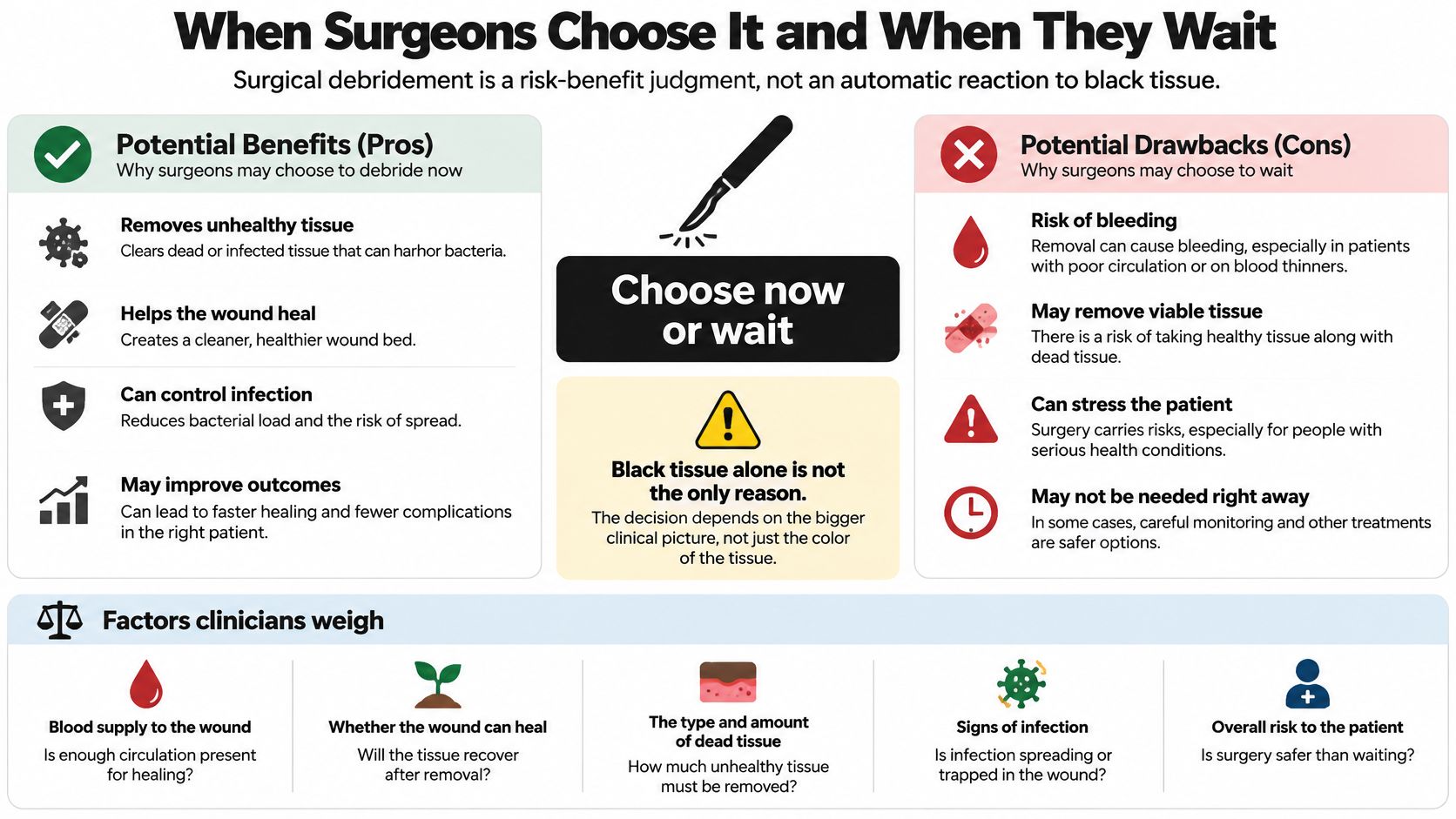
Black tissue doesn't automatically mean immediate surgery. Surgeons weigh blood supply, healability, surrounding skin, pain, anticoagulation or coagulopathy, infection severity, your goals and the structures at risk. Our escalation pathway for surgical wound evaluation reflects that need to assess whether a higher level of care fits, rather than assuming surgery follows every referral.
| Situation | Typical stance | Why it matters |
|---|---|---|
| Necrotic tissue driving sepsis or infection spreading | Prompt or urgent debridement | Removing the source can limit systemic spread |
| Deep infection, gangrene or suspected deep extension | Surgical removal favored | Sharp excision reaches deeper structures |
| Poor blood supply to the wound | Limited or delayed excision until perfusion is addressed | Aggressive removal can make the wound worse |
| Severe coagulopathy | Sharp debridement avoided | Bleeding risk is an absolute contraindication in expert guidance |
| Chronic nonhealing wound without urgent infection | Assess the cause first; debridement may be a relative contraindication | Removing tissue alone rarely closes the wound |
The clearest stop sign
Severe coagulopathy means blood doesn't clot adequately. The expert wound management guidance on sharp debridement contraindications describes it as an absolute contraindication to sharp debridement. A chronic nonhealing wound can be a relative contraindication, but limb-threatening or life-threatening infection may override that caution.
Poor perfusion calls for similar care. If little blood reaches the foot, cutting away a stable dry eschar can create a larger open wound that cannot heal. Vascular assessment and the treatment goal need attention before aggressive excision.
Care that surrounds the operation
- Source control: Drain pus and remove infected, nonviable tissue.
- Circulation and infection care: Confirm blood flow can support healing and treat infection systemically when needed.
- Pressure correction: Offload a foot wound or relieve pressure over a bony area.
- Wound environment: Balance moisture, protect surrounding skin and reassess the wound serially.
- Nutrition and medical control: Address factors that impair tissue repair.
A technically complete excision won't produce durable closure if pressure, poor circulation or uncontrolled infection remains. The likely result is recurrent breakdown in the same place.
What to Expect Before, During and After Surgery
Ask what anesthesia or sedation is planned and whether you'll be awake. A small procedure may need local anesthesia, while deeper or more painful removal may require sedation or general anesthesia. Also ask how much tissue may be removed, whether imaging or cultures will be obtained, who changes the first dressing, and what limits apply to walking, bathing, work and weight bearing.
Pain, bleeding and repetition
Some procedural pain and bleeding are expected, but your team should explain how they'll prevent and treat both. Tell them about anticoagulants, bleeding problems, allergies and previous trouble with anesthesia before the procedure. Afterward, the wound may look larger because dead tissue that covered its true depth has been removed. A larger visible opening doesn't necessarily mean surgery made the wound worse.
Many chronic wounds need reassessment and repeat removal because necrotic tissue and biofilm can return. Maintenance debridement means smaller, tissue-preserving removal repeated when the wound shows it is needed. It treats debridement as an ongoing process rather than a single event.
What the evidence does and doesn't show
The 2025 systematic review and meta-analysis of maggot debridement included ten randomized trials involving 839 participants. Maggot treatment removed devitalized tissue faster than conventional treatment, but there was no statistically significant difference in overall healing, time to healing, infection-free rates or ulcer-related pain. The same source notes that a systematic review found no randomized controlled trials evaluating surgical debridement itself.
Removing dead tissue is not the same as closing the wound.
That distinction keeps expectations honest. Faster clearance may still matter for infection control, odor, drainage or preparing for a graft, but closure also depends on circulation, pressure relief, infection treatment and ongoing wound care.
Seek prompt review for fever, spreading redness, heavy bleeding, worsening pain, new foul drainage or a dressing that becomes rapidly saturated. Confusion, chills or feeling faint need urgent assessment.
Confirm Whether Debridement Fits Your Wound
A surgical opinion can help clarify whether removing dead tissue is likely to support the next stage of wound care. Prepare the details that show how the wound has changed and what treatment has already been tried.
- Gather the record. Bring the wound history, recent dated photos, imaging reports, culture results, and a list of treatments tried, including how the wound responded.
- Request an evaluation. A surgical wound evaluation begins with a virtual review of the history, wound, imaging, and treatment response. A surgical wound-care nurse then validates the wound in person.
- Bring specific questions. Ask about anesthesia, the tissue that may be removed, cultures, follow-up timing, possible repeat procedures, and what would count as progress.
- Act promptly on warning signs. Fever, spreading redness, heavy bleeding, worsening pain, new foul drainage, or confusion calls for urgent medical attention.
At Wound Services, the surgeon who evaluates the wound is also the surgeon who operates when intervention is appropriate and follows healing afterward. If surgery is needed, transportation is arranged and the patient goes to the practice's own ambulatory surgical center. Use the discussion to understand how the wound's tissue, depth, and signs of infection inform the recommendation.
If dead tissue, repeated breakdown, or a stalled wound has raised questions about surgical debridement, Wound Services offers virtual and in-person evaluation for complex wounds. Visit Comprehensive Wound Services to request an assessment, coordinate with your existing care team, and learn whether debridement or another level of care may be appropriate.