A chronic wound is a wound that fails to move through the normal stages of healing and doesn't close within the expected time. There's no single agreed cutoff: clinicians set the mark anywhere from 3 weeks to 3 months, and a 2022 international consensus landed on 4 weeks of standard care without progress.
Two patients can sit in the same clinic with wounds of identical size, and one leaves with a fresh dressing while the other leaves with a vascular workup booked. The difference is rarely the calendar. It's whether the wound is moving.
That distinction matters more than the label. A wound that's slow but shrinking is doing its job. A wound that has stopped, fills with dead tissue, or keeps reopening after it looked healed is telling you something about the body underneath it and about the plan currently on it. Learning to read that signal is what separates a wound that closes from one that drains a family's time, money and patience for a year or more.
## Table of Contents - What Makes a Wound Chronic Instead of Slow - Why the calendar keeps moving - Common Types and Causes of Chronic Wounds - One wound, several drivers - Why Some Wounds Get Stuck in Inflammation - Warning Signs That Call for Specialist Review - What to bring to the visit - How Clinicians Evaluate and Treat Chronic Wounds - Barriers That Keep a Wound From Healing - Run a barrier audit alongside the medical one - Decide Whether to Get a Specialist Evaluation
What Makes a Wound Chronic Instead of Slow
The British Journal of Dermatology review defines a chronic wound as one that fails to progress through the normal, orderly healing process and does not achieve anatomical and functional integrity within the expected timeframe. Those normal stages run in order: hemostasis, where bleeding stops and a clot forms; inflammation, where immune cells arrive to clear debris and fight bacteria; proliferation, where new tissue and skin cells fill the gap; and remodeling, where the patch strengthens and matures.
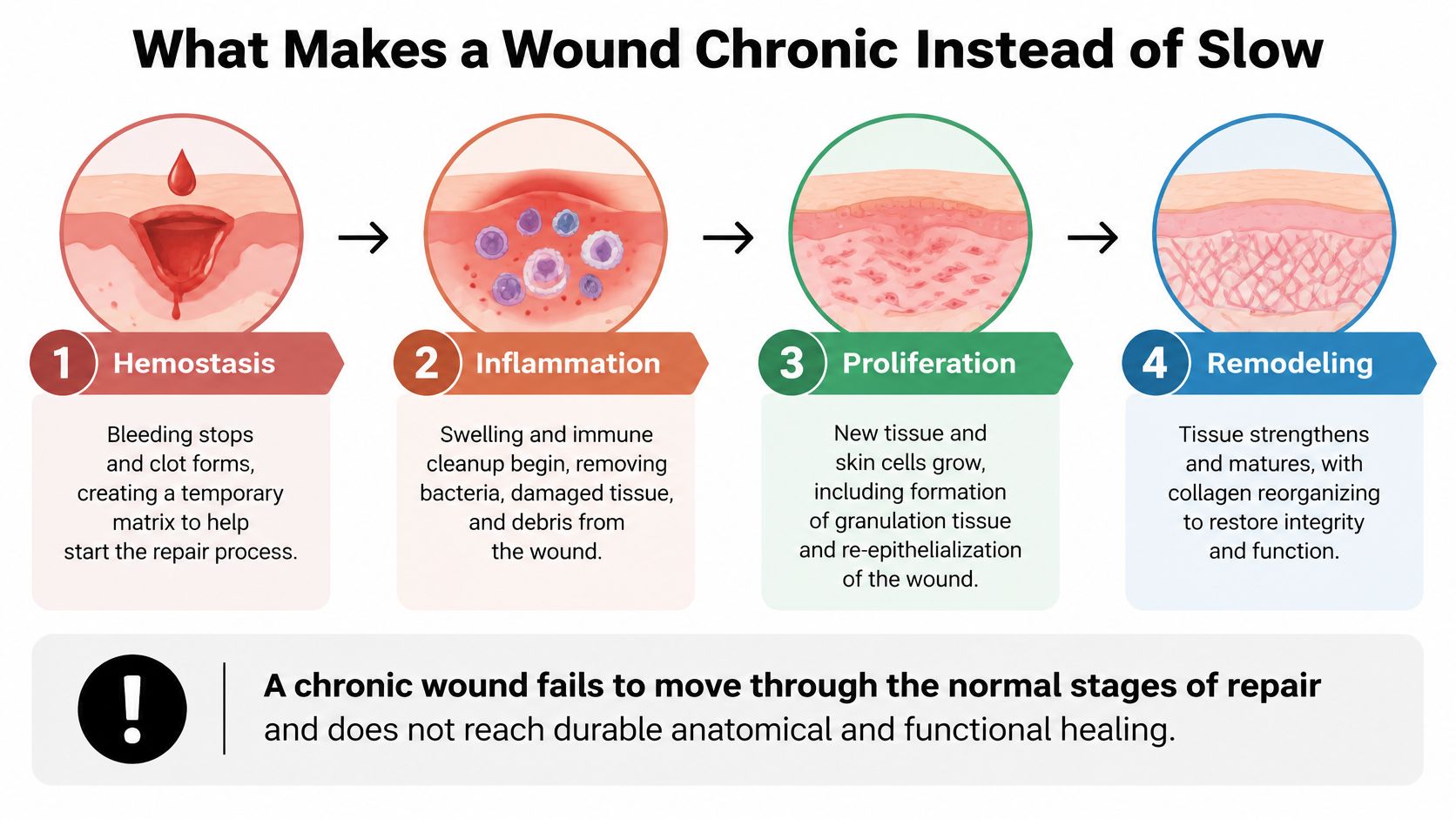
A useful way to picture it is a building site. The plumber finishes before the electrician, the electrician before the drywall, the drywall before the painter. A chronic wound isn't a site where everyone is working slowly. It's a site where the electricians never leave, so the drywall crews are still standing in the street with their tools.
Why the calendar keeps moving
There's no single universally accepted duration, and that has created real inconsistency in research and reporting. A review of 669 articles found that 68% did not provide a definition or staging system, and only six articles specified a duration for chronicity. A 2022 international consensus proposed a practical clinical threshold: a wound that has received standard care but hasn't progressed toward healing within 4 weeks should be considered chronic. Other research uses thresholds of 3 weeks or longer, and some literature uses a full 3 months.
| Source of threshold | Timeframe | What counts as chronic |
|---|---|---|
| 2022 international consensus | 4 weeks of standard care | No progress toward healing; less than about 40%-50% closure is treated as hard to heal |
| Common clinical threshold | 3 weeks or longer | Failure to progress toward healing |
| Some literature | 3 months | No sustained anatomical and functional repair |
| 2024 Journal of Wound Care review | 4-12 weeks | Not healed within that window |
Those differences aren't arbitrary. Healing depends on cause, tissue perfusion, infection, pressure, diabetes, venous and arterial disease, nutrition and other patient factors. A 23-year-old with a clean surgical incision and a 74-year-old with diabetes and poor leg circulation shouldn't be judged against the same stopwatch.
The scale explains why this matters beyond one person's leg. A 2024 Journal of Wound Care study reports that chronic wounds affect approximately 1%-2% of the global population. The 2022 U.S. compendium estimated that 10.5 million Medicare beneficiaries had chronic wounds, up 2.3 million from 2014, equal to 16.3% of the Medicare population in 2019.
A wound that stalls, repeatedly breaks down, develops necrotic tissue, or fails to shrink despite appropriate treatment needs reassessment. Not another month of the same dressing.
Common Types and Causes of Chronic Wounds
Most chronic wounds carry a name that points straight at the cause. That name is the most useful piece of information you have, because it decides which treatment will work and which will waste six weeks.
| Wound type | Main driver | Typical feature |
|---|---|---|
| Venous leg ulcer | Venous insufficiency and high venous pressure | Ankle swelling, brownish skin discoloration |
| Arterial ulcer | Reduced arterial blood flow | Pale or cool foot, pain, tissue loss |
| Diabetic foot ulcer | Neuropathy, pressure and infection | Loss of sensation, callus, foot deformity |
| Pressure injury | Sustained pressure and reduced movement | Bony prominence such as heel, sacrum or hip |
| Surgical wound dehiscence | Infection, tension or poor healing after surgery | Wound opening, drainage, exposed tissue |
Consider a woman with long-standing varicose veins and ankle swelling whose leg ulcer barely shrinks after three weeks of diligent dressing changes. The dressings are fine. The problem is the column of high-pressure venous blood sitting in her lower leg, leaking protein and fluid into the skin and keeping the wound wet and inflamed. Swap the dressing ten times and nothing changes. Address the pressure with compression, once blood flow has been checked, and the wound finally has a chance.
One wound, several drivers
Many chronic wounds have more than one cause, which is where guesswork becomes dangerous. A patient with diabetes may have neuropathy that hides a blister, arterial narrowing that starves the tissue, and a shoe that presses on the same spot every day. Treat only the infection and the other two keep the wound open.
That's why cause comes before product. At our wound practice, the first question is never which dressing to use. It's which of these drivers is present, and whether we've tested for it rather than assumed it.
Why Some Wounds Get Stuck in Inflammation
The defining biological problem in many chronic wounds is a loop that feeds itself, described in detail in this review of chronic wound biology. It runs in four steps.
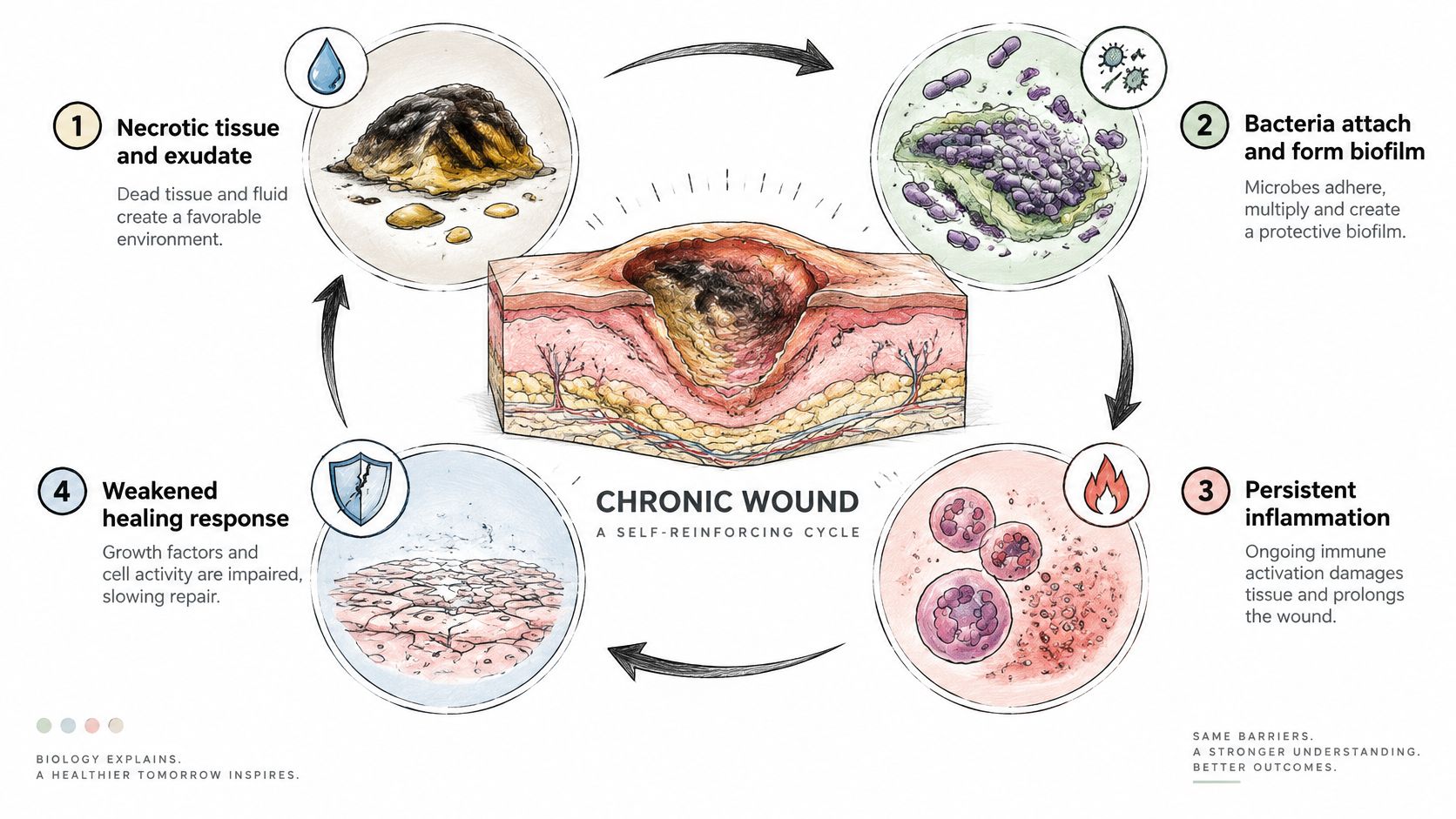
- The wound bed becomes friendly to bacteria. Necrotic tissue, exudate and weakened host defenses let bacteria attach and build biofilms, which are structured microbial communities inside an extracellular matrix that reduces penetration of antimicrobials and limits immune-cell activity.
- The immune response stays switched on. Persistent microbial stimulation keeps neutrophils and macrophages flooding in, releasing inflammatory mediators including IL-6, IL-10, IL-17A and TNF-α.
- Enzymes start eating the scaffolding. Excessive protease activity degrades the extracellular-matrix proteins and growth factors that repair depends on.
- Repair stalls, which buys the biofilm more time. Fibroblast activity, keratinocyte migration, wound contraction, angiogenesis and re-epithelialization all slow down.
The everyday version of this is a jammed doorway. Everyone inside pushes harder to get out, which wedges the door tighter, which makes the next person push harder still. Adding force to a stuck system doesn't unstick it.
What the loop means in practice: the answer to a stalled wound is usually not more antibiotic. Biofilm evidence supports repeated reassessment and appropriate debridement, but it doesn't justify indiscriminate systemic antibiotics. Treatment follows infection findings, perfusion, tissue viability and the wound's underlying cause.
Warning Signs That Call for Specialist Review
The sharper test than duration is trajectory. A practical consensus benchmark classifies a wound as chronic or hard to heal when it has achieved less than approximately 40%-50% closure after 4 weeks of appropriate standard care, as this wound journal analysis sets out. The advantage is that it catches treatment failure early instead of waiting out a calendar.
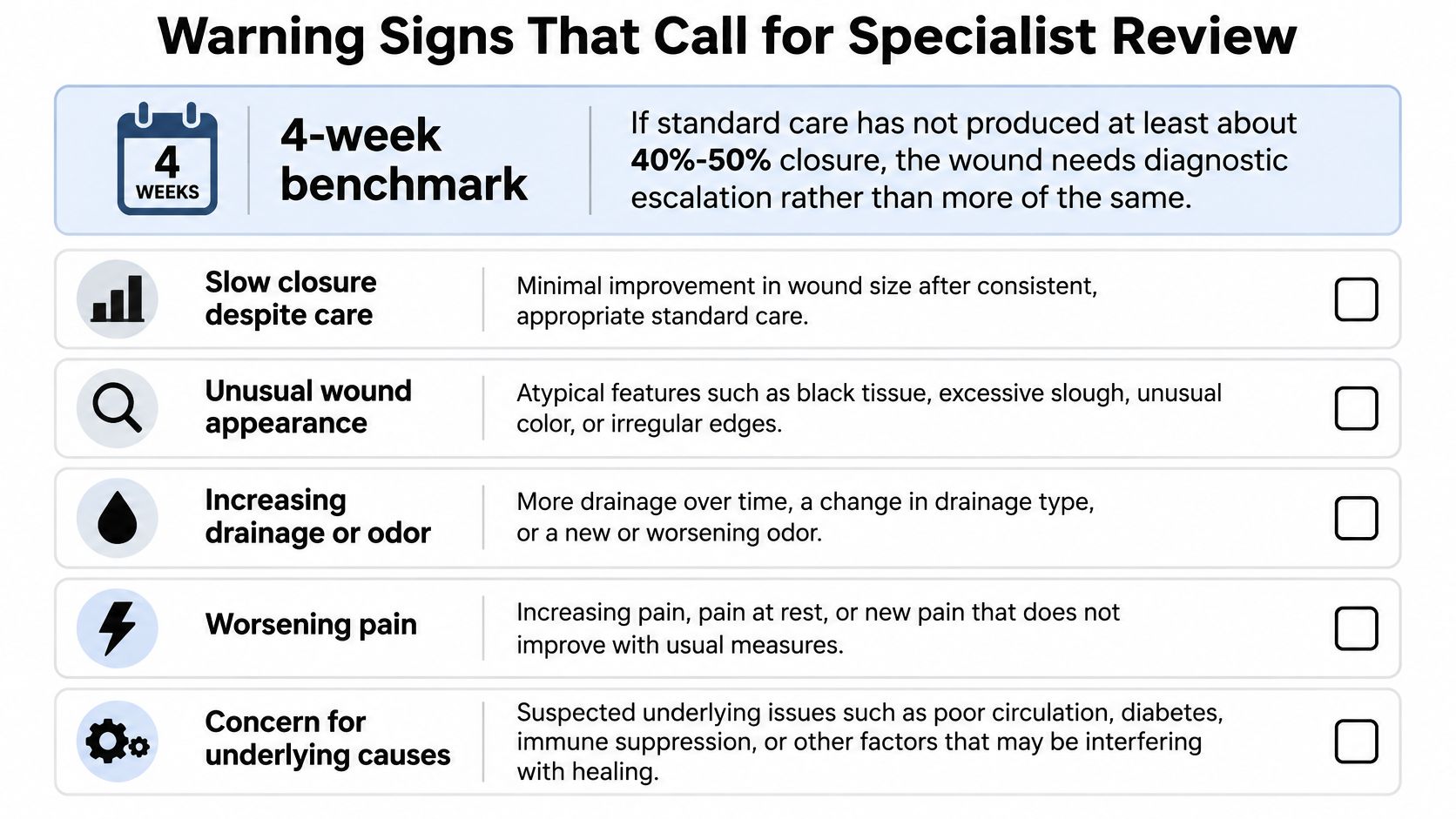
Our clinical team lists eight indicators that a wound may deserve surgical evaluation, and each one has a reason behind it.
- No measurable size reduction: if a ruler says the same number three weeks running, the current plan isn't working.
- Necrotic or dead tissue: black or yellow tissue can hide infection underneath and physically blocks new cells from crossing the wound.
- Persistent undermining: pockets tunnelling under intact skin trap fluid and bacteria where a dressing can't reach.
- Infected tissue or recurrent cellulitis: repeated rounds of redness spreading up the limb suggest a source that hasn't been controlled.
- Exposed tendon or bone: open structures raise the risk of deep infection and change what treatment is appropriate.
- Persistent slough: soft yellow debris keeps the wound bed from granulating.
- Recurrent wound breakdown: a wound that keeps reopening after closing points at an unaddressed cause, often pressure or venous disease.
- Minimal improvement despite appropriate evidence-based care: the plan was right and the wound still didn't respond, which is information, not failure.
What to bring to the visit
Measure length, width and depth on the same day each week, with the same ruler and the same light. Photograph the wound beside that ruler so the trend is visible even when memory isn't. Write down drainage, odor, pain and any fever, and bring your medication list and recent blood glucose readings if you have diabetes.
One clarification for anyone hesitating: an assessment is not a decision to operate. Conservative care stays the foundation. A review answers the question of why the wound has stopped, and that answer is often a dressing change, a compression plan, better off-loading or a medication adjustment.
How Clinicians Evaluate and Treat Chronic Wounds
Treatment follows the cause, so evaluation comes first. The table below is the menu, and the assessment is what tells you which row applies.
| Treatment | Used for | What it addresses |
|---|---|---|
| Sharp or surgical debridement | Necrotic and devitalized tissue | Removes tissue that harbors bacteria and blocks healing |
| Compression therapy | Venous leg ulcers | Reduces venous pressure and edema, after perfusion is checked |
| Off-loading | Diabetic foot and pressure wounds | Relieves repeated pressure on the wound |
| Revascularization referral | Arterial insufficiency | Restores blood flow so wound care can succeed |
| Infection control | Clinical infection or recurrent cellulitis | Targets infection guided by clinical signs |
| Advanced dressings | Wounds matched to exudate level | Maintains a moist, controlled healing environment |
| Surgical wound care | Exposed bone or tendon, deep infection, failed conservative care | Closes or reconstructs tissue when conservative care fails |
The evaluation itself is a sequence rather than a single test. First comes history: diabetes, vascular disease, medications that interfere with healing such as steroids, smoking, and nutrition, including protein intake. Then wound measurement, so there's a baseline to compare against. Perfusion comes next, starting with pulse assessment and moving to an ankle-brachial index or Doppler study when the pulses are weak or the wound looks arterial.
Pressure and off-loading get reviewed in parallel, because a diabetic foot ulcer under a weight-bearing callus won't close no matter how good the dressing is. Infection is assessed from clinical signs rather than swab results alone, since a positive culture from a colonized wound tells you about bacteria, not about infection. If bone involvement is suspected, imaging follows.
The ordering rule that prevents harm: compression heals venous ulcers and can damage arterial ones. The cause sets the choice, which is why perfusion gets checked before any wrap goes on.
Reassessment runs on a schedule, not on intuition. Measure every one to two weeks with a consistent method, and change the plan when the measured trend stays flat. Advanced options such as advanced wound care therapies are added on top of a correct diagnosis, never in place of one.
Barriers That Keep a Wound From Healing
The assumption worth challenging is that a nonhealing wound means a noncompliant patient. Often it means a plan that was never deliverable. A 2025 Association for the Advancement of Wound Care task-force report identifies cost, inadequate insurance coverage, local unavailability of services, lack of culturally competent care, and unequal access to dressings, cleansers, advanced therapies and specialty referral as drivers of different outcomes.
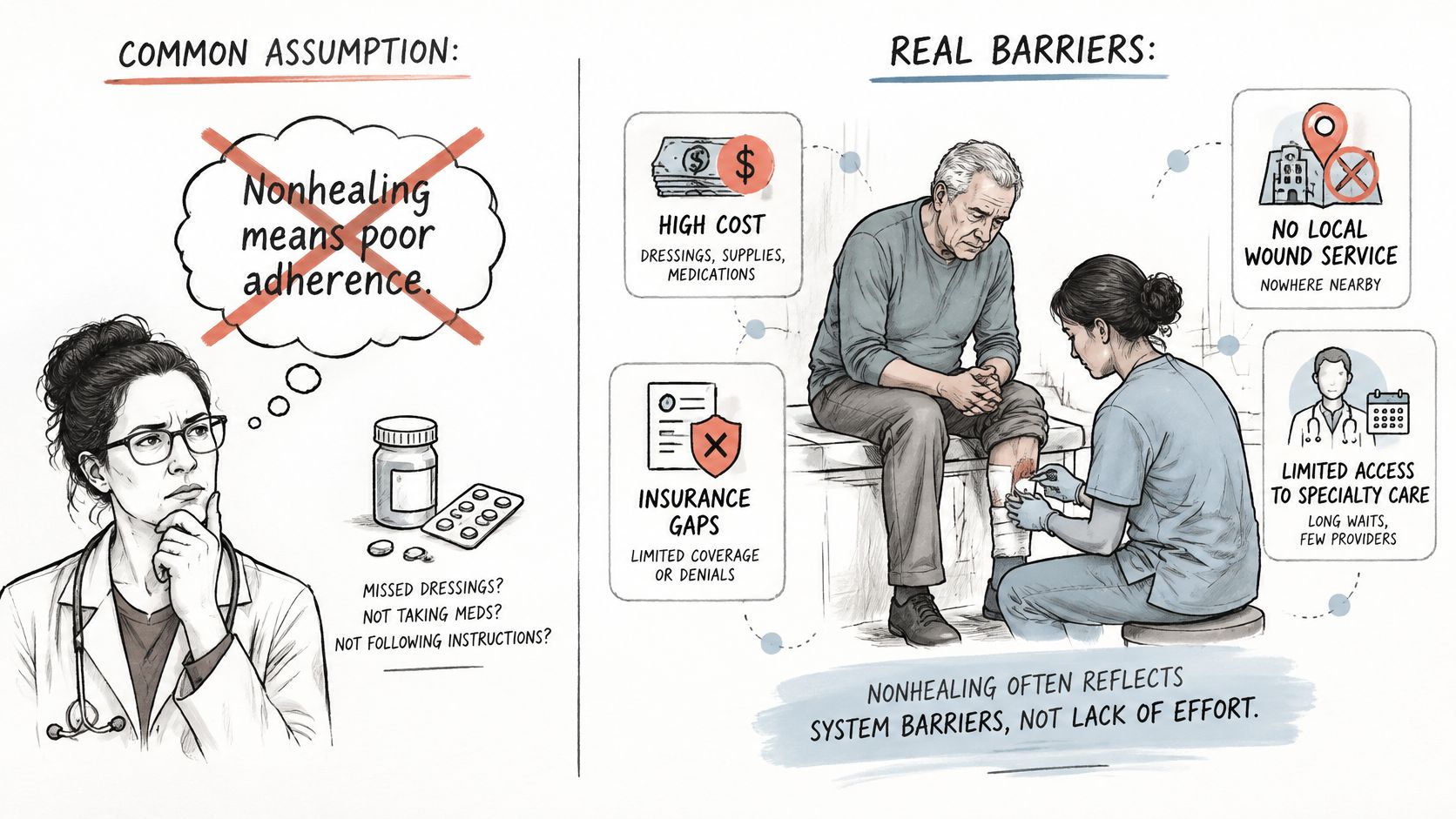
That same review describes chronic-wound self-care as shaped by pain, other medical conditions, functional limits, socioeconomic inequality, limited education, insufficient social support and health-system barriers. The finding is blunt: nonhealing isn't always biological resistance or patient "noncompliance". It may be transport, supply shortages, a caregiver who can't physically lift the patient, food insecurity, housing conditions, or instructions that don't fit the shape of a real day.
Run a barrier audit alongside the medical one
- Can you reach appointments? If transport is the obstacle, virtual review closes the gap without a long drive.
- Can supplies be stored and restocked weekly? Running out on a Friday night means three days of the wrong dressing.
- Can someone change the dressing as instructed? Not everyone has a caregiver with the hands, eyes and time for it.
- Is adequate protein and medication realistic? Nutrition and prescriptions depend on budget and access to a grocery store.
- Can pressure be relieved at home? Off-loading fails if the equipment never arrives.
- Who gets called when the wound changes? A named contact beats a phone tree.
The video below walks through how these practical gaps show up in day-to-day wound care.
Each gap is a problem to solve, not a character flaw. None of it changes the medical foundation. Conservative treatment stays the base, and removing the obstacles is what lets it work.
Decide Whether to Get a Specialist Evaluation
A stalled wound is a process problem before it is a permanent one. The decision comes down to two questions: is the wound measurably improving on the current plan, and are the barriers around that plan being removed? Work through the steps in order.
- Start the log today. Measure and photograph on the same day each week from now on, because a trend needs a starting point.
- Set the trigger. If the wound isn't tracking toward closure, or any warning sign appears, book a review with the treating clinician within days rather than waiting for the next routine slot.
- Bring the whole picture. Ask for perfusion and infection to be checked, and share the answers from your barrier audit with the clinician. A plan that looks correct on paper still fails if transport, supplies or caregiver support can't carry it out.
- Close the loop. Send the same measurements and audit to every clinician involved, so each one works from identical numbers.
A specialist evaluation is usually lighter than people expect. A wound surgeon reviews your history, images and treatment response by video, often within days, so the material gets examined before anyone travels. A surgical wound-care nurse then validates the wound in person to confirm what was seen. When a wound is already under specialty care, that review follows an escalation pathway for surgical wound evaluation. An evaluation does not automatically lead to surgery, and individual results vary with wound type, health history and care plan.
The rule to carry out of all of this is simple. A wound that isn't getting smaller on the current plan gets reassessed. It doesn't get watched.
---
If a wound has stopped shrinking or keeps reopening, Wound Services reviews complex and stalled wounds virtually or in person and coordinates with the providers already treating you, so visit cwswounds.com to start that review.