
The stop point depends on why the packing was placed, not on how shallow the opening looks or a fixed number of days. Routine cavity packing should be reassessed once bleeding is controlled, on the treating clinician's schedule. The clinician can check whether meaningful dead space still needs filling. Stopping remains a clinician's decision.
Gauze used to control bleeding has a different job from gauze loosely placed in a healing cavity. A wound may look smaller at the opening while a pocket remains underneath. Conversely, an open abscess cavity does not automatically need continued packing. The reason for packing guides the next step.
Pain, drainage, and messy dressing changes can make the decision feel urgent. Ask for a clear reason if packing should continue, when the wound should be reassessed, and what dressing to use next. Do not stop or change the packing based on appearance alone.
## Table of Contents - Why the Packing Was Placed - Match the material to its job - Why an abscess deserves a fresh decision - When to Ask About Stopping the Packing - Don't confuse changing packing with continuing it - A stalled wound needs assessment, not more stuffing - How to Follow Each Change and When to Get Help - Follow the order and record what changed - A missing piece isn't a reason to dig - Pain and mess still need interpretation - Healing Times With and Without Packing - Compare the outcomes without turning them into deadlines - What these comparisons don't permit - Confirm the Plan Before You Stop - Keep appropriate conservative care in place - Get answers you can use at the next change
Why the Packing Was Placed
Say you're caring for someone whose abscess was drained. It's the sixth day of changing gauze, the bleeding stopped early, and the discharge paperwork still says to pack daily. Each change hurts, but you're worried that leaving out the gauze will let the skin close too soon.
That situation calls for clarification of the order, not an independent decision to stop. A daily-change instruction tells you how to manage packing while it's prescribed. It doesn't necessarily explain how long the prescription should continue.
Match the material to its job
Packing is a temporary, countable intervention. Before discussing removal, identify which purpose the treating clinician intended:
- Short-term bleeding control. Material applies pressure within a bleeding cavity. Removing it prematurely can disturb bleeding control.
- Loose filling of dead space. Dead space means an underlying pocket that still needs management, rather than an opening visible at the skin.
- Contact within a tunnel or undermined area. A tunnel is a narrow passage extending from the wound. Undermining is a pocket beneath an overhanging skin edge.
- Surgical damage control. A surgeon may place gauze during an operation with a planned return to remove or exchange it.
These purposes aren't interchangeable. Instructions for loosely filling a healing wound must never be used to decide how to remove emergency or operative bleeding-control packing.
Practical rule: Ask what finding proves that the packing still has a useful job. A pink wound bed or a smaller opening isn't enough by itself.
Why an abscess deserves a fresh decision
Continued packing isn't automatically protective after an abscess has been drained. A 2024 systematic review and meta-analysis of three randomized trials involving 490 patients found that prolonged packing of anorectal abscess cavities was associated with more pain and delayed healing, without reducing recurrence or fistula formation.
That finding applies to a particular kind of wound. It doesn't authorize caregivers to remove packing from traumatic injuries or postoperative cavities with different risks.
For a complex wound, an advanced wound-care assessment can help distinguish an ongoing treatment need from an instruction that needs updating. Ask the ordering clinician to document the indication, the finding that would end packing, and the transition plan. Use the purpose-based comparison below to organize that conversation, but don't pull material placed for bleeding control on your own.
When to Ask About Stopping the Packing
Find the row that matches the written reason for packing, not just the wound's nickname. An abscess, surgical incision, or pressure wound can have different packing needs at different stages.
When packing still helps and when to ask to stop
| Packing purpose | Keep or modify when | Ask before stopping when | Usual reassessment |
|---|---|---|---|
| Drained abscess cavity | Bleeding, a deep or irregular cavity, exposed structures, poor drainage, or a written surgical order still requires management | Bleeding is controlled and drainage is adequate. An open skin surface alone doesn't establish a need to continue | After the initial bleeding-control period, according to the treating clinician's plan |
| Hemorrhage or damage-control gauze | Removal could restart bleeding and requires a planned procedure | Always. Removal isn't a home-care decision | At the surgeon's planned review or reoperation |
| Dead space, undermining, or tunnel | A meaningful pocket still needs loose filling because a surface dressing can't reach the wound bed adequately | The cavity no longer requires internal fill | At every ordered change, using the clinician's measurements |
| Chronic or repeatedly stalled wound | Necrosis, persistent undermining, infection, or exposed tendon or bone requires reassessment of the treatment plan | There's no size reduction, repeated breakdown, or little improvement despite appropriate care | Prompt clinician review, not indefinite repetition of the same packing |
| Shallow wound with no dead space | Packing shouldn't be used to separate tissue planes or create tight pressure | A non-packing dressing can contact the wound surface adequately | At the next ordered change, with clinician approval |
Don't confuse changing packing with continuing it
The World Health Organization wound-management guidance/csy/surgical-care/imeesc-toolkit/best-practice-safety-protocols/wound-management.pdf) describes managing an open infected wound with lightly placed damp saline gauze, a dry covering, and packing and dressing changes at least daily. That's a description of care while packing is indicated, not proof that every drained cavity should remain packed until closure.
For a drained abscess, the useful question is whether the initial reason for packing remains. If bleeding has stopped and drainage is adequate, ask whether the clinician wants another internal pack or a cover dressing instead.
A different plan may still be appropriate for active bleeding, unusual cavity shape, exposed structures, impaired drainage, or specific surgical instructions. Don't discard those instructions because someone else's abscess was treated without ongoing packing.
A stalled wound needs assessment, not more stuffing
Comfort matters, but it isn't the only decision point. Less pain doesn't prove that a tunnel has resolved, and more pain doesn't mean the answer is to use less gauze without checking the wound.
Likewise, a wound that isn't shrinking needs a review of the cause. Persistent undermining, dead tissue, recurrent infection, or exposed tendon or bone may require changes beyond the packing material itself.
For a shallow wound, the clinician may decide that an appropriate surface dressing can now do the necessary work. Stopping internal packing doesn't mean stopping wound care. Cleaning, covering, drainage management, and follow-up may still be needed.
Please confirm why this wound still needs internal packing, what finding would end it, when you'll reassess it, and which dressing should replace it.
Use that wording when calling the office or home-health team. If the written order doesn't answer those questions, request an updated order that everyone involved in the dressing changes can follow.
How to Follow Each Change and When to Get Help
Home packing should happen only when the care team has specifically taught you how to manage that wound. A written description can't establish whether a cavity is safe for a caregiver to explore or pack.
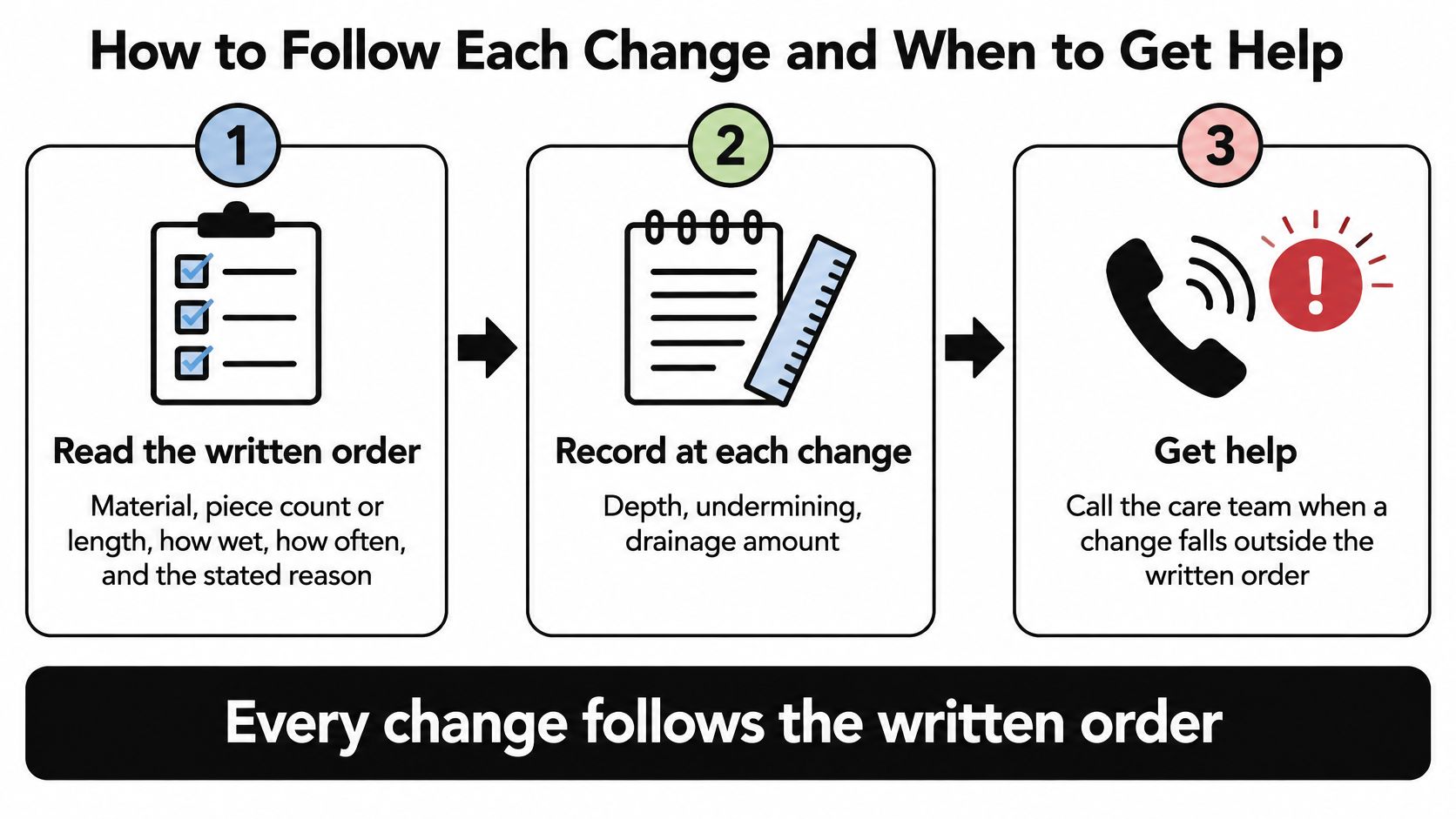
Every change follows the written order. If the wound, material, or removal doesn't match what you were taught, stop and contact the team rather than improvising.
Follow the order and record what changed
The Queen Elizabeth Hospital wound-care guidance supports assessing wound depth, undermining, drainage, tissue condition, and infection signs, while placing packing loosely rather than compressing the wound bed. The practical endpoint is management of a clinically meaningful cavity, not fitting in as much material as possible.
- Read the order before opening supplies. Confirm the material, piece count or length, prescribed moisture, change frequency, and reason for packing. Know who to call if removal is difficult or the wound looks different. Don't substitute a different product because it looks similar.
- Check the previous record and remove only as taught. Distinguish the outer cover dressing from the material inside the wound. Compare the removed packing with the recorded amount before inserting anything new. If you encounter unexpected resistance, new bleeding, or material that appears embedded, don't pull harder.
- Record observations without exploring beyond your training. Note drainage amount and color, odor, pain, surrounding redness, and the visible tissue. Use measurements taken by the clinician or follow the measurement method you've specifically been taught. Probing a tunnel isn't a routine task for an untrained caregiver.
- Place prescribed material gently. For routine cavity filling, the aim is contact without stuffing, pressure, or forcing tissue apart. Use the ordered material and amount, not a collection of small scraps. A wound that suddenly accepts much more or less material needs clarification rather than an attempt to reproduce yesterday's volume.
- Leave the retrieval end visible and apply the prescribed cover. The Hong Kong Hospital Authority retained-packing safety guidance recommends a continuous piece where possible, an exposed end of about 3 cm when the site and wound size allow, and verification of the amount removed; it also describes planned operative removal or exchange of damage-control packing, often within 24–72 hours, with timing balanced against rebleeding risk.
- Complete the record. Document material type, number or length, location, depth if assessed, insertion date and time, and intended removal or exchange. Record whether the previous packing came out completely. Keep the information where the next caregiver or nurse can find it.
- Change to a non-packing dressing only after approval. The clinician should confirm that the wound no longer requires internal filling and specify the replacement dressing. Don't continue adding a tiny strip just because packing has become part of the routine.
A missing piece isn't a reason to dig
If the amount removed doesn't match the record, treat that as possible retained material. Don't assume a missing strip dissolved, fell out unnoticed, or is harmless.
Contact the care team promptly and tell them exactly what was inserted, what came out, and what's uncertain. Don't probe with tweezers, push another piece over a suspected retained pack, or cut off a retrieval tail.
Retained material can contribute to infection and persistent nonhealing. A clinician may need to examine the wound and decide whether imaging or exploration is necessary.
Packing should be accounted for when it goes in and when it comes out. A count mismatch needs professional review, not a deeper search at home.
Pain and mess still need interpretation
Drainage on the outer dressing doesn't, by itself, tell you whether packing should continue. Describe how quickly the dressing becomes wet, whether the drainage has changed, and whether swelling or pain is increasing.
Overpacking can cause pressure injury, maceration or softened wet skin, pain, and delayed healing. Don't dismiss pain that becomes worse after each change as proof that the packing is working.
Contact the treating team the same day for:
- Infection concerns: Fever, spreading redness, pus, recurrent swelling, or foul odor, especially with feeling unwell.
- Bleeding or removal problems: New or heavier bleeding, a missing retrieval tail, resistant packing, or an incomplete count.
- A worsening pattern: Increasing pain, persistent drainage, repeated breakdown, or failure to reduce in size.
Heavy uncontrolled bleeding, fainting, confusion, or rapid deterioration requires emergency care, not a routine message to the clinic. Don't independently remove packing that's controlling bleeding.
When progress has stalled despite appropriate care, a structured wound-care escalation pathway can help organize further assessment. That review should address why the wound isn't improving, rather than renewing the same daily packing instruction.
Healing Times With and Without Packing
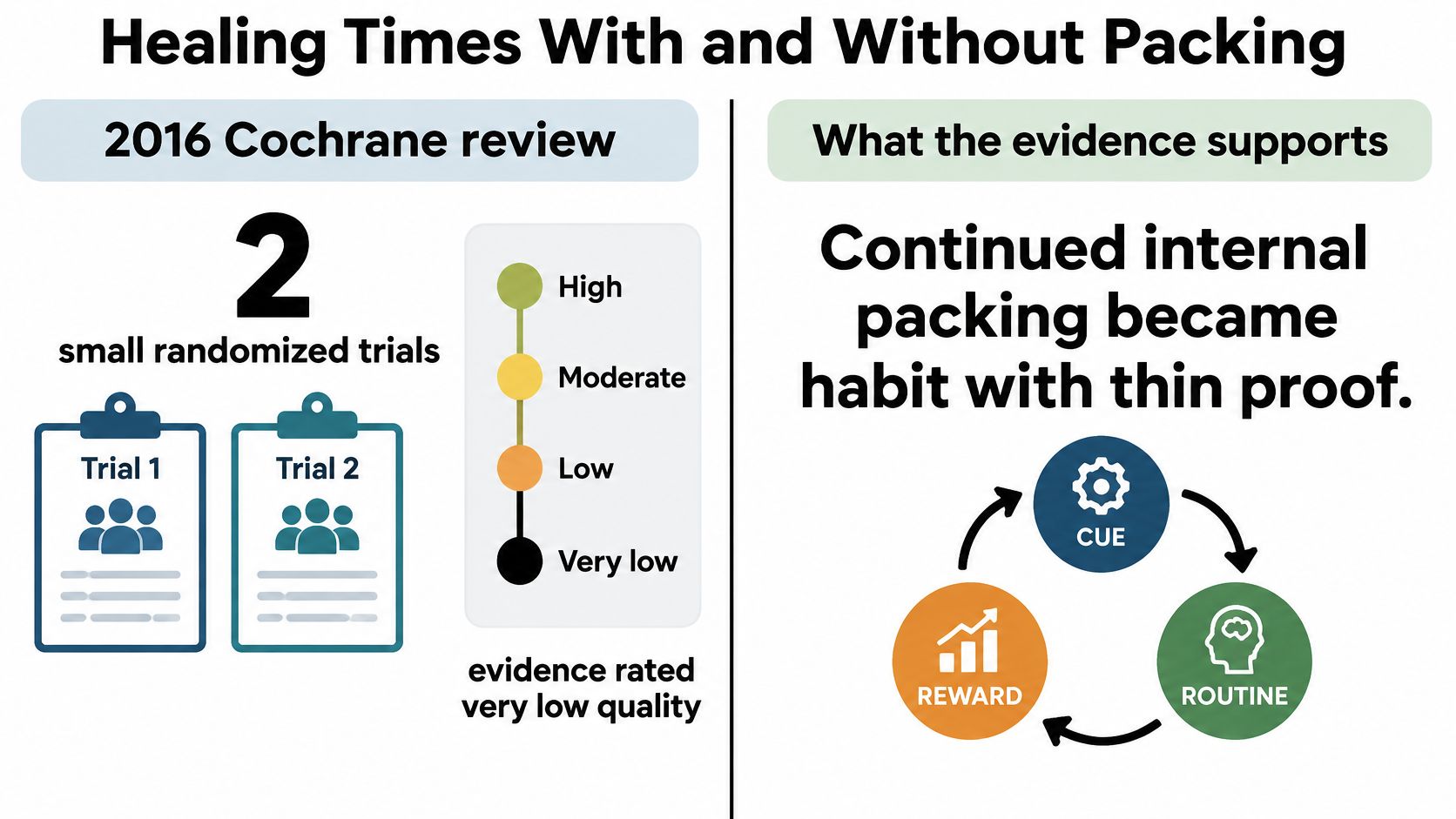
A wound may look smaller before it is ready for packing to stop, and an open cavity may still be healing well. The right stopping point depends on why the material was placed: to control bleeding, fill dead space, reach a tunnel, or provide temporary damage control. Study averages can inform a discussion, but they cannot set an individual deadline.
Routine internal packing became common despite limited proof of benefit. The 2016 Cochrane review of internal dressings for perianal abscess cavities identified two small randomized trials and rated the evidence very low quality. One trial reported mean healing times of 26.8 days with packing and 19.5 days without. The other reported median times of 24.5 days and 21 days, respectively.
Compare the outcomes without turning them into deadlines
Healing with continued packing versus limited or no packing
| Evidence | Continued packing | Limited or no ongoing packing | Read it as |
|---|---|---|---|
| Cochrane review, first small trial, mean healing | 26.8 days | 19.5 days | The evidence was very low quality and could not establish a reliable timetable. |
| Cochrane review, second small trial, median healing | 24.5 days | 21 days | The direction favored less packing, but the result does not predict an individual's healing time. |
A mean is the average of participants' healing times. A median is the midpoint: half healed sooner and half later. Neither is a target date for your wound.
The early trials were small, and their results do not establish that stopping packing will shorten healing by a particular number of days. They do support asking whether packing still serves a purpose. A result from a study of abscess cavities also cannot decide what to do with gauze placed for bleeding control, a tunnel, or another specific need.
What these comparisons don't permit
The evidence does not authorize removing material that is controlling bleeding, disregarding an operative plan, or assuming that a tunnel can be managed with a surface dressing alone. The reason packing was placed still matters. A shallower appearance is not, by itself, a signal to stop, just as an open skin surface does not prove that packing remains useful.
Nor does a study average tell a caregiver to stop before the planned review. The treating clinician must decide whether the original purpose has been met and whether another approach fits the wound. Continued packing needs a clinical reason, not just the fact that the opening has not closed.
For patients asking when to stop packing a wound, the useful question is: Does packing still address a specific problem in this wound? If it no longer serves its original purpose, the clinician may recommend a different dressing or another plan. If the purpose remains, the plan may need to continue or be adjusted. Ask for instructions that make clear what packing is meant to do and when the clinician will reassess it.
Confirm the Plan Before You Stop
Before the next change, contact the clinician who wrote the order if the purpose is unclear, pain is rising, removal has become difficult, or measurements aren't improving. Have the written instructions and dressing-change record available so the conversation can lead to a specific decision.
Describe the original indication, latest measurements, change in pain, drainage pattern, and whether the removed material matched the record. Those details are more useful than saying the wound looks better or worse.
Keep appropriate conservative care in place
An evaluation doesn't automatically mean surgery. Conservative care remains the foundation, including prescribed dressings and, when appropriate for the condition, offloading, compression, nutrition support, pressure relief, and treatment of the cause of the wound.
Don't independently add compression or change pressure-management instructions. These measures need to fit the wound and the patient's medical condition.
A specialist review becomes reasonable when the current plan isn't producing progress. At Wound Services, we consider findings such as:
- Absent progress: No measurable size reduction or minimal improvement despite appropriate evidence-based care.
- Unresolved tissue problems: Necrotic tissue, persistent slough, or ongoing undermining.
- Infection or exposure: Infected tissue, recurrent cellulitis, or exposed tendon or bone.
- Repeated failure to stay closed: Recurrent wound breakdown.
Our approach begins with conservative care, recognizes when progress has stopped, and uses surgical judgment to decide whether intervention is appropriate. We coordinate recommendations with the existing care team rather than treating a referral as an automatic decision to operate.
Get answers you can use at the next change
Ask the ordering clinician these questions:
- Why is this wound still being packed?
- What specific finding would end internal packing?
- When is the next reassessment?
- Which cover dressing replaces the gauze, and how should it be changed?
Request written answers if several family members or home-health staff share care. The patient information page can help you prepare for specialty review when the current plan has stalled.
The safest outcome isn't permission to stop. It's an updated plan that explains what to remove, what to apply, what to watch for, and who will reassess the wound. Until that plan is confirmed, don't forcibly remove packing or improvise a replacement.
---
Wound Services offers virtual and in-person specialty evaluation for complex, stalled, and recurrent wounds, with recommendations coordinated with your current clinicians. If continued packing has no clear endpoint or your wound isn't progressing, visit Comprehensive Wound Services to request a review, and bring your packing order, wound measurements, and dressing-change record.