Fewer than half of grafts are fully closed one week after surgery. In a published study of skin-grafted burn wounds, complete healing took between 2 and 75 days, and at postoperative day 7 only 46% of grafts had reached 100% wound closure, as reported in Plastic and Reconstructive Surgery. Most patients in that cohort healed within about 2 weeks, yet some needed many more weeks. That spread is why skin graft wound care can't follow one calendar. You're caring for two wounds, the graft and the donor site. A dry, untouched dressing is only the first instruction. What matters is whether the graft is progressing, whether fluid is pooling under it, and whether the donor site is becoming its own problem with pain, scarring, and limits on daily life.
## Table of Contents - Graft Healing Timeline and Checkpoints - What you can track at home - How to Protect the Graft Step by Step - Seven steps and the reason for each - How to Choose a Donor Site Dressing - How to take a stuck dressing off - Donor Site Pain, Scarring and Daily Limits - Soreness versus pain that should be rechecked - Warning Signs and the Escalation Ladder - Three tiers, not one phone number - While you wait - What normal progress looks like - Confirm Your Follow-Up Plan Before Discharge
Graft Healing Timeline and Checkpoints
Use the phases below as a shared checklist, then write your surgeon's actual dates into the empty margin of your discharge papers so the table becomes yours.
| Phase | Typical timing | Graft care focus | Donor site focus |
|---|---|---|---|
| Early postoperative | Days 0-3 | Dressing left undisturbed unless soaked or loose | Dressing left in place; watch for bleeding |
| First dressing review | Set by surgeon, often days 3-7 | Check for hematoma, seroma and edge lift | Assess drainage and choose coverage |
| Day 7 checkpoint | Day 7 | 46% of grafts fully closed in the burn cohort | Record percent re-epithelialized |
| Typical closure | About 2 weeks | Most grafts healed in the burn cohort | Epithelium usually closing under a moist dressing |
| Full range | 2-75 days | Recovery time varies widely | Individual review required |
In that burn-wound cohort, no grafts were lost to infection, while graft loss from seroma was significantly tied to longer healing. Other delays lined up with lower preoperative prealbumin, hypergranulation tissue, and burns caused by hot solids. Early closure is common and not guaranteed. If your graft isn't sealed at day 7, that doesn't mean it has failed. It means the next review should look for fluid, nutrition, and the wound bed, not just "slow healing."
What you can track at home
First review date: That's the day the surgeon set, not a day you pick because the dressing looks boring.
Edge seal: Pink edges that stay put are a better sign than a pale center you keep peeking at.
Donor weeping: Note whether the donor dressing is still wet, and roughly how much of that wound looks re-epithelialized at each visit.
Nutrition and shear: Skipping protein and rubbing the graft across a sheet both slow the same clock.
Practical rule: If the graft isn't smaller or more sealed from one planned check to the next, call rather than waiting out the full 75-day end of the range.
Between visits, a photo taken in the same light can be shared through remote wound monitoring so the clinic sees the trend, not just your memory of it. Write every dressing-change date the surgeon named into this table before you leave the building.
How to Protect the Graft Step by Step
The graft survives only while it stays stuck to a living bed. Early peels, walking across it, and a failed seal are the slips that undo a careful operation.
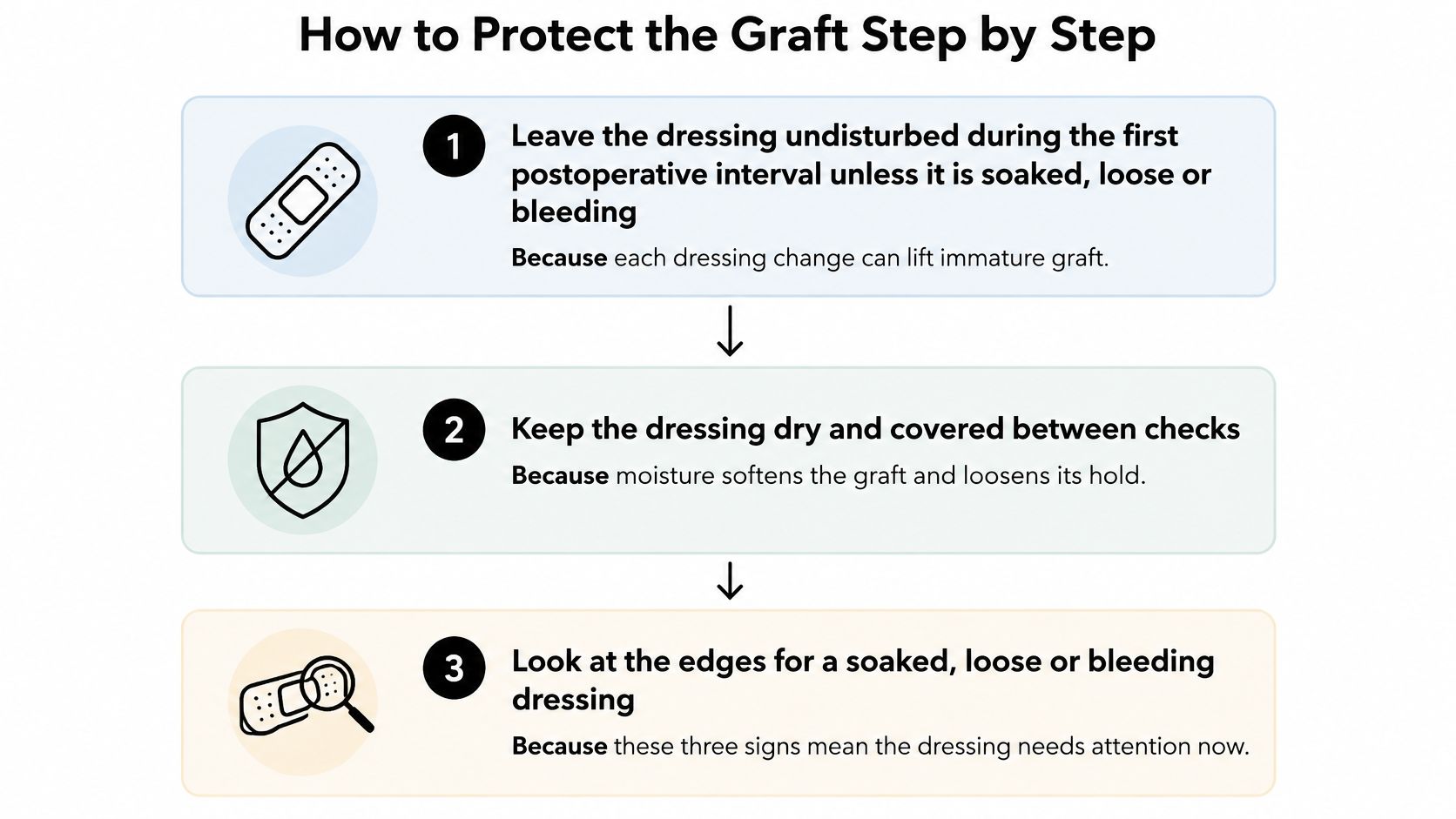
A retrospective analysis of split-thickness grafts found about 80% lower odds of graft failure with negative-pressure wound therapy versus a bolster alone (OR 0.203, p=0.0308), as reported by Georgetown Medical Review. In that same cohort, pre-existing bacterial burden carried roughly 2.89-fold higher failure odds, and congestive heart failure carried 2.55-fold higher odds. Take those as reasons to protect contact and to speak up early, not as a promise that any one dressing wins.
Seven steps and the reason for each
- Leave the first dressing alone unless it is soaked, loose, bleeding, or the seal on a negative-pressure device has failed. Each early peel can shear graft that hasn't locked to the bed yet. The common slip is "just a quick look" in the bathroom.
- Stop shear. Support the limb, and don't drag clothing, sheets, or a towel across the graft. Shear pulls the graft sideways even when you never touch the dressing. People do this turning in bed.
- Keep pressure off the bolster and raise the limb as directed so fluid doesn't pool underneath. Sitting on the site, or letting a cast edge dig in, recreates the space a hematoma loves. Prop the limb on pillows, not on the graft itself.
- Don't add tape or extra wraps over the surgeon's nonadherent layer and bolster. Extra pressure isn't safer pressure. It wrinkles the graft and hides drainage. If a corner lifts, call instead of reinforcing it with household tape.
- If negative-pressure therapy is on, protect the seal and watch the canister. The device holds the graft against irregular or draining beds and pulls fluid out. A whistling leak or a full canister is a call, not a wait-until-morning problem. Showering over the tubing before you're cleared is the usual mistake.
- Don't walk or stretch across the graft until fixation and blood supply have been checked. Unplanned steps tear immature attachments. "It feels fine" is not a clearance.
- Write down color, swelling, drainage, and odor at every planned change. Dusky color, edge lift, malodor, pus, or pain that's worse than yesterday are the notes that change the plan. Skipping meals and fluids belongs on that same log, because a graft can't build vessels on an empty tank.
This short clip shows how little movement it takes to shift a fresh dressing. Watch it once with the person who helps you at home, then go back to your written limits.
A bolster or a negative-pressure dressing only works if the graft stays flat against living tissue. Showering early, sleeping on the site, and skipping protein are the three habits that undo that contact.
If the graft looks stalled despite this routine, advanced wound care is the point where dressing tweaks give way to a surgical look at the bed.
How to Choose a Donor Site Dressing
The donor site is a second wound in its own right, with its own healing job to finish. It's a partial-thickness wound that closes from the edges and the base, so the dressing's job is moisture without sticking. A dry covering does the opposite: it bonds to new surface cells and lifts them away at the next change.
| Drainage level | Dressing type | Key handling point |
|---|---|---|
| Light to moderate | Polyurethane film | Suited to light-to-moderate drainage; keep the seal intact |
| Moderate | Hydrocolloid | Suited to moderate drainage; check edges at each review |
| Heavy | Calcium alginate | Suited to heavy exudate; change when saturated |
| Dressing stuck to the site | Remove after moistening | Lift slowly; never tear new epithelium |
Match the product to what you see at each check, not to what a neighbor used. Polyurethane film suits lighter drainage and should stay sealed until it's meant to come off. A hydrocolloid handles moderate drainage, and you inspect its edges rather than peeling it daily. Calcium alginate takes heavy exudate and comes off when saturated, not on a fixed morning schedule.
How to take a stuck dressing off
Moisten the stuck layer with saline, wait until it releases, and lift slowly. Tearing "just this corner" restarts the raw surface and the pain. If it won't release, stop and call. Forcing it is how donor sites get larger.
At every review, write seven things: percent re-epithelialized, amount and character of drainage, pain score, odor, fever, redness around the site, and whether the person can tolerate the change. A systematic review summarized on PubMed found moist products superior to non-moist products for healing, infection outcomes, and pain. A newer umbrella review in that same summary linked platelet-rich plasma and human amniotic membrane with better re-epithelialization and less pain, and platelet-rich plasma with fewer infections in the adult studies reviewed. Those are clinician-chosen add-ons. They sit on top of the basics: treating infection, relieving pressure, and feeding the person.
Graft failure and reoperation happen in a real share of cases, so no package insert can guarantee a kitchen-table recovery. The surgeon's instructions on wear time carry more weight than any label, because they reflect your wound's drainage pattern and healing rate. If the site stalls or the drainage trend worsens, the dressing question becomes a wound-bed question, and that's a call, not a product swap.
Ask, before you go home: how long should this exact dressing stay on, and which three things (saturation, leak, or a fever) mean I change it sooner?
Donor Site Pain, Scarring and Daily Limits
Most handouts stop at "keep it dry." They rarely say what the donor site will feel like next month, or why a surviving graft can still wreck sleep.
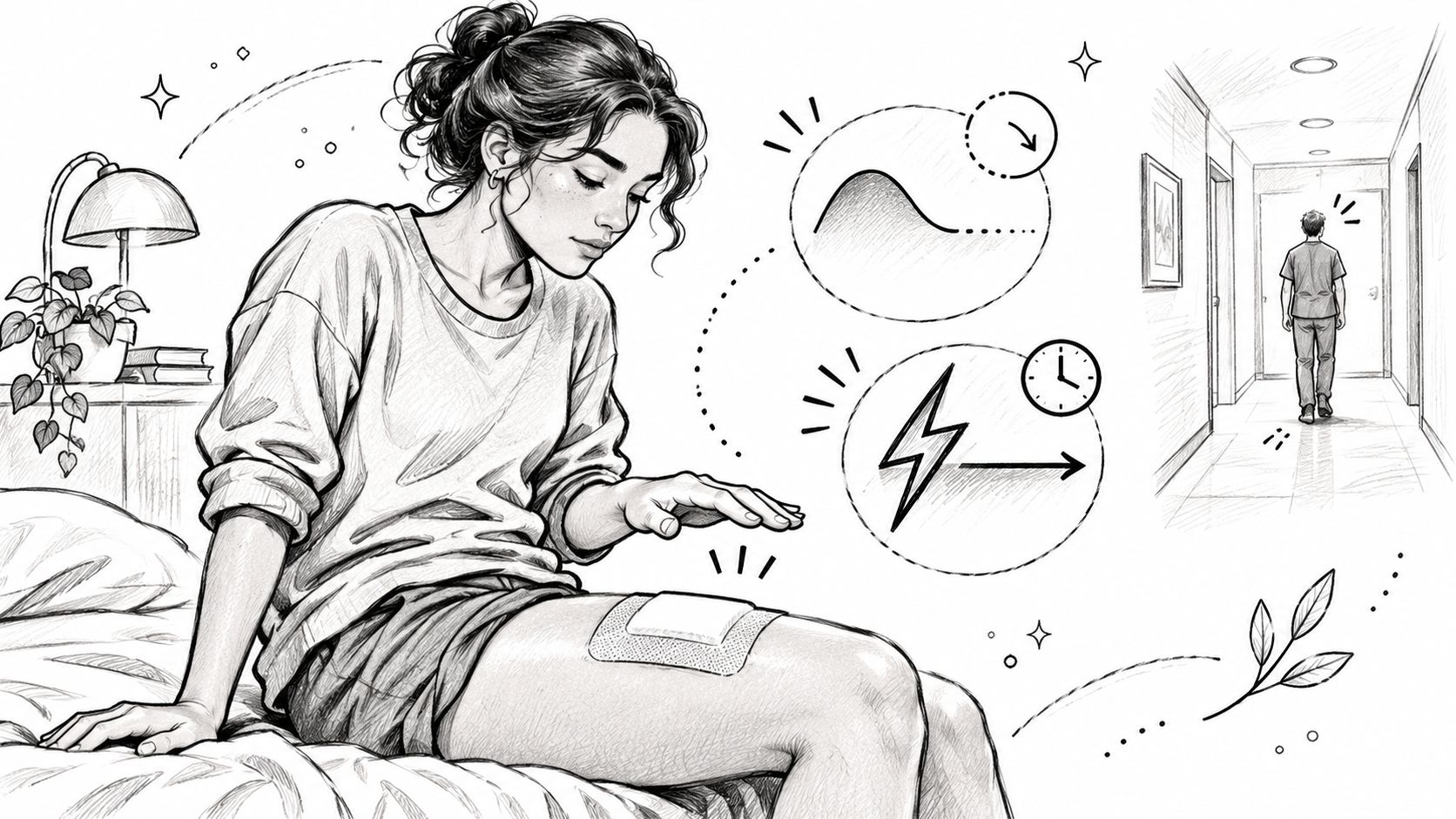
StatPearls notes that donor sites can develop infection, scarring, keloids, hyperesthesia, or chronic pain, and that contrast between donor and recipient skin can worry people with darker skin tones more. Routine sheets tell you to report fever, pus, spreading redness, or bleeding that won't stop. They rarely separate ordinary soreness from pain that needs another look. No single dressing or calendar fits every graft type, body site, or comorbidity.
Soreness versus pain that should be rechecked
Early soreness that eases as the surface closes is expected. Burning, electric, or tingling pain, or light touch that feels unbearable, is different. That's hyperesthesia or neuropathic pain, and it deserves a call even when the dressing looks clean. Don't wait for the site to "toughen up."
Scars and keloids: Watch for thick, raised, itchy bands over the following months. Silicone sheeting or a prescribed scar gel comes after the surface is closed, not while it's still weeping.
Pigment: Donor skin often heals lighter or darker than nearby skin. On deeper skin tones that contrast shows more. Once the surgeon says the surface is closed, sun protection on that patch is the practical fix, not scrubbing it.
Daily limits: A waistband, bra strap, or heavy blanket can sit exactly on a thigh or hip donor site. Stairs tug it. Bathing waits on the surgeon's date. Caregivers often take the lifting.
Loose cotton, a thin pad under the strap, a pillow so you aren't lying on the site, and several short walks instead of one long one will carry you further than grit. Donor-site pain can limit work and caregiving even when the graft itself has taken.
Warning Signs and the Escalation Ladder
"Keep it dry and undisturbed" is necessary and it isn't a full plan. You need a ladder for the hour the dressing sticks, the color changes, or a piece of graft lifts.
| Sign | What it may mean | Action |
|---|---|---|
| Fever | Possible infection | Call surgeon same day |
| Pus or foul-smelling drainage | Possible infection | Call surgeon same day |
| Spreading redness, warmth or tenderness | Infection or inflammation | Call surgeon same day |
| Fluid collecting under the graft | Seroma | Call surgeon same day |
| Increasing pain | Infection, hematoma or graft problem | Call surgeon same day |
| Partial graft loss | Graft failure | Call surgeon same day |
| Dressing stuck to the graft | Adherence and trauma | Call surgeon before removing it |
| Bleeding that does not stop with pressure | Bleeding or hematoma | Seek urgent care now |
| Dusky or dark discoloration | Poor blood supply | Seek urgent care now |
StatPearls on skin grafting lists fever, purulent or foul drainage, spreading redness, warmth, tenderness, and bleeding that doesn't stop with pressure as the usual warnings. It also notes how rarely instructions say how fast to act, whom to call after hours, or whether to peel a stuck dressing. Newer scaffolds and keratinocyte constructs are still developing tools. They don't replace this watch.
Three tiers, not one phone number
Same day: Phone the clinic that did the surgery before the next scheduled visit. Fever, pus, a new red halo, fluid under the graft, rising pain, or a piece of graft that has lifted all sit here. After hours, use the number on your discharge sheet, not a general advice line that doesn't know the operation.
In-person review within the day: Suspected infection or a graft that has shifted belongs in front of a clinician, not in another photo album. Say you need to be seen, and name the change since yesterday.
Urgent care now: Bleeding that continues after firm pressure, or a graft turning dusky or black, doesn't wait for office hours. Heavy bleeding that soaks through pressure is emergency services, not a callback.
While you wait
Keep the area covered and off pressure. Don't peel a partly lost graft. Leave the loose piece for the clinician. If a dressing is stuck, moisten it and stop if it won't release. Raise the limb the way you were shown. Write the time the change started.
Diabetes, smoking, poor circulation, immunosuppression, malnutrition, and immobility move you up a tier. The same red edge that can wait until morning in a healthy nonsmoker is a same-day visit if circulation is already poor.
What normal progress looks like
Edges pink up over days. Drainage tapers. Pain eases week by week, even if it isn't gone. A stall is different: no measurable shrinkage, dead tissue, persistent undermining, recurrent cellulitis, exposed tendon or bone, slough that won't clear, a wound that breaks down again, or almost no gain despite solid care. Those are the eight indicators we use when a wound may deserve surgical evaluation. The surgeon who evaluates is the same surgeon who operates when an operation is appropriate, and who follows the healing after.
Photos are for triage, not diagnosis. Same light, same distance, date and temperature on the note.
Send that log to the surgeon or home nurse before the visit, and use the escalation pathway when the trend is flat or backward rather than merely slow.
Confirm Your Follow-Up Plan Before Discharge
Settle these points out loud, then get them on one page.
- First dressing change: Which calendar day, and who is allowed to do it?
- After-hours contact: Which number, and until what time is it a nurse versus the surgeon?
- Call versus go: Which signs are a same-day call, and which mean urgent care now?
- Wear time: How long does this dressing stay, and what triggers an earlier change?
- Home health: Will a nurse check the graft, and do they have the surgeon's note?
- Next review: What date, and is it in person?
Ask the team to write the escalation plan on a single sheet and share it with family, caregivers, and any home health nurse. After surgery, follow-up and recommendations return to your existing care team, and virtual follow-up tracks the wound toward closure. Photos at each visit keep that shared record honest.
Bring four things to the next review: the photo log, the dressing record, the healing timeline with dates filled in, and the questions above that still don't have answers.
Book that next review before you leave the clinic, and bring these records with you.