The common advice for a wound that smells is to assume it's infected and reach for antibiotics. That skips the most important step: finding out what changed. Odor alone isn't a diagnosis, and covering it up can leave the underlying problem unaddressed.
A useful assessment connects the smell with the wound's appearance, drainage, pain, surrounding skin, and healing progress. You don't need to identify bacteria by scent. You need to recognize when a dressing needs review, when a clinician should examine the wound, and when it's unsafe to wait.
## Table of Contents - Causes of Wound Odor at a Glance - Match the suspected cause to the next step - Odor Is a Clue and Red Flags Signal Urgent Care - Same-day clinical contact - Emergency care now - How to Record Odor Changes for Your Clinician - Record what you can safely observe - Keep the entry brief - What a Clinical Evaluation Covers - Testing follows the clinical question - When specialty review becomes useful - Odor by Wound Type - Pressure and diabetic foot wounds - Draining, malignant, and postoperative wounds - How Odor Is Reduced Alongside Wound Treatment - Odor control options and their limits - Dressings must manage moisture too - Choosing Your Next Step for a Smelly Wound - If the odor is mild and stable - If something has changed - If emergency warning signs appear
Causes of Wound Odor at a Glance
| Likely cause | Odor described as | Other signs | Usual next step |
|---|---|---|---|
| Bacterial colonization | Mild to moderate | Stable wound, no spreading redness | Cleanse as directed, reassess dressing, monitor daily |
| Anaerobic bacterial burden | Sour, cheese-like, or foot-like | Heavy, thick exudate | Source control with clinician-directed antimicrobial treatment when indicated |
| Necrotic or devitalized tissue | Strong, rotten, or sweet | Dark, dead-looking tissue or slough | Clinician-directed debridement after assessment |
| Ischemia | Foul, persistent | Pale or dusky skin, slow healing, cool tissue | Urgent perfusion assessment |
| Clinically significant infection | Strong and persistent | Spreading redness, warmth, pus, pain | Prompt clinical evaluation and cultures when indicated |
| Malignant fungating wound | Persistent, often strong | Growing mass, bleeding, heavy exudate | Oncology and wound-specialist review |
| Dressing residue or hydrocolloid dressing | Unpleasant when the dressing is removed | Odor clears after cleansing and dressing change | Review dressing type with the clinician |
These descriptions overlap. A rotten smell doesn't prove dead tissue, and a sour smell doesn't identify a particular organism. Bacteria breaking down wound material can produce several odors within the same wound.
A stable wound with mild odor needs a different response from one with increasing drainage or changing skin color. Anaerobic bacteria, which grow without oxygen, can contribute to strong odor and heavy exudate, the fluid draining from a wound. Dead tissue provides additional material for microbial breakdown.
Match the suspected cause to the next step
When tissue looks dark or dead, the clinician must assess its viability and blood supply before deciding whether to remove it. Ischemia, meaning inadequate blood flow, requires circulation assessment rather than changing to a stronger deodorizing dressing. Spreading redness, warmth, pus, or increasing pain shifts attention toward clinically significant infection.
Less obvious causes also matter. Malignant fungating wounds develop when cancer involves the skin; a review of malignant wound odor reports that the breast or chest wall accounts for approximately 39%–62% of malignant wounds across reported international cases. That finding describes malignant wounds, not the likelihood that an ordinary smelly wound is cancer.
Hydrocolloid dressings can also release an unpleasant odor when removed. Smell that disappears after cleansing is different from odor that remains in the wound bed, but neither observation replaces examination.
Practical rule: If the smell is new, stronger, or accompanied by concerning changes, arrange clinical evaluation instead of choosing treatment by scent.
Odor Is a Clue and Red Flags Signal Urgent Care
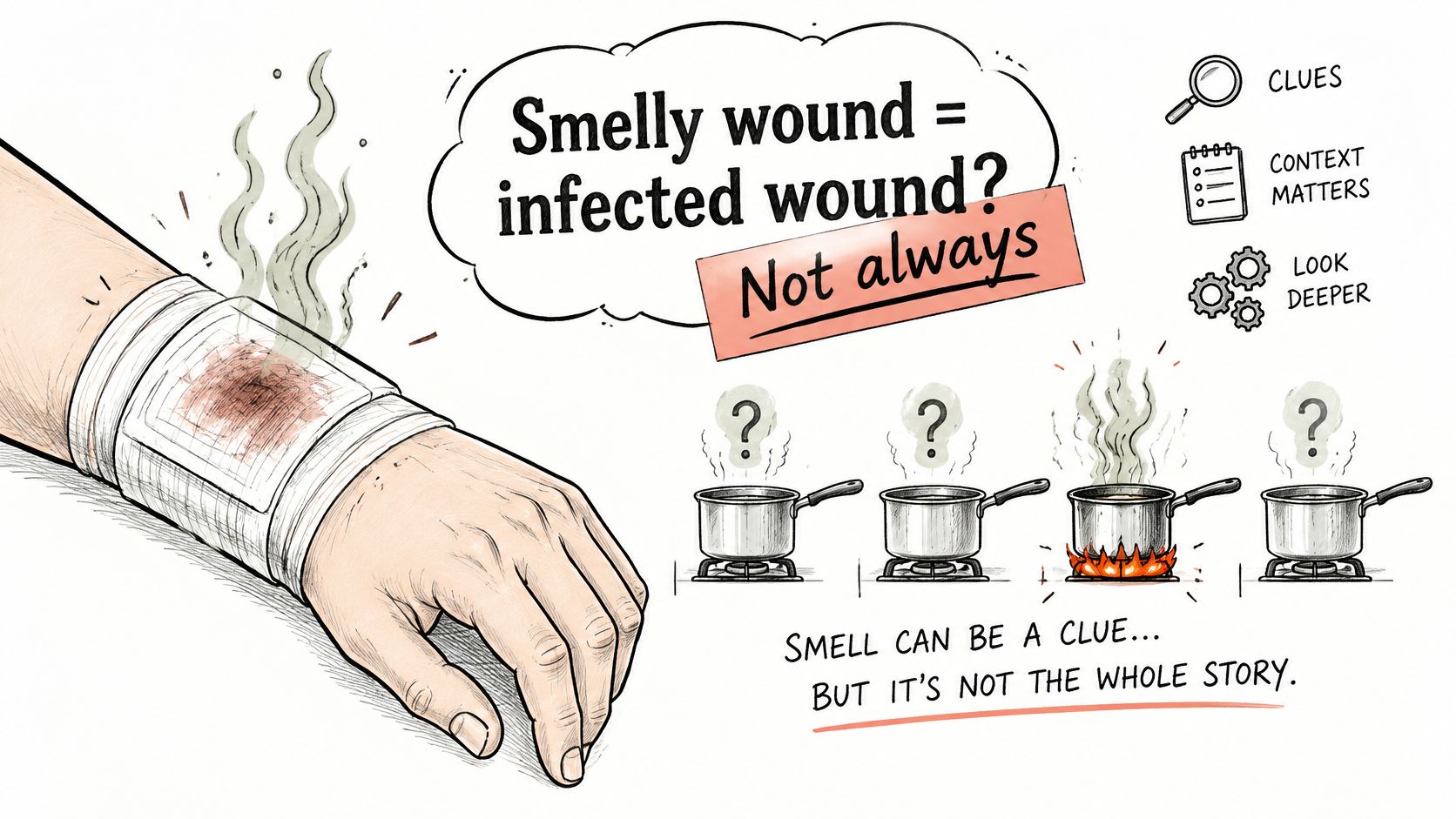
The myth is straightforward: a smelly wound must be infected and must need antibiotics. Think of odor like smoke from a kitchen. It tells you something needs attention, but it doesn't identify the pan or tell you whether a fire has spread.
Colonization means microorganisms are present without causing clinically significant tissue damage. A colonized wound may remain stable. Infection becomes more concerning when the person develops worsening local changes or becomes unwell.
Reflexive antimicrobial use isn't a substitute for that distinction. A wound-care antimicrobial-stewardship paper describes a 2025 global survey in which 41% of respondents used antimicrobial dressings “just in case,” and 37.2% reported not following antimicrobial-stewardship guidance.
Same-day clinical contact
Contact the treating clinician that day for:
- Changing odor: A new smell or a noticeable increase in strength.
- Worsening local findings: More drainage, spreading redness, warmth, swelling, pus, or increasing pain.
- A worsening wound: A previously stable or stalled wound that suddenly deteriorates.
A review of wound malodor explains that microbial breakdown produces volatile compounds, while rapid deterioration, disproportionate pain, gas beneath the skin, and tissue discoloration warrant urgent medical evaluation. Both oxygen-dependent and oxygen-independent organisms can contribute, so the smell can't identify the pathogen.
Emergency care now
Seek emergency assessment for:
- Systemic illness: Fever or chills with a worsening wound, confusion, unusual drowsiness, dizziness, or a racing heartbeat.
- Rapid tissue changes: Fast-spreading redness, new dark discoloration, or crackling beneath the skin.
- Severe pain: Pain that seems out of proportion to the visible wound.
Don't wait for every sign to appear. Call emergency services for emergency warning signs, especially if the person is confused, faint, or rapidly deteriorating.
Compare today's wound with yesterday's notes, but don't delay care to complete documentation. For nonemergency concerns about a stalled or complex wound, an escalation pathway for wound evaluation can help frame a discussion with the existing care team.
How to Record Odor Changes for Your Clinician
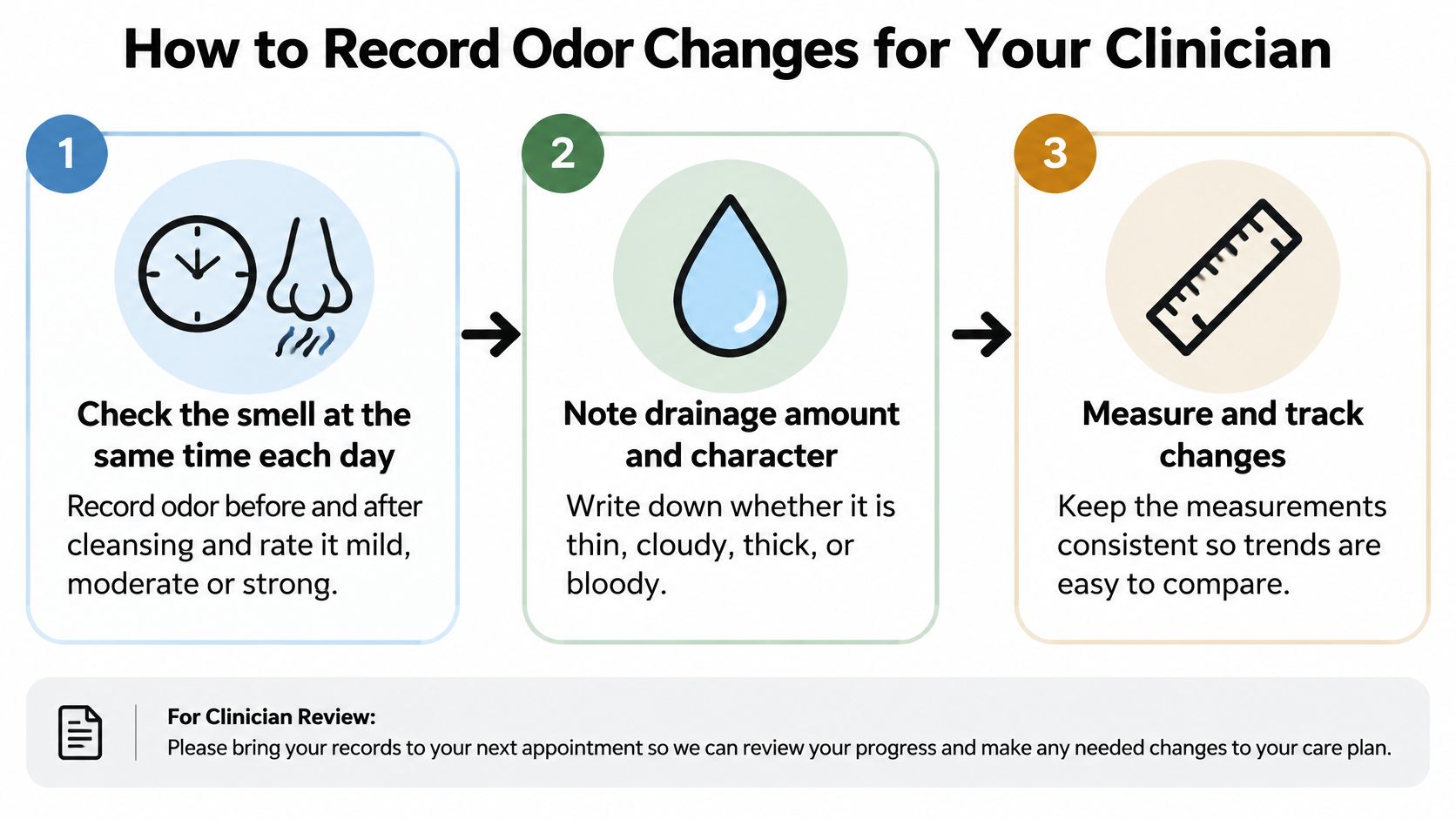
A useful wound log describes observations rather than conclusions. Write “odor remains after cleansing” instead of “infection worse.” Keep observations consistent with the prescribed dressing schedule; don't remove a dressing unnecessarily just to check the smell.
Record what you can safely observe
- Odor: At scheduled care, note whether it's mild, moderate, or strong before and after cleansing. This helps separate dressing-related odor from persistent wound odor.
- Drainage: Record how wet the dressing is and whether drainage is thin, cloudy, thick, or bloody. A sudden change can matter more than the description alone.
- Dimensions: If you've been taught how, measure visible length and width consistently with a disposable wound ruler. Leave depth, tunneling, and undermining measurements to a trained clinician; never insert a tool into the wound yourself.
- Visible tissue: Describe pink or red tissue, yellow material, or black areas without assuming what each color means. Note any visible tendon or bone and contact the clinician.
- Surrounding skin and discomfort: Record new redness, warmth, swelling, tenderness, or pain using the same descriptive scale each time. Changes outside the wound can be important.
- General condition: Record the measured temperature and any chills, unusual tiredness, or confusion. These observations help the clinician assess the person, not just the wound.
- Care changes: Note a new dressing, cleanser, medication, bathing routine, or missed dressing change. These details help explain a change in odor or drainage.
Keep the entry brief
Example log entry: Morning dressing change, moderate odor before cleansing and mild afterward; dressing heavily wet with cloudy drainage; visible size unchanged; surrounding skin newly warm; pain greater than yesterday; clinician contacted.
Consistent observations are more useful than elaborate descriptions made only when something looks alarming.
Bring the log to appointments and keep it available during urgent calls. Photographs may help if your clinician requests them, but they don't replace examination.
What a Clinical Evaluation Covers
A clinician starts with the history: how the wound began, when the odor appeared, what treatments have been used, and whether healing has stalled. Diabetes, cancer, circulation problems, medications, and recent procedures can change the interpretation of the same wound findings.
The examination then addresses depth, tissue viability, drainage, wound edges, and surrounding skin. The clinician looks for undermining, where damage extends beneath an apparently intact edge, and checks for exposed structures. Circulation and pressure relief are assessed because a wound won't improve by controlling its smell if inadequate blood flow or continued pressure remains unaddressed.
Testing follows the clinical question
Microbiologic sampling is considered when infection is suspected, rather than ordered solely because a wound smells. The discussion of molecular wound testing belongs within that broader assessment: what question needs answering, and how would the result change treatment?
Devitalized tissue may be removed when appropriate, but the clinician first considers blood supply, bleeding risk, wound cause, and treatment goals. Emergency warning signs bypass this routine process and require immediate assessment.
When specialty review becomes useful
At CWS, we review the history, wound, imaging, and treatment response virtually, then a surgical wound-care nurse validates the wound in person to confirm what was seen.
We consider these findings reasons a wound may deserve surgical evaluation:
- Limited progress: No measurable size reduction or minimal improvement despite appropriate evidence-based care.
- Persistent unhealthy tissue: Necrotic tissue or persistent slough.
- Structural concerns: Persistent undermining or exposed tendon or bone.
- Repeated complications: Infected tissue, recurrent cellulitis, or recurrent wound breakdown.
Evaluation doesn't automatically mean surgery. The findings determine whether the next step is a revised dressing plan, pressure relief, circulation care, targeted infection treatment, or an appropriate procedure.
Odor by Wound Type
The wound's cause changes what the clinician needs to investigate first. A heavily draining leg ulcer and a cool, dusky foot wound shouldn't receive the same response merely because both smell unpleasant.
Pressure and diabetic foot wounds
Pressure injuries can conceal damage beneath the visible opening. Odor accompanied by undermining or necrotic tissue prompts assessment for deeper injury, tunneling, and exposed bone. The clinician also reviews repositioning, support surfaces, and whether pressure is being relieved between visits.
For a diabetic foot ulcer, pale or dusky skin, cool tissue, or poor healing raises concern about circulation and possible deep infection. Perfusion assessment guides treatment decisions, including whether and when debridement is appropriate. Don't cut away dark tissue at home or assume that limited pain means the wound is safe.
Draining, malignant, and postoperative wounds
| Wound type | What may accompany odor | What needs attention first |
|---|---|---|
| Venous leg ulcer | Heavy drainage and softened, waterlogged surrounding skin | Dressing absorbency, skin protection, and clinician review of compression suitability |
| Malignant fungating wound | A growing mass, bleeding, or substantial exudate | Oncology coordination, symptom relief, bleeding risk, and specialist wound care |
| Surgical or traumatic wound | New drainage, wound separation, packing, or possible retained material | Review by the treating team for deeper complications or a foreign body |
For venous ulcers, don't independently increase compression to manage leakage or odor. The clinician needs to confirm that the circulation and treatment plan support its use.
Malignant wound care may prioritize comfort and odor reduction even when closure isn't achievable. After surgery or injury, new odor deserves prompt review, particularly if packing is involved; don't probe the wound or pull out material unless instructed.
The useful question isn't “What does this smell resemble?” It's “Given this wound type, what problem must be checked first?”
How Odor Is Reduced Alongside Wound Treatment
Treat the source before trying to mask the smell. Cleansing removes accumulated drainage and debris, while appropriately selected debridement removes devitalized tissue that supports microbial breakdown.
A review of wound-odor treatments identifies debridement and treatment of underlying infection as direct measures, with topical therapies and odor-adsorbing dressings serving as adjuncts. Follow the prescribed cleansing plan, and don't scrape tissue away or apply perfume, household deodorizer, or essential oils to an open wound.
Odor control options and their limits
| Option | Targets | Evidence reported | Limits |
|---|---|---|---|
| Cleansing and clinician-directed debridement | Dead tissue and bacterial substrate | Reviews identify source removal as a direct measure | Tissue removal requires clinical assessment |
| Topical metronidazole gel | Anaerobic-linked odor | Small studies report improvement, but controlled findings are mixed | Prescription-directed use; not complete treatment for every wound infection |
| Systemic metronidazole | Selected anaerobic infection or malignant wound odor | A very small crossover trial reported lower odor scores | Requires a clinician's indication and prescribing |
| Activated-charcoal dressing | Odor molecules | Adsorbs volatile compounds | Doesn't treat infection, ischemia, or malignancy |
| Fragrance or deodorizing product | Perceived smell | Masking doesn't establish wound improvement | Doesn't remove the source; unsuitable products may irritate tissue |
A Cochrane review discussing antimicrobial treatment evidence reports that a series using daily 0.75% metronidazole gel found substantially reduced odor in 45 of 47 patients, or 96%, after 14 days, while a 41-patient randomized placebo-controlled study found no statistically significant final difference, with 76% of placebo recipients also reporting odor control. These findings support cautious interpretation, not a promise that an antibiotic gel will solve every odor problem.
Don't crush antibiotic tablets onto a wound or use leftover oral antibiotics without a specific prescription. Treatment selection must account for the wound's cause and the person's overall condition.
Dressings must manage moisture too
An absorbent dressing should handle drainage without leaving the surrounding skin waterlogged, a condition called maceration. Leakage or repeated saturation calls for review of dressing capacity and change frequency, not an extra layer over the smell.
The principles behind advanced wound care include matching treatment to tissue condition and healing response.
A better smell is a comfort improvement. It isn't proof that infection has cleared or that the wound is healing.
Judge progress by healthier tissue, appropriate drainage, protected surrounding skin, and the wound's overall course. Odor-treatment evidence remains limited by small, short-duration studies.
Choosing Your Next Step for a Smelly Wound
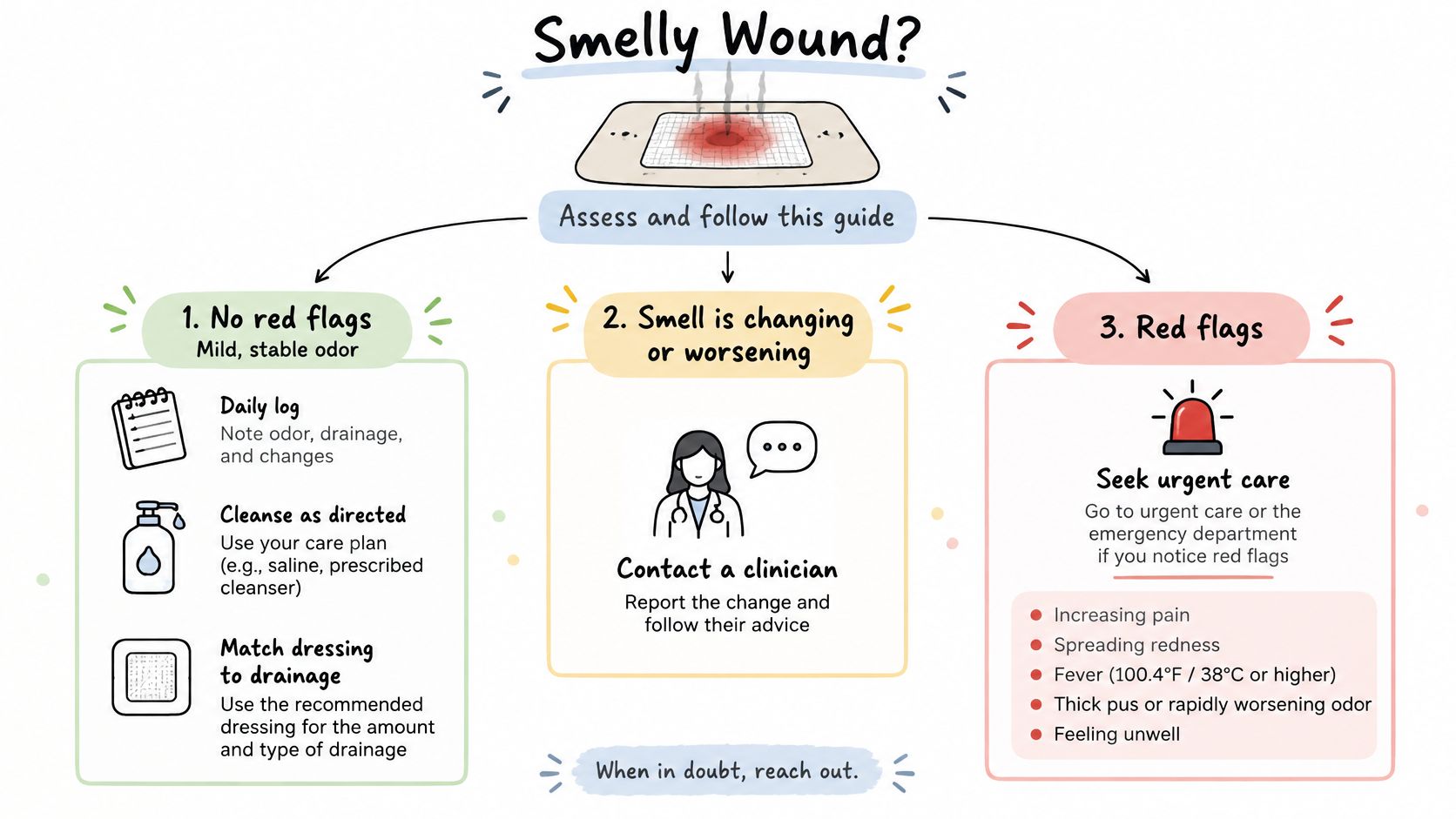
Choose your next step from the whole picture, not the intensity of the smell alone. This guide can help you organize what to report.
If the odor is mild and stable
If there are no red flags, continue prescribed cleansing and dressing care, maintain your log, and check whether drainage is being contained. Confirm dressing concerns with the treating team rather than switching repeatedly between antimicrobial products.
Say an established wound smells unpleasant only when an old dressing comes off, then looks unchanged and loses the odor after cleansing. Document that pattern. It's useful information, but it doesn't justify stopping planned follow-up.
If something has changed
Contact the clinician the same day for new or stronger odor, worsening drainage, increasing pain, or concerning skin changes. If persistent odor remains despite appropriate care, or the wound isn't progressing, arrange clinical review rather than waiting through repeated dressing changes without a plan.
Keep the log, current medication list, and dressing names ready. Ask for clear instructions about what to continue while awaiting assessment and what changes should trigger faster care.
The following video can support a conversation about wound care, but shouldn't delay assessment.
If emergency warning signs appear
Seek emergency care now for rapid deterioration, severe disproportionate pain, confusion, gas beneath the skin, or rapidly spreading discoloration. Don't wait for an outpatient appointment or a reply to a photograph.
For caregivers and home-health teams, the smell is a prompt to look, not a diagnosis. Examination confirms the likely cause and gives everyone a concrete plan.
---
Wound Services offers virtual and in-person specialty evaluation for complex, stalled, and potentially surgical wounds, with care coordinated alongside existing providers. If persistent odor accompanies poor healing or repeated wound breakdown, visit Comprehensive Wound Services to request an evaluation and discuss the appropriate next step.